A Bequest from a Stranger: The Smithsonian Is Born, August 10, 1846
On August 10, 1846, President James K. Polk signed the Smithsonian into existence — funded by a British scientist who never once set foot in America.
The strangest thing about the Smithsonian Institution is how it started: with a gift from a man who never visited the United States, for a purpose he barely described. On August 10, 1846, President James K. Polk signed the act of Congress that turned that mysterious bequest into the world's largest museum and research complex.
James Smithson was a British scientist — a chemist and mineralogist respected enough that a zinc carbonate mineral, smithsonite, was named for him. He lived from 1765 to 1829 and, so far as anyone knows, never crossed the Atlantic. In his will, written in 1826, he left his fortune first to his nephew, Henry James Hungerford. But he added a remarkable condition: if the nephew died without heirs, the entire estate would go to the United States of America, to found "at Washington, under the name of the Smithsonian Institution, an establishment for the increase and diffusion of knowledge among men."
In 1835, the nephew died childless, and the strange clause took effect. President Andrew Jackson informed Congress of the bequest, and the diplomat Richard Rush sailed to England to claim it. He came home with 11 boxes holding 104,960 gold sovereigns — more than $500,000, a staggering sum — plus Smithson's mineral collection, library, and scientific papers. On July 1, 1836, Congress accepted the gift and pledged the faith of the nation to the trust.
Then came eight years of arguing. What did "the increase and diffusion of knowledge" actually mean? Congress debated founding a national university, a public library, an observatory. The Treasury invested the money in Arkansas bonds — which promptly defaulted. It took former president John Quincy Adams, then serving as a Massachusetts congressman, to shame Congress into restoring the lost funds with interest and keeping the money dedicated to science and learning.
The bill that finally emerged was drafted by Indiana congressman Robert Dale Owen. When Polk signed it on August 10, 1846, the Smithsonian became a trust administered by a Board of Regents — including the vice president and the chief justice — and a secretary. The first secretary, the physicist Joseph Henry, wanted a center for pure research. But the institution also became the attic of the young nation: specimens from the U.S. Exploring Expedition's round-the-world voyage, surveys of the American West, and government collections poured in.
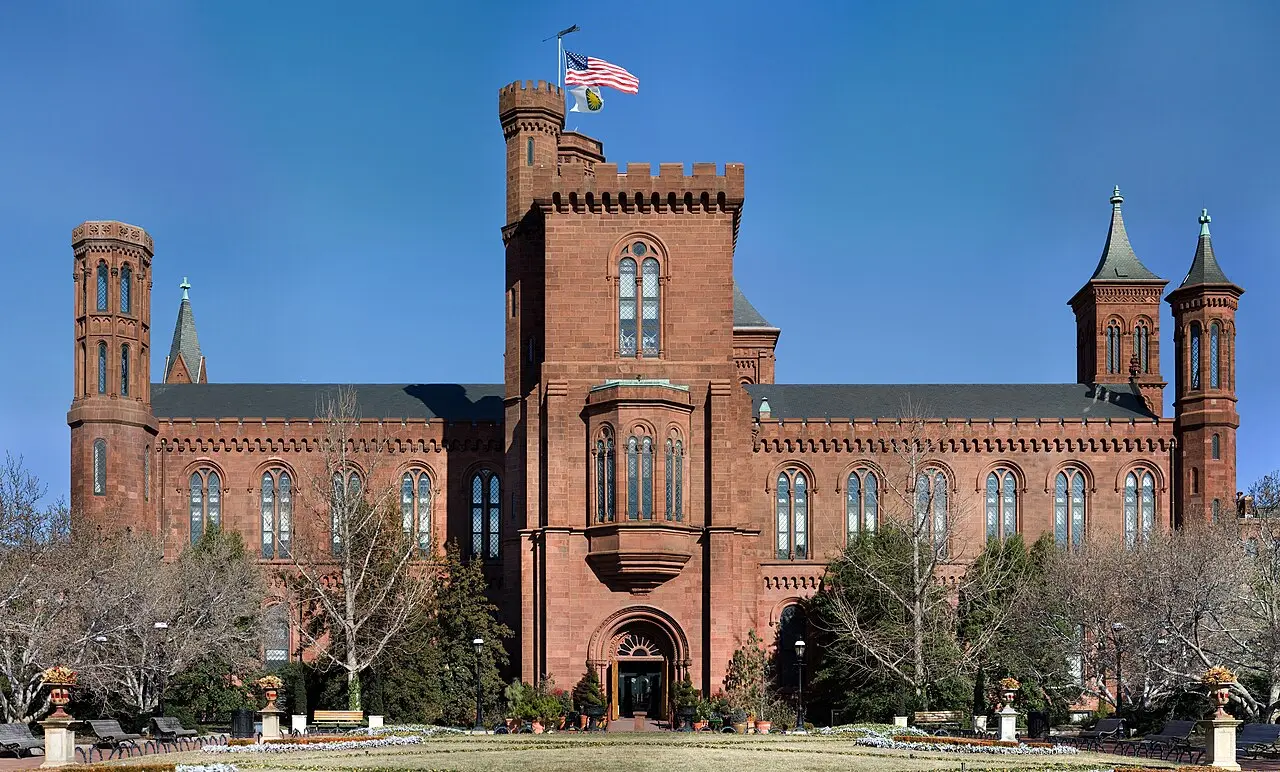
The red-sandstone Castle that became its symbol was designed by architect James Renwick Jr. and finished in 1855; a fire in 1865 gutted its upper floors, destroying Smithson's diaries and mineral collection, though his library survived. Smithson himself eventually came to Washington — his remains were brought to the Castle, where his crypt sits on the first floor to this day.
From one Englishman's will grew 19 museums, the National Zoo, and research centers spanning the country and the world, holding some 140 million objects. Nobody knows for certain why Smithson chose America. What matters is what the gift became: proof that knowledge, once given away, only multiplies.
Photo: Noclip, public domain (via Wikimedia Commons).