The Samurai Coup That Made Modern Japan
On January 3, 1868, samurai from the Satsuma and Choshu domains seized Kyoto's Imperial Palace and proclaimed the Meiji Restoration — the lightning modernization that made Japan a world power.
The young emperor was fifteen years old, and he had never ruled anything. But on the morning of January 3, 1868, in Japan's ancient capital of Kyoto, he became the centerpiece of a revolution.
For more than two and a half centuries, real power in Japan had belonged to the Tokugawa shoguns, who had kept the country isolated from the outside world while the emperors sat as ceremonial figureheads in Kyoto. That order was cracking. Western warships had forced Japan open, and the shogunate's inability to resist foreign demands made it look weak and obsolete. A movement of young, furious samurai from the feudal domains of Satsuma and Choshu — men who had watched China being carved up by Western powers and concluded Japan would be next — decided the shogun had to go.
They didn't wait for an army. On January 3 they simply seized the Kyoto Imperial Palace, secured the teenage emperor Mutsuhito, and proclaimed the restoration of imperial rule. The last shogun, Tokugawa Yoshinobu, was declared deposed. It was a coup carried out by a handful of men inside a palace — and it detonated a transformation.
The boy-emperor, who would reign as Meiji, became the symbol of a crash program of modernization with no precedent in history. In a single generation, Japan abolished the feudal domains, ended the samurai class as a hereditary caste, built railroads and telegraph lines, created a modern army and navy, and adopted a constitution and parliamentary system. The rallying cry was fukoku kyohei — "enrich the country, strengthen the army" — and the goal was explicit: match the Western powers so Japan would never be colonized.
The price was a short civil war — the Boshin War of 1868–69 — but the new government won decisively. Barely three decades after the palace coup, Japan shocked the world by defeating China, and then, in 1905, by defeating Russia. The nation that the West had once dismissed as a feudal backwater had become an industrial power in a single lifetime.
Everything about modern Japan — its industry, its military, its institutions — traces back to that January morning in Kyoto, when a few samurai walked into a palace and rewrote their country's future.
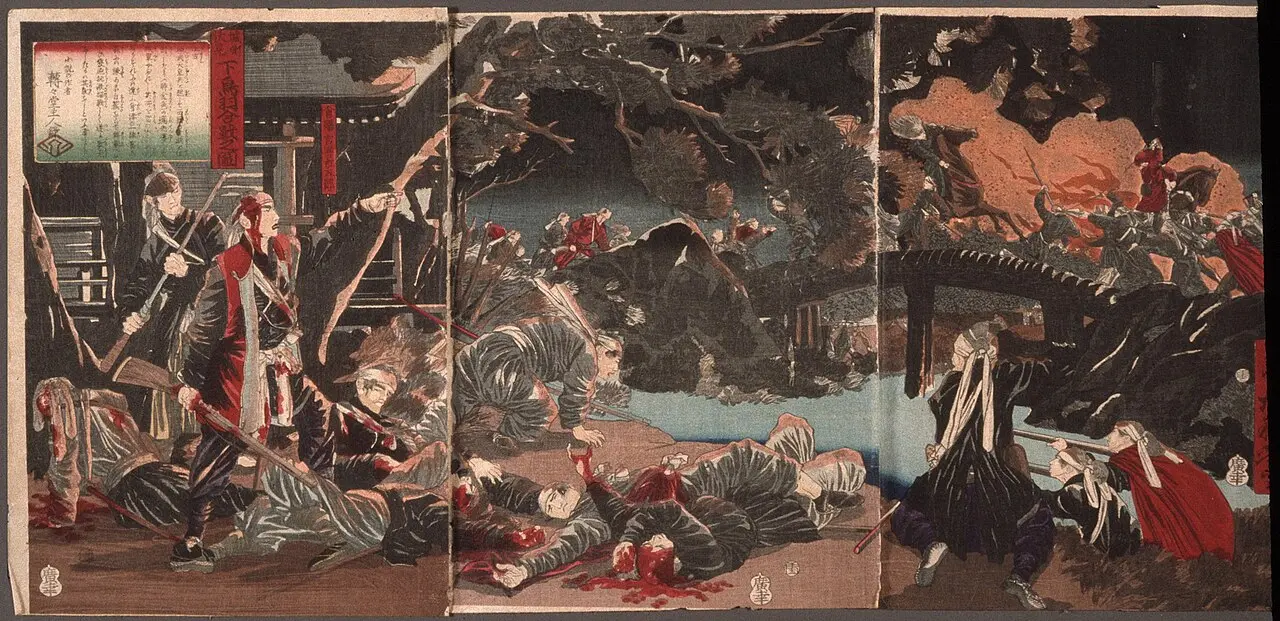
Photo: Tsukioka Yoshitoshi, public domain (via Wikimedia Commons). This 19th-century Japanese woodblock triptych depicts the Battle of Toba-Fushimi, fought in late January 1868 — the first battle of the civil war that followed the restoration proclamation.