Cast Out: Martin Luther Is Excommunicated
On January 3, 1521, Pope Leo X issued the bull Decet Romanum Pontificem, formally excommunicating Martin Luther and sealing the split that would become the Protestant Reformation.
The monk would not take it back. For three years, Martin Luther — a German theology professor at Wittenberg — had been accusing the Catholic Church of corruption, above all for selling indulgences, the forgiveness of sins for cash. In 1520 Pope Leo X had given him sixty days to recant forty-one of his condemned propositions, or face the ultimate punishment.
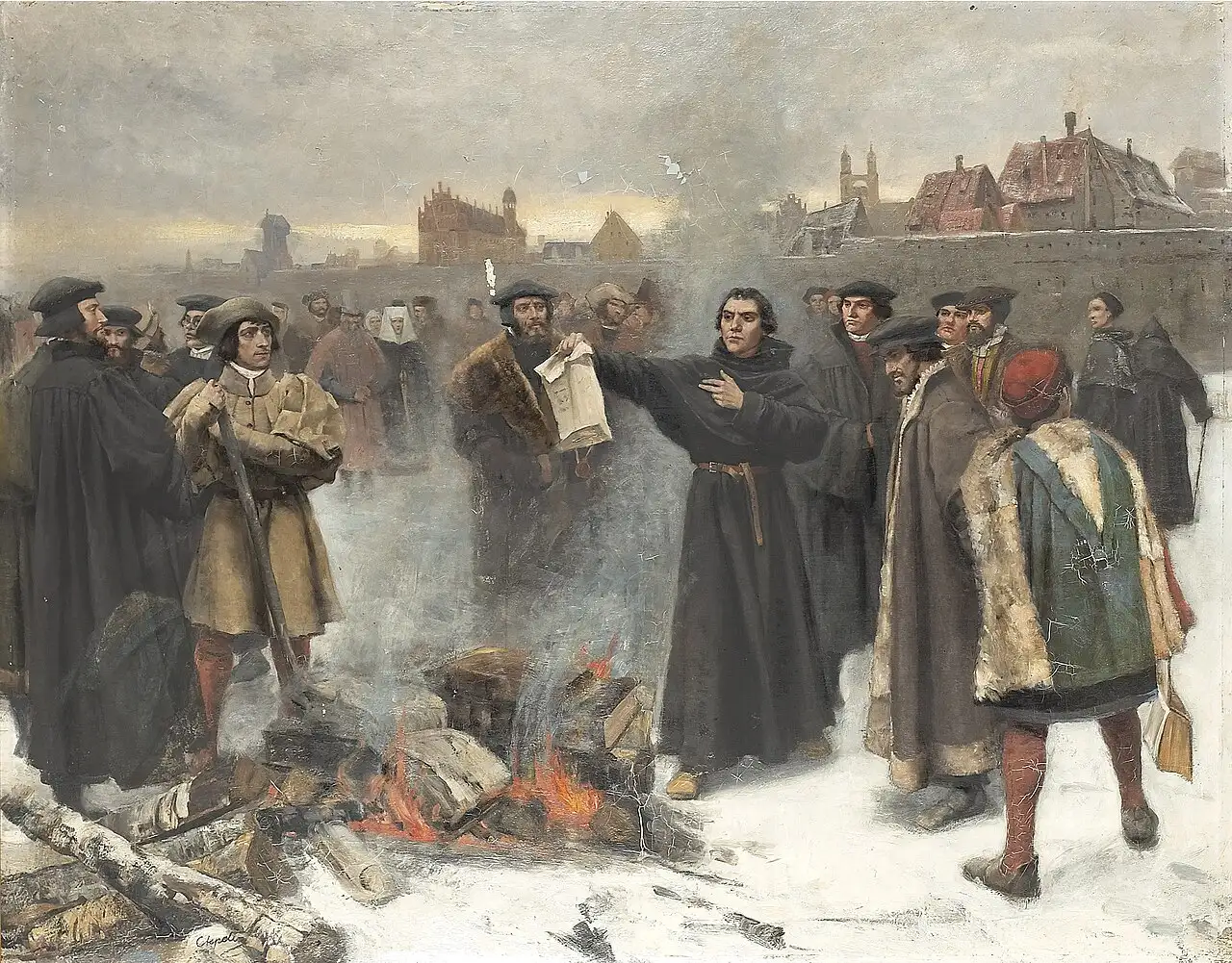
Luther answered with fire — literally. On December 10, 1520, he led his supporters to the Elster Gate outside Wittenberg and threw the papal bull, along with books of canon law, into a bonfire. It was a public, deliberate act of defiance: he would not recant.
So on January 3, 1521, Leo X issued a second bull, Decet Romanum Pontificem — "It Befits the Roman Pontiff" — and with it, Martin Luther was formally excommunicated from the Catholic Church, along with some of his colleagues, including fellow reformer Andreas Karlstadt. The door to reconciliation was now officially shut. What had begun in 1517 as a dispute over indulgences — sparked when Luther sent his 95 Theses challenging Church practice to the Archbishop of Mainz — had become an open schism between a monk and a pope.
The bull's authors imagined it would end the matter. They were wrong. Luther was protected by powerful German princes, and the printing press carried his writings to every corner of Europe faster than Rome could burn them. Three months later he was summoned before the young Holy Roman Emperor Charles V at the Diet of Worms — where, according to tradition, he refused to retract his writings and stood his ground. Declared an outlaw and a heretic by the Edict of Worms that May, he went into hiding in Wartburg Castle, where he translated the New Testament into German and kept writing, his ideas spreading further in exile than they ever could have in a pulpit.
The excommunication did the opposite of what Rome intended. Instead of extinguishing one monk's rebellion, it confirmed a permanent break — the wound that became the Protestant Reformation, reshaping the religion, politics, and culture of Europe for centuries. Luther would live another quarter-century, dying in 1546, but he never came back into the Church's fold.
Painting: Karl Aspelin, public domain (via Wikimedia Commons). This early-20th-century painting depicts Luther burning the papal bull Exsurge Domine at Wittenberg on December 10, 1520 — the act of defiance that prompted his excommunication a few weeks later.