The Night Music Got Its Own Trophy: The First Grammy Awards, 1959
On May 4, 1959, the music industry handed out its first Grammy Awards — at two small banquet halls on opposite coasts, where an Italian love song and a cartoon chipmunk beat Frank Sinatra.
On the evening of May 4, 1959, the biggest names in American music got dressed up for the biggest night of their year — which turned out to be two modest dinner banquets, one in Beverly Hills and one in New York, where the winners were announced over dessert. There was no red carpet, no television audience, no orchestra to play anyone off the stage. There were just 28 little gold gramophones, and the beginning of an institution.
The idea had been brewing since 1957, when a group of Los Angeles record executives decided music deserved its own Academy Awards. They founded the National Academy of Recording Arts and Sciences, and for the trophy they chose a miniature gramophone — the machine Emile Berliner had invented decades earlier. The award was nearly named the "Eddie," after Thomas Edison. "Grammy" won instead, and on May 4, 1959, the first Grammys honored the music of 1958.
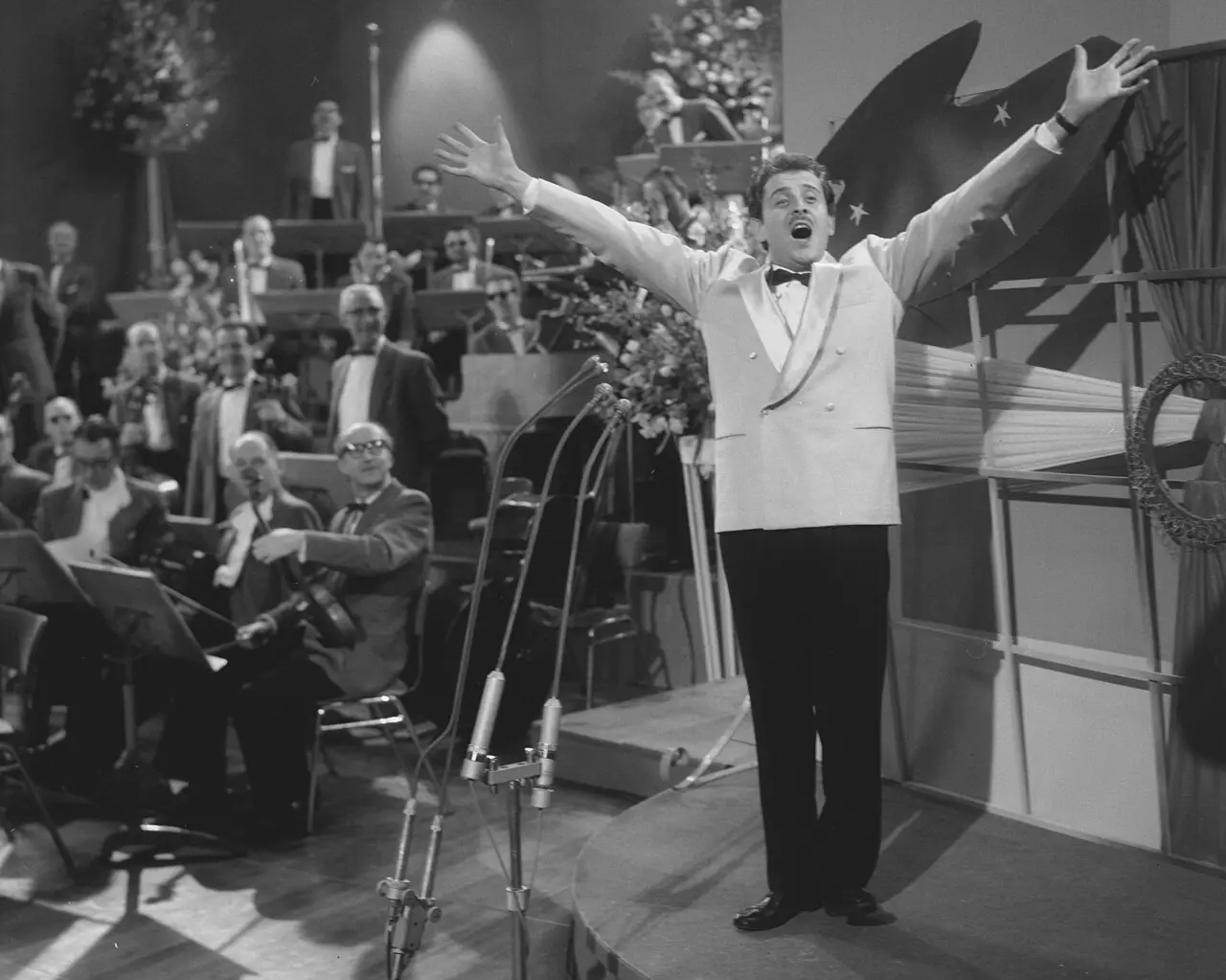
The headline winners tell you how different the music world was then. Record of the Year — and Song of the Year — went to "Nel blu dipinto di blu," better known as "Volare," sung in Italian by Domenico Modugno. It beat Perry Como's "Catch a Falling Star," Peggy Lee's "Fever," Frank Sinatra's "Witchcraft," and — improbably — "The Chipmunk Song." Album of the Year went to Henry Mancini's The Music from Peter Gunn, the jazzy score of a TV detective show.
But the night's most joyful footnote belongs to that chipmunk. Ross Bagdasarian Sr., recording as David Seville, had invented Alvin and the Chipmunks by speeding up his own voice on "The Chipmunk Song (Christmas Don't Be Late)" — and it won two Grammys: Best Recording for Children and Best Comedy Performance. A novelty record about a cartoon rodent took home twice as many Grammys as Frank Sinatra did that night. Sinatra went home empty-handed.
Ella Fitzgerald and Count Basie each won two awards, becoming the first African-American Grammy winners. Fitzgerald took Best Vocal Performance, Female for Ella Fitzgerald Sings the Irving Berlin Songbook and Best Jazz Performance, Individual for her Duke Ellington songbook; Basie won for his band's jazz and dance-band performances. In classical music, the young Texan pianist Van Cliburn — fresh off his stunning victory at Moscow's Tchaikovsky Competition — won for his recording of Tchaikovsky's Piano Concerto No. 1.
Why it matters: the first Grammys were so small that history barely noticed them — yet every year now, hundreds of millions of people watch the descendant of that double banquet. Institutions almost never start out grand. They start as a few believers in a hotel ballroom, handing out trophies over dessert, trusting that the thing they love deserves celebrating. More than sixty years and thousands of trophies later, music's biggest night is proof they were right.
Photo: Harry Pot / Anefo (Dutch National Archives), CC0 (via Wikimedia Commons). (1958 photograph of Domenico Modugno, whose "Volare" won the first Grammy for Record of the Year.)