The Night Germany Became Whole Again
On October 3, 1990, East Germany voted itself out of existence and joined the West, ending 45 years of division and restoring Berlin as the capital of a single German state.
At the stroke of midnight, a single flag went up over Berlin.
It was October 3, 1990. In front of the Reichstag — the old parliament building that had watched an empire, a republic, and a dictatorship rise and fall — a black, red, and gold flag climbed into the night sky as fireworks burst overhead and crowds celebrated across the country. At that exact moment, midnight Central European Summer Time, the German Democratic Republic ceased to exist.
After 45 years as two countries, Germany was one country again.
The division had begun in the rubble of World War II. Defeated Germany was carved into occupation zones, and the zones hardened into rival states: the Federal Republic in the west, the German Democratic Republic in the east, with the Berlin Wall — raised almost overnight in August 1961 — as the division's concrete symbol. Families were split by it, and more than a hundred people died trying to cross it.
Then, in less than a year, it all came undone. On November 9, 1989, a bungled announcement by an East German spokesman sent crowds streaming to the Wall's checkpoints, and confused border guards opened the gates. Months of Monday demonstrations and a mass exodus through Hungary had already hollowed out the regime's authority. That night, the pressure broke through.
What followed was eleven months of the fastest diplomacy in modern European history. Chancellor Helmut Kohl laid out a ten-point plan for unity within weeks. East Germany held its first free elections in March 1990 and chose a government committed to reunification. The Deutsche Mark replaced the East German mark on July 1. That same month, Soviet leader Mikhail Gorbachev agreed that a united Germany could choose its own alliances — clearing the last great obstacle.
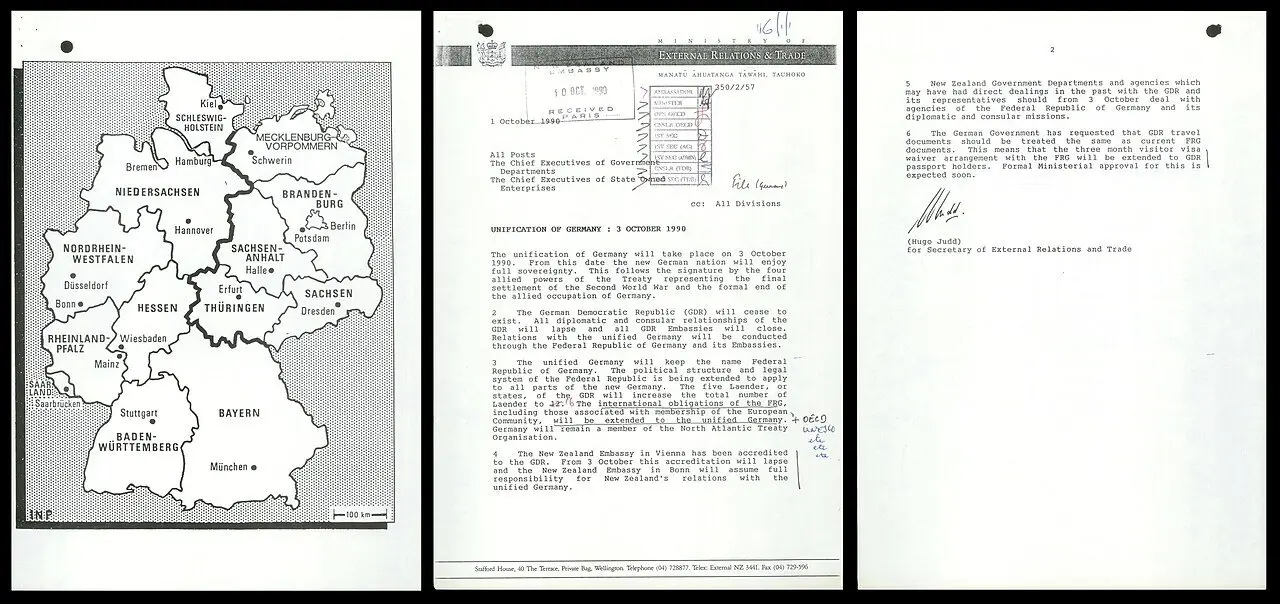
The legal machinery moved just as fast. On the night of August 22–23, East Germany's parliament, the Volkskammer, voted 294 to 62 to accede to the Federal Republic under Article 23 of the West German Basic Law — effectively voting its own country out of existence. The Unification Treaty was signed on August 31. On September 12 in Moscow, the two Germanys and the four wartime Allied powers signed the treaty settling the last unresolved claims of the Second World War and restoring Germany's full sovereignty.
And so, at midnight on October 3, five re-created eastern states — Brandenburg, Mecklenburg-Vorpommern, Saxony, Saxony-Anhalt, and Thuringia — joined the Federal Republic. East and West Berlin became one city again, and Berlin became the capital of a united Germany for the first time since 1945.
The date itself was a deliberate choice. November 9 — the day the Wall fell — would have been the emotional pick, but it is also the anniversary of the 1938 pogroms against Germany's Jews, and the country judged it unfit for celebration. October 3, the day the law took effect, became the Day of German Unity, the national holiday.
It matters because of how it happened. No war, no conquest — a division imposed by force was undone by votes, treaties, and people in the streets. The reunification closed the book on the Cold War order in Europe and proved that even the most entrenched borders can yield to peaceful pressure. Every October 3, Germany celebrates not a military victory but a homecoming.
Photo: Archives New Zealand, CC BY-SA 2.0 (via Wikimedia Commons).