The Morning Magellan Never Came Home
On April 27, 1521, Ferdinand Magellan was killed on the Philippine island of Mactan, ending his quest to sail around the world.
He had sailed farther than any human being then alive — and he died in knee-deep water on a beach that had nothing to do with his mission.
In September 1519, the Portuguese navigator Ferdinand Magellan sailed from Spain with five ships and about 270 men, chasing a prize no one had ever claimed: a westward route to the Spice Islands, all the way around the planet. What followed was one of the great ordeals of exploration — mutiny, scurvy, and a Pacific crossing so vast and empty that the crew were reduced to eating leather and sawdust to survive.
In March 1521, the expedition reached the islands of the Philippines. On Cebu, Magellan forged an alliance with the local ruler, Rajah Humabon, who with his queen accepted baptism as Christians. But Magellan made a fatal mistake: he waded into local politics. When Lapu-Lapu, the chief of neighboring Mactan Island, refused to acknowledge Spanish authority or convert, Magellan offered to make an example of him.
At dawn on April 27, 1521, Magellan led about 49 armored men ashore — the figure comes from Antonio Pigafetta, the expedition's chronicler and our main source for the battle. Shallow water over the reef kept the ships and their cannons uselessly far offshore. Waiting on the beach were some 1,500 warriors, by Pigafetta's count, armed with spears and blades. The Europeans' armor and guns meant little against such numbers in the surf. Magellan was killed in the fighting; his body was never recovered.
The defeat broke the expedition's momentum in the islands, and the surviving ships sailed on without their captain. Under Juan Sebastián Elcano, one vessel — the Victoria — completed the circumnavigation, limping back to Spain in September 1522 with just 18 men of the roughly 270 who had set out. The first voyage around the world had succeeded, but its commander was not aboard.
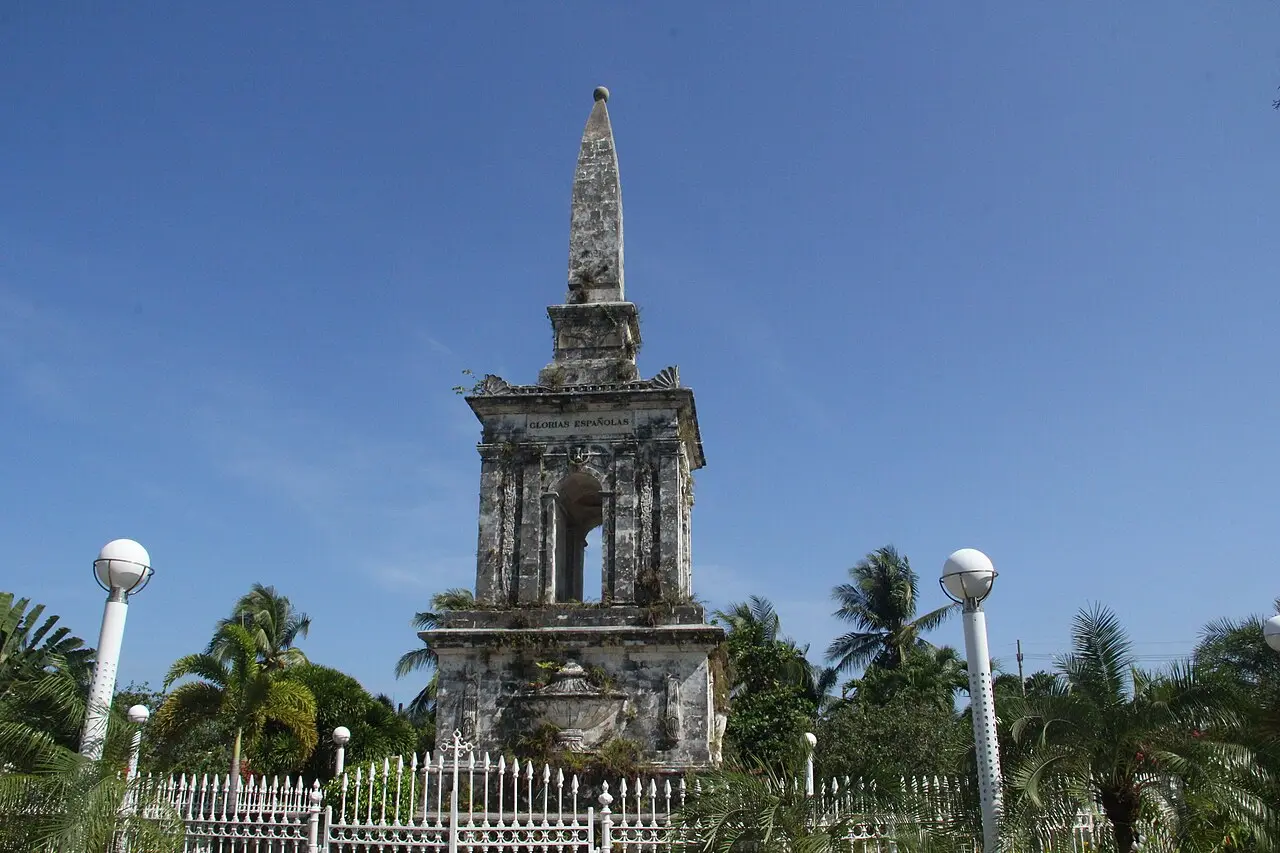
Magellan's death delayed the Spanish colonization of the Philippines by more than four decades, until Miguel López de Legazpi's expedition in the 1560s. And in the Philippines, Lapu-Lapu is honored to this day as the first national hero to resist foreign rule — his statue stands at the Mactan Shrine near the spot where the battle was fought, and a city bears his name. Little else is known of him with certainty; nearly everything comes from Pigafetta's pen. But on that April morning, he stopped an empire in its tracks.
Photo: Badz Patanag, CC BY-SA 3.0 (via Wikimedia Commons).