The First Transatlantic Phone Call Shrinks an Ocean
On January 7, 1927, AT&T's president picked up a phone in New York and spoke to London — the first commercial transatlantic call, launched by radio across 3,000 miles of ocean.
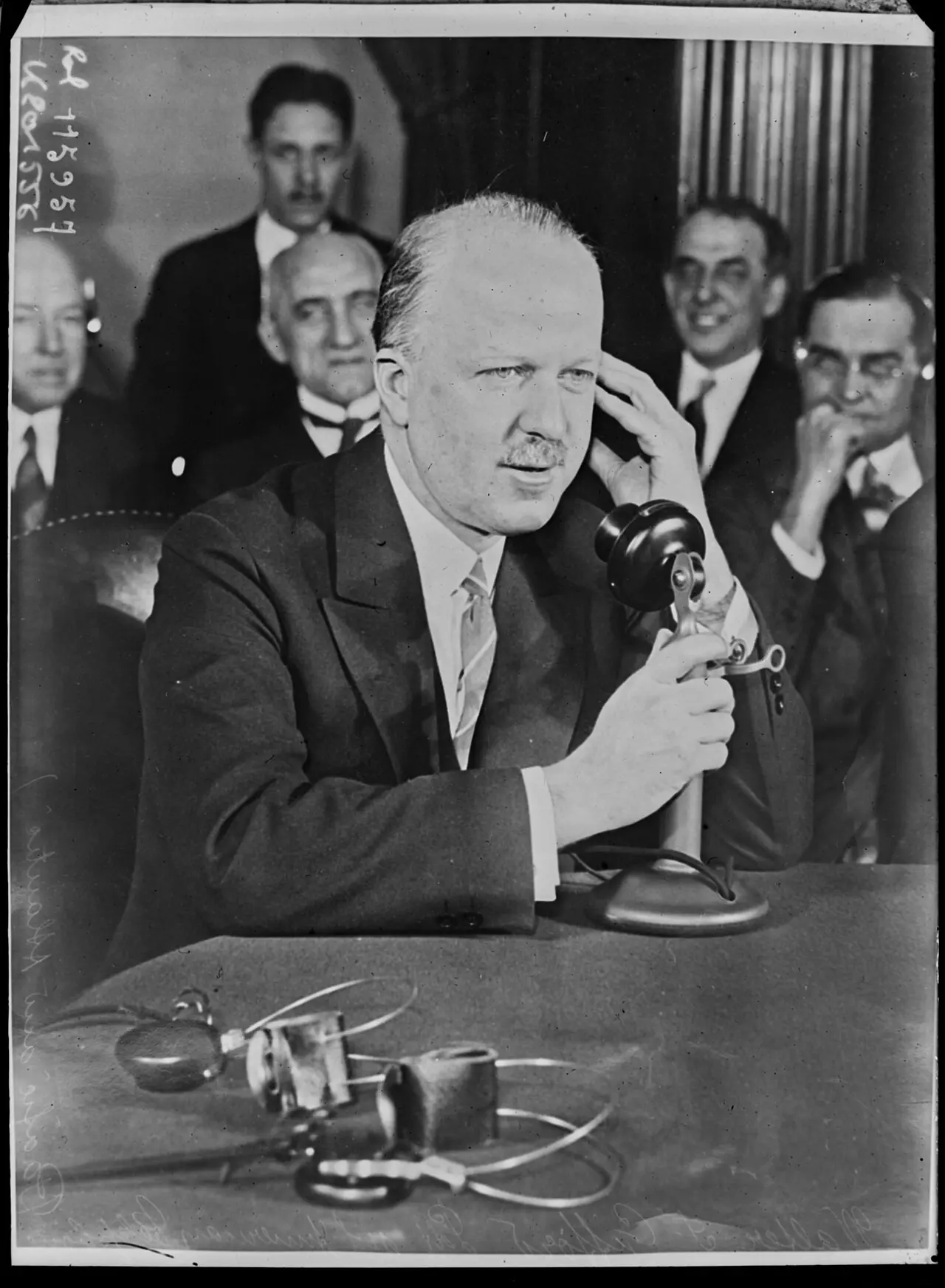
At 9:35 on the morning of January 7, 1927, Walter S. Gifford picked up a telephone on the 26th floor of AT&T's building at 125 Broadway in New York and asked to be connected to London. Three thousand miles of open ocean lay between him and the man he wanted to reach, and no cable on the seafloor could carry a human voice. So his words went up into the sky instead.
The call's journey was a relay race between wire and radio. From Gifford's desk the signal traveled by wire to a transmitter at Rocky Point, Long Island, where it was launched into the air as a longwave radio signal. It crossed the Atlantic and was caught by the receiving station at Rugby, in Warwickshire, England. Wire carried it the last stretch to the desk of Sir Evelyn Murray, secretary of Britain's General Post Office. Murray answered, and the two men exchanged prepared remarks about what the new service could mean for friendship and business between their countries. The first commercial transatlantic telephone call had cost seventy-five dollars — and it worked.
Getting there had taken more than a decade. In October 1915, AT&T engineers had sent a voice across the Atlantic for the first time, from a Navy station in Arlington, Virginia to a receiver beneath the Eiffel Tower in Paris — but it was one-way, a voice without a reply. The following year brought the first two-way ship-to-shore conversation in mid-ocean. Then World War I and the limits of early radio equipment stalled the work for years. A two-way New York–London test finally succeeded in 1926, and on January 6, 1927, the men ran an unscripted rehearsal. One of them remarked, in words that still sound prophetic: "Distance doesn't mean anything anymore. We are on the verge of a very high-speed world."
The new service was clunky by any modern standard. Only one conversation could cross the ocean at a time, the whole call had to be booked in advance, and atmospheric static could intrude uninvited. But on January 7, after Gifford and Murray hung up, the line opened to paying customers — and the customers came. By the end of the day, businesses in New York and London had conducted more than six million dollars' worth of transactions over the new circuit, and a news dispatch had been sent from Europe to America by phone.
The service spread from there: ship-to-shore calls on the ocean liner SS Leviathan in 1929, telephone service to Hawaii in 1931, Tokyo in 1934, and in 1935 the first round-the-world call, with two men's voices traveling the entire globe to reach two rooms in the same building. The static problem was only truly solved in 1956, when the TAT-1 cable finally laid a telephone line across the Atlantic floor. But everything that came after — the cables, the satellites, the pocket computers we call with today — began with one voice crossing the ocean through the air on a winter morning in 1927.
Photo: AT&T president Walter S. Gifford speaking on a telephone in a press photograph dated January 1927, the month of the historic call, by the Agence Rol (public domain), via Wikimedia Commons.