Galileo Spots Jupiter's Moons and Rewrites the Cosmos
On January 7, 1610, Galileo Galilei aimed his homemade telescope at Jupiter and saw strange points of light — the first sighting of the four moons that helped topple the Earth-centered universe.
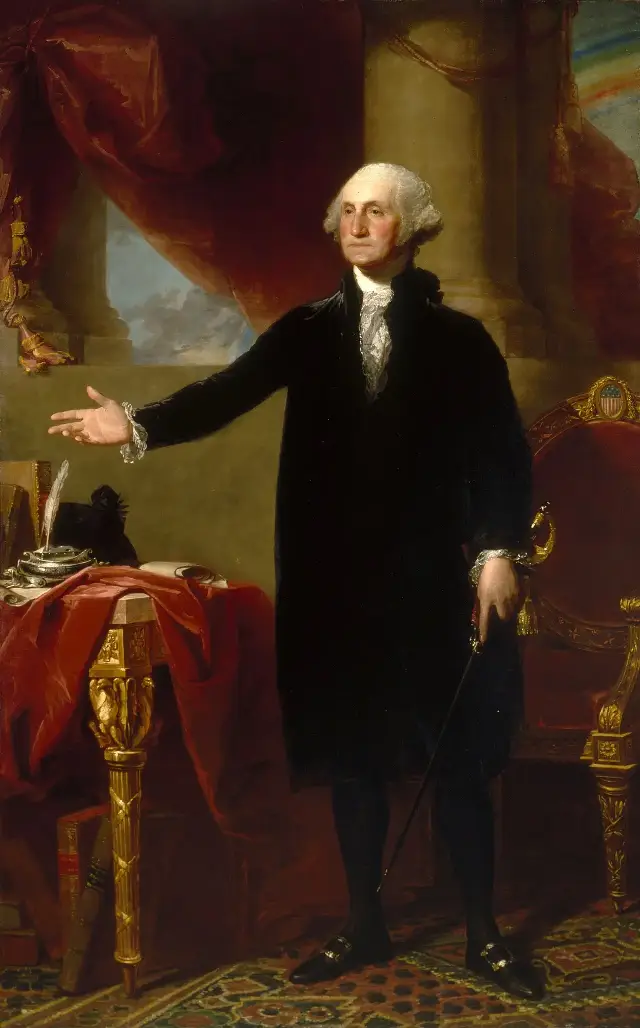
On a cold January night in 1610, an Italian professor aimed a homemade spyglass at the planet Jupiter and saw something that should not have been there. Three tiny points of light hung near the giant planet, in a neat row. Galileo Galilei assumed they were distant stars. He was wrong — and his mistake would help rewrite the universe.
It was January 7, 1610. Galileo's telescope was no ordinary spyglass: he had ground and polished the lenses himself until it magnified twenty times, far better than the crude instruments then circulating in Venice. Jupiter was bright in the winter sky, and the three little "stars" beside it caught his eye. But they did not behave like stars. Night after night he watched them, and each night they had shifted — moving in the wrong direction compared to the background stars, always staying close to Jupiter, constantly changing their positions relative to one another. On January 13, a fourth point of light joined the dance with the same strange behavior. By January 15, Galileo had reached the only sensible conclusion: these were not stars at all, but four bodies orbiting Jupiter itself.
It is hard to overstate how explosive that was. The accepted model of the cosmos, inherited from Ptolemy, held that the Earth sat at the center of everything and every heavenly body circled it. Nicolaus Copernicus had proposed a sun-centered alternative nearly seventy years earlier, but it was a mathematical argument with little visible proof. Now, anyone who cared to look through a telescope could see four worlds plainly circling something other than Earth. The discovery also disarmed one of the oldest objections to a moving Earth: critics had argued that a traveling Earth would leave its Moon behind — yet here was Jupiter, clearly in motion, carrying its whole family of moons along with it.
In March 1610, Galileo published his findings in a short book, Sidereus Nuncius — The Starry Messenger — the first scientific work built on observations made through a telescope. Alongside the moons it described mountains and craters on the Moon and countless stars in the Milky Way invisible to the naked eye. As discoverer, Galileo claimed naming rights and called the moons the Medicean Stars, after his patrons the Medici family. Johannes Kepler suggested the mythological names we use today: Io, Europa, Ganymede, and Callisto.
In fairness, one rival claimed to have gotten there first: the German astronomer Simon Marius said he had observed the moons in late 1609. But he used the old Julian calendar and did not publish until after Galileo, so the historical record — and the name "Galilean moons" — belongs to the man who announced them to the world.
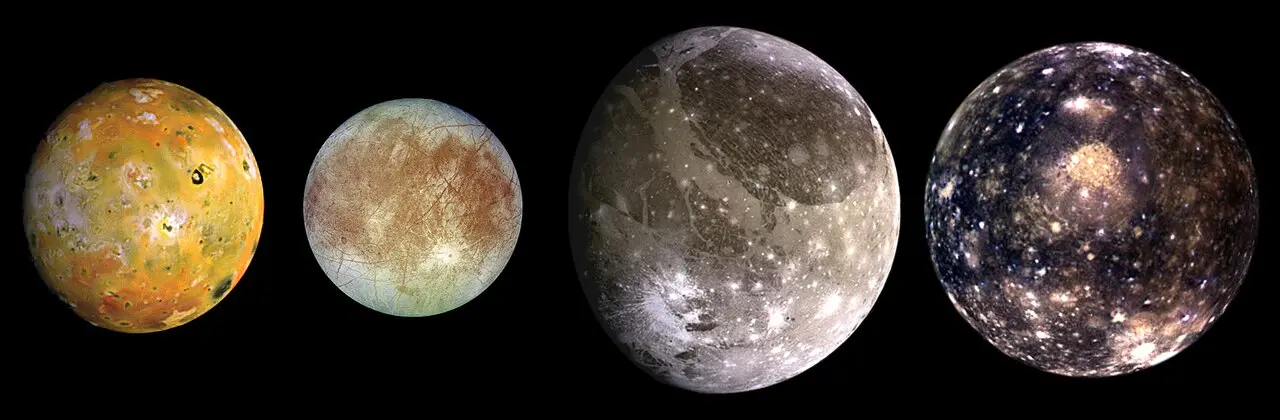
The moons kept their secrets for centuries, then gave them up one by one. NASA's Galileo spacecraft spent eight years orbiting Jupiter in the 1990s, revealing Io's volcanoes, Europa's cracked ice shell that may hide an ocean, Ganymede's magnetic field, and Callisto's ancient cratered face. All because, on January 7, 1610, one curious man looked up and refused to look away.
Image: a composite of Jupiter and its four Galilean moons, captured by NASA's Galileo spacecraft (public domain: NASA/JPL/DLR), via Wikimedia Commons.