The Day Rome Reset Time
On January 1, 45 BC, Julius Caesar's brand-new calendar — 365 days, with a leap day every fourth year — took effect in Rome after a monster 445-day year brought the seasons back into line.
By the time Julius Caesar took charge of Rome's calendar, the seasons were a joke. Harvest festivals were falling in the wrong months, and the official calendar had drifted so far from the solar year that some years were a full three months out of step with the sun. Nobody was quite sure which month they were supposed to be in.
The mess was partly innocent and partly crooked. Rome's old calendar was lunisolar, and keeping it aligned with the seasons required the pontifices — the priests in charge — to insert extra days and months by hand. In practice, they used that power like a weapon, adding days to lengthen a friendly magistrate's term in office or skipping them to cut a rival's short. The calendar had become a political machine, and the sky was paying the price.
Caesar, who had just come through his campaign in Egypt, had seen a better way. The Egyptians ran their lives on a simple solar year, and Caesar enlisted an Alexandrian astronomer, Sosigenes, to design Rome's escape. The plan was bold: scrap the lunar fiddling entirely and run the year at 365 days, with one extra day added to February every fourth year to keep the count honest.
But first came the cleanup. To shove the calendar back into alignment with the seasons, Caesar stretched the year 46 BC to an astonishing 445 days — later remembered as the "year of confusion" — by inserting 67 extra days. When that long year finally ended, the new calendar snapped into place on January 1, 45 BC.
The reform held its power for more than sixteen centuries. Caesar was assassinated within months of his new year's gift to the empire, but the calendar outlived him: the month of Quintilis was soon renamed July in his honor, and later Sextilis became August for his successor. Rome ran on Julian time, and so did most of the Western world, until the small error in Sosigenes's math — about eleven minutes a year — accumulated into ten lost days and forced Pope Gregory XIII's correction in 1582.
Even so, we still live inside Caesar's design. The twelve-month year, the 365-day count, and the leap year that saves February every fourth year are all his. New Year's Day on January 1 — the date Caesar picked to restart time itself — has been the world's most celebrated morning ever since.
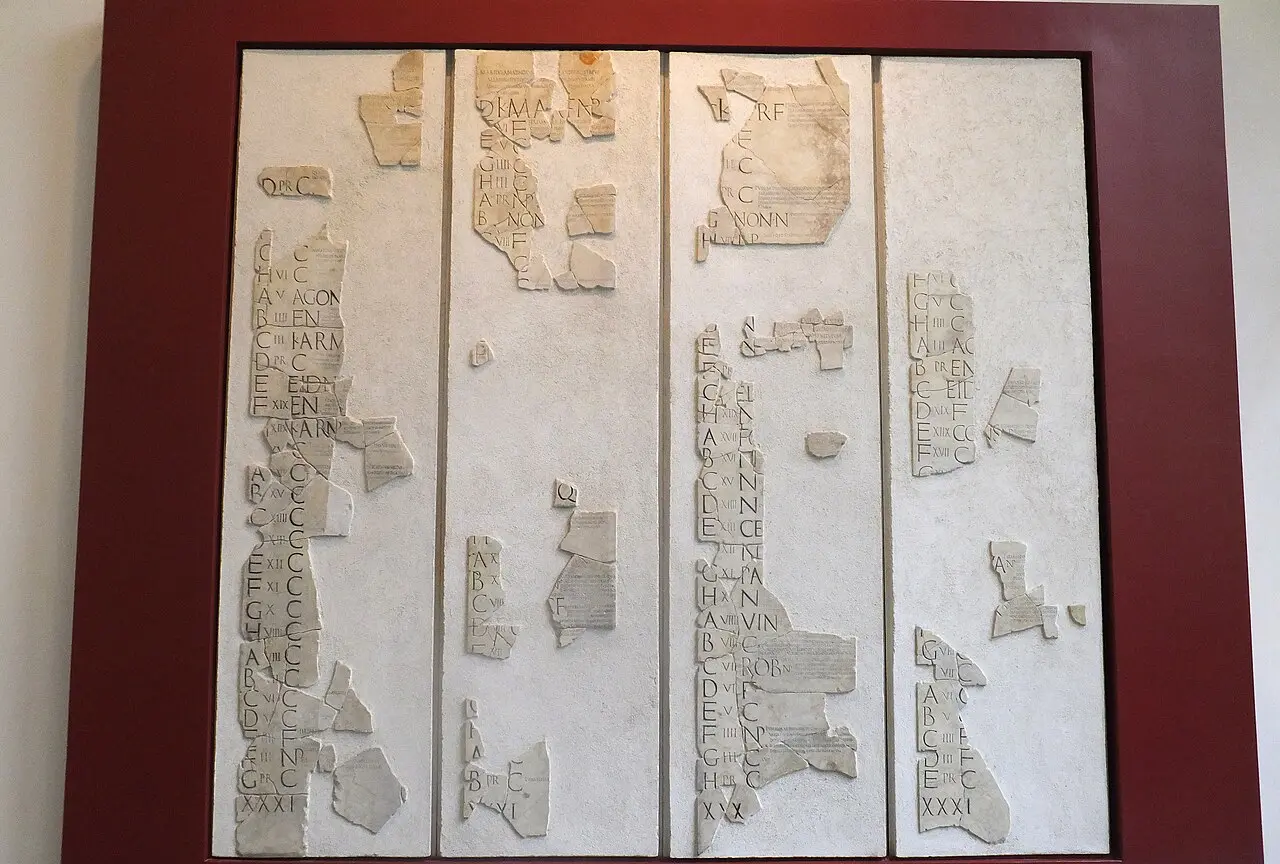
Photo: Amphipolis, CC BY-SA 2.0 (via Wikimedia Commons). The image shows fragments of the Fasti Praenestini, an ancient Roman wall calendar on display at the Museo Nazionale Romano — a survivor of the Roman calendar tradition that Caesar's reform replaced and reorganized.