
The Day American Women Won the Vote
On August 26, 1920, Secretary of State Bainbridge Colby certified the 19th Amendment, making women's suffrage the law of the land after a 72-year struggle.
On the morning of August 26, 1920, the most important signature in the fight for American democracy was made quietly. U.S. Secretary of State Bainbridge Colby put his name to a proclamation certifying the 19th Amendment to the Constitution. With that one act, the right to vote could no longer be denied to any American citizen on account of sex — and more than 26 million women became eligible voters overnight.
That quiet morning was deliberate. Colby signed the proclamation at 8 a.m. in his own Washington home, witnessed only by the State Department's solicitor and one other official, with no ceremony. He knew anti-suffragists were still hunting for an injunction, and he wanted the document signed before they could act. A formal ceremony was out of the question for another reason: the movement's two main factions, Alice Paul's National Woman's Party and Carrie Chapman Catt's National American Woman Suffrage Association, were barely on speaking terms, and Colby felt he could not fairly choose whom to invite. Abby Scott Baker of the National Woman's Party voiced what many felt: women should have witnessed the signing — but nothing could take away their triumph.
The road to that morning had been brutally long. The first women's suffrage amendment had been introduced in Congress back in 1878. For decades, suffragists were mocked, jailed, and force-fed on hunger strikes. Susan B. Anthony, who had devoted her life to the cause, died in 1906 without ever casting a legal ballot. But a new generation — led by organizers like Alice Paul and Carrie Chapman Catt — carried the fight forward, picketing the White House through World War I and demanding that a nation fighting for democracy abroad live up to it at home.
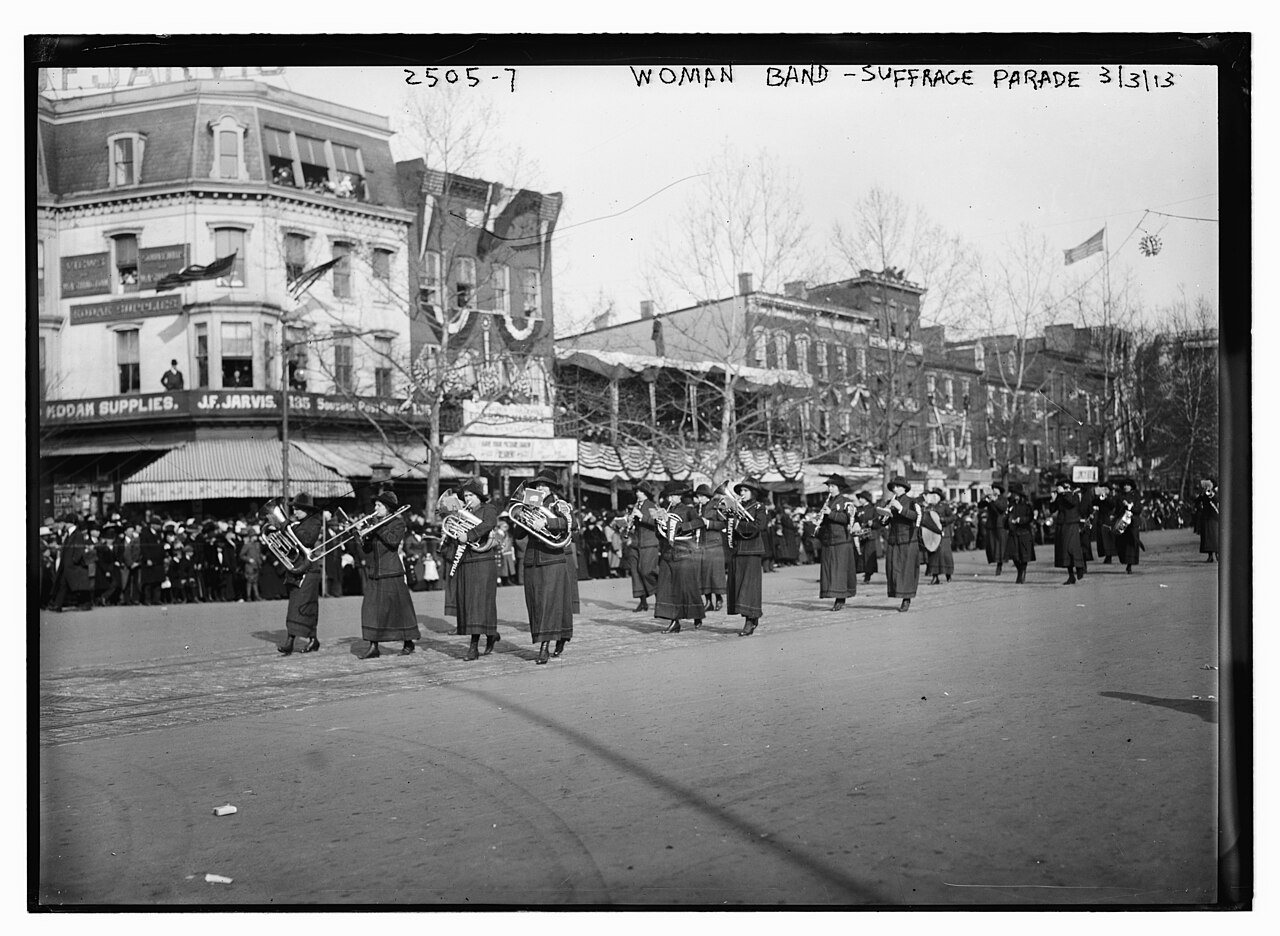
The image above captures the movement's boldest gambit: the 1913 suffrage parade. On March 3, 1913 — the day before Woodrow Wilson's presidential inauguration — Alice Paul organized some 8,000 marchers to walk down Pennsylvania Avenue, led on horseback by activist Inez Milholland. Men in town for the inauguration crowded the route, jeering at and attacking the women while police stood by; more than a hundred marchers were hospitalized. The violence became a national scandal. Congress held hearings, the capital's police superintendent lost his job, and the suffrage cause became impossible to ignore.
The amendment finally passed the House on May 21, 1919, and the Senate on June 4, 1919. Then began the state-by-state battle for ratification: 36 states were needed. The drama came down to Tennessee in August 1920. The state Senate voted yes, but the House vote was deadlocked — until 24-year-old legislator Harry Burns changed his vote after receiving a letter from his mother urging him to support suffrage. On August 18, Tennessee became the 36th state to ratify.
Eight days later, Colby's certification made it official. That November, more than 8 million American women voted in a presidential election for the first time. August 26 is still celebrated as Women's Equality Day.
Paul cast her first presidential vote that November — and she never stopped campaigning. Convinced that the ballot alone would not deliver equality, she authored the Equal Rights Amendment in 1923. Introduced in Congress that December, it was reintroduced in nearly every session afterward. Congress passed it in 1972, but it fell three states short of ratification by the 1982 deadline. Paul died in 1977, still working for the amendment she had written fifty years earlier.
The story has an honest footnote, and it matters: the amendment did not secure the vote for all women. Black women in the South were blocked by poll taxes, literacy tests, and intimidation for another 45 years, until the Voting Rights Act of 1965. Native Americans did not hold the vote in every state until 1962. The 19th Amendment was a triumph — and a reminder that rights won on paper still have to be defended in practice.
Photo: Library of Congress, public domain (via Wikimedia Commons).