
The Day Alan Shepard Played Golf on the Moon
On February 5, 1971, Apollo 14 landed at Fra Mauro — and before leaving, commander Alan Shepard hit two golf balls across the lunar surface.
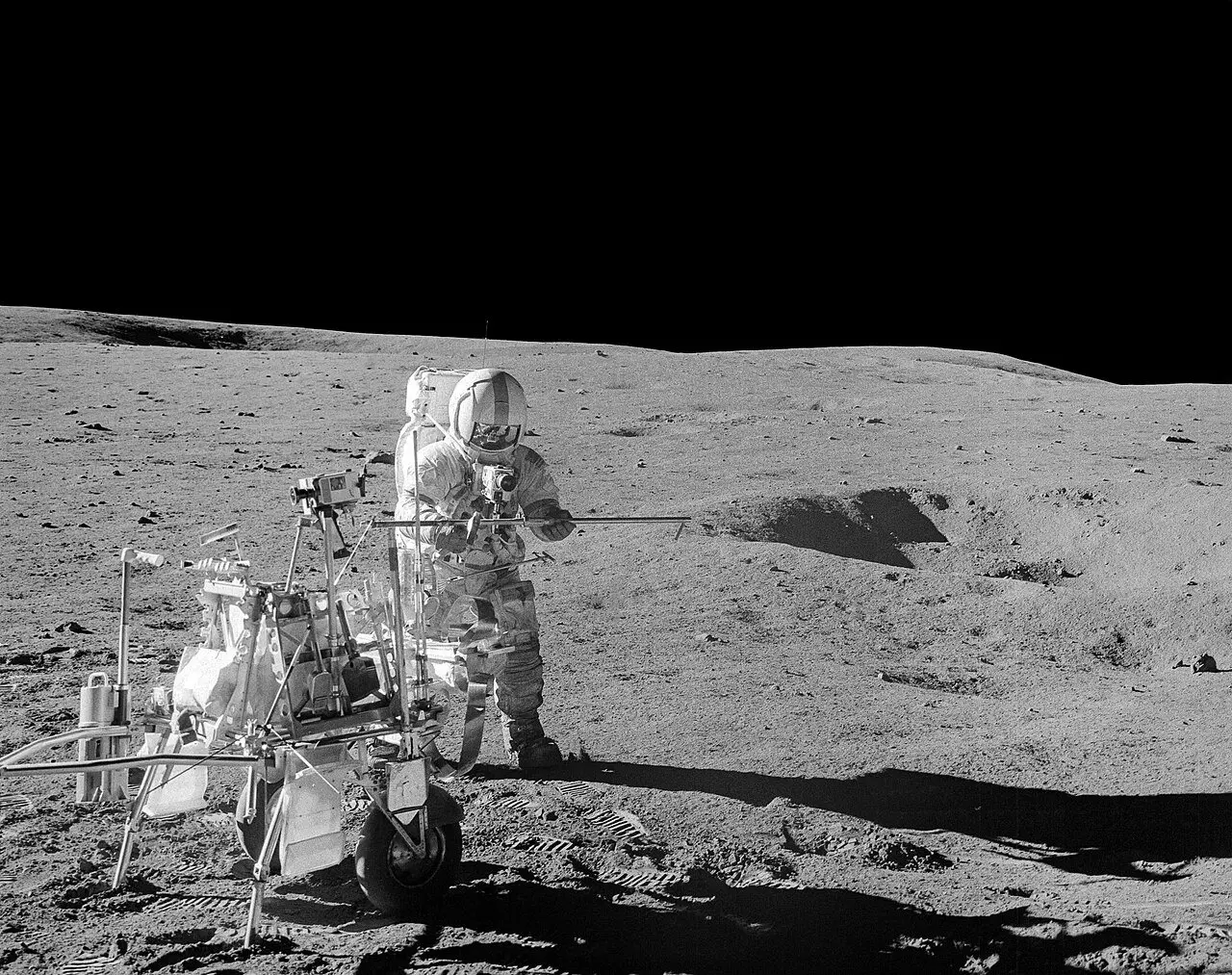
At 47, Alan Shepard was too old for this. Or so people thought. The first American in space — he had ridden a Redstone rocket on a fifteen-minute suborbital hop back in 1961 — had been grounded for years by an inner-ear disorder. Surgery fixed it. A decade later, he was going back, this time all the way to the Moon, as commander of Apollo 14.
The mission had a point to prove. Apollo 13 had failed to land the year before, and Apollo 14 was headed for the very spot 13 never reached: the Fra Mauro highlands, the first landing in the Moon's rugged uplands. After a forty-minute weather delay — the first launch delay in the Apollo program — Shepard, lunar module pilot Edgar Mitchell, and command module pilot Stuart Roosa lifted off on January 31, 1971.
On February 5, the lunar module Antares touched down at Fra Mauro. Shepard and Mitchell spent thirty-three and a half hours on the surface across two moonwalks, collecting 94 pounds of Moon rocks and setting up scientific experiments. They even hauled a two-wheeled cart, the first ever used on the Moon. They never quite reached the rim of Cone Crater as planned — lunar landmarks proved devilishly hard to read — but the mission was a scientific success.
Meanwhile, Roosa circled overhead in the command module Kitty Hawk, photographing the surface — including the future Apollo 16 landing site — and carrying an unusual cargo: several hundred tree seeds. Back on Earth, many of them germinated and were planted around the country as "Moon trees."
But nobody remembers Apollo 14 for the rocks. They remember it for the golf.
Before the second moonwalk ended, Shepard pulled out a surprise he had carried all the way from Earth: a six-iron clubhead fitted to the handle of a lunar sample scoop, and two golf balls. Wearing a bulky spacesuit, swinging one-handed, he took his stance in the moondust and whacked the first ball into a nearby crater. The second shot was better. "Miles and miles and miles!" he shouted over the radio.
It was not quite miles. In the Moon's one-sixth gravity, the ball probably traveled a few hundred yards — still the longest drive in history, and the most famous sporting moment ever played off-planet.
Apollo 14 splashed down in the Pacific on February 9, 1971. Shepard, who had waited ten years for his second flight, got his Moon landing and his moment of pure joy — the sight of a 47-year-old man, a quarter-million miles from the nearest golf course, taking a swing anyway.
Why does it matter? Apollo 14 did serious science — the Fra Mauro rocks helped date the Moon's early history — but the golf shot did something science could not. It made the Moon feel like a place, not just a destination: somewhere a person could stand, play, and laugh. Exploration needs its data, but it also needs its delight.
Photo: Kevin M. Gill, CC BY 2.0 (via Wikimedia Commons).