The Bullseye Landing: Apollo 12 Hits Its Mark
On November 19, 1969, Apollo 12's lunar module Intrepid touched down on the Moon within walking distance of a robot probe that had been sitting there since 1967.
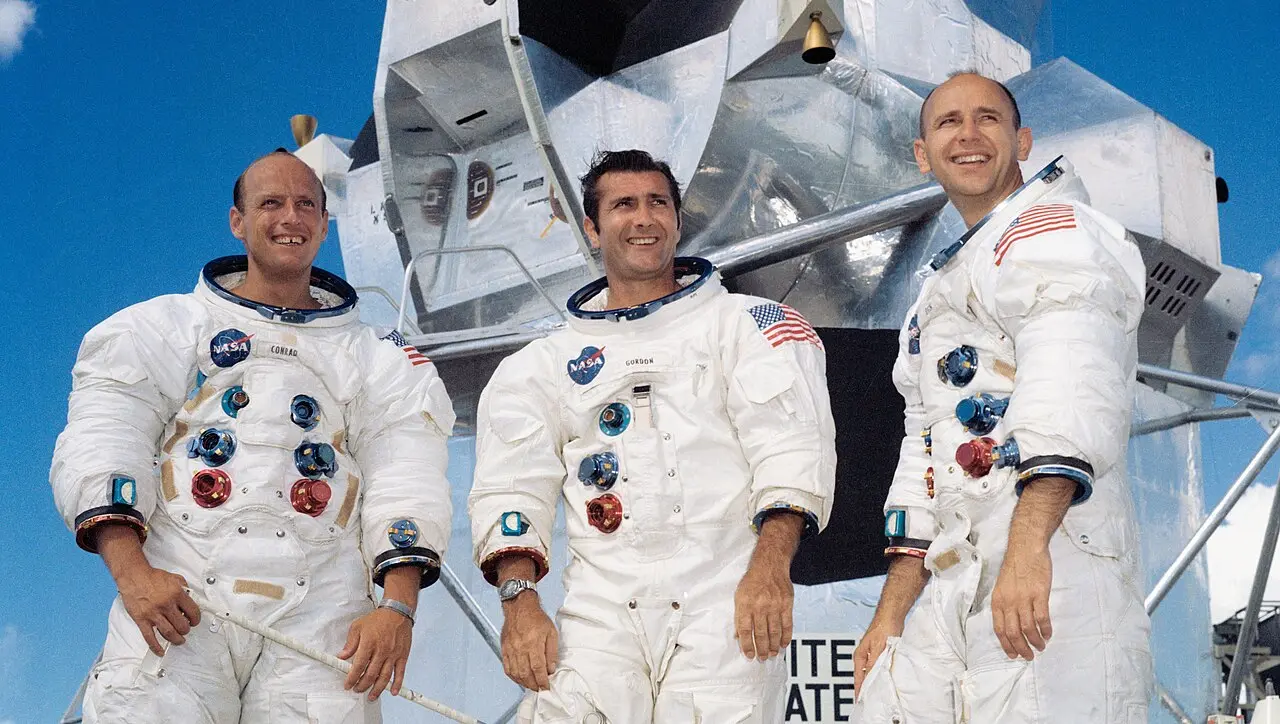
Apollo 12 was struck by lightning twice before it even left Earth's shadow. Within the first minute after liftoff on November 14, 1969, two bolts hit the Saturn V rocket, knocking out most of the spacecraft's electrical systems and sending the instrument panel into a blizzard of warnings. Flight controllers on the ground scrambled through circuit breakers, brought the systems back, and decided the mission could go on. It was a scare that could have ended the flight on the launch pad.
Four months earlier, Apollo 11 had made history but missed its target zone by roughly four miles — close enough for glory, not for science. Apollo 12 had a bolder assignment: prove NASA could land a crew exactly where it wanted to. NASA chose the hardest target imaginable, the precise patch of the Ocean of Storms where the unmanned Surveyor 3 probe had landed on April 20, 1967, more than two years earlier.
On November 19, 1969, Commander Pete Conrad and Lunar Module Pilot Alan Bean separated from the command module — where crewmate Richard Gordon remained in lunar orbit — and began their descent in the lunar module Intrepid. The onboard guidance was aiming even closer to the old probe than proved safe, so Conrad took over manual control, flew across a small crater, and set Intrepid down about 600 feet from Surveyor 3. A bullseye across a quarter of a million miles.
About five hours later, at roughly 7 p.m. Eastern time, Conrad stepped onto the surface — the third human to walk on the Moon — and marked the moment with a line that answered Armstrong's famous words with a wink: "Whoopee! Man, that may have been a small one for Neil, but that's a long one for me." (Conrad, at five-foot-six, was joking about his own height.)
Conrad and Bean spent a day and a half on the surface and made two moonwalks. They walked over to Surveyor 3 and, with bolt cutters, removed its television camera and sampling scoop to carry back to Earth — proof they had stood beside the robot, and a chance for engineers to study two and a half years of lunar wear and tear on real hardware.
One thing went wrong. While repositioning the mission's TV camera, Bean accidentally pointed it at the Sun, destroying its optics. Only the first few moments of the Apollo 12 moonwalks were ever seen live on Earth. The crew documented the rest with Hasselblad still cameras — and Bean, who later retired from NASA to become a painter, turned his memories into a celebrated series of moon paintings.
Apollo 12 is remembered not for a first but for a precision. The Moon had become a place you could visit on purpose.
Photo: NASA, public domain (via Wikimedia Commons).