
The Boy from Pisa Who Moved the Earth
Galileo Galilei was born on February 15, 1564, in Pisa, the curious son of a musician who turned a telescope to the heavens and changed humanity's place in the universe.
On February 15, 1564, in the Italian city of Pisa, a boy was born into a family of musicians who would grow up to rearrange the entire universe. His name was Galileo Galilei. Three days later, Michelangelo died. In that same year, William Shakespeare was born. It was quite a year for changing how humans see the world.
Galileo was the eldest of six children of Vincenzo Galilei, a respected lutenist, composer, and music theorist. His father wanted him to study medicine at the University of Pisa, a respectable profession. But the young Galileo kept getting distracted by mathematics, and mathematics, as it turned out, was the language he was born to speak. He never finished his medical degree. Instead he invented a hydrostatic balance around 1586, won a mathematics lectureship at Pisa in 1589, and began the experiments that would make him famous: rolling balls down inclined planes, timing swinging pendulums, and showing that falling bodies accelerate uniformly, whatever the textbooks of Aristotle claimed.
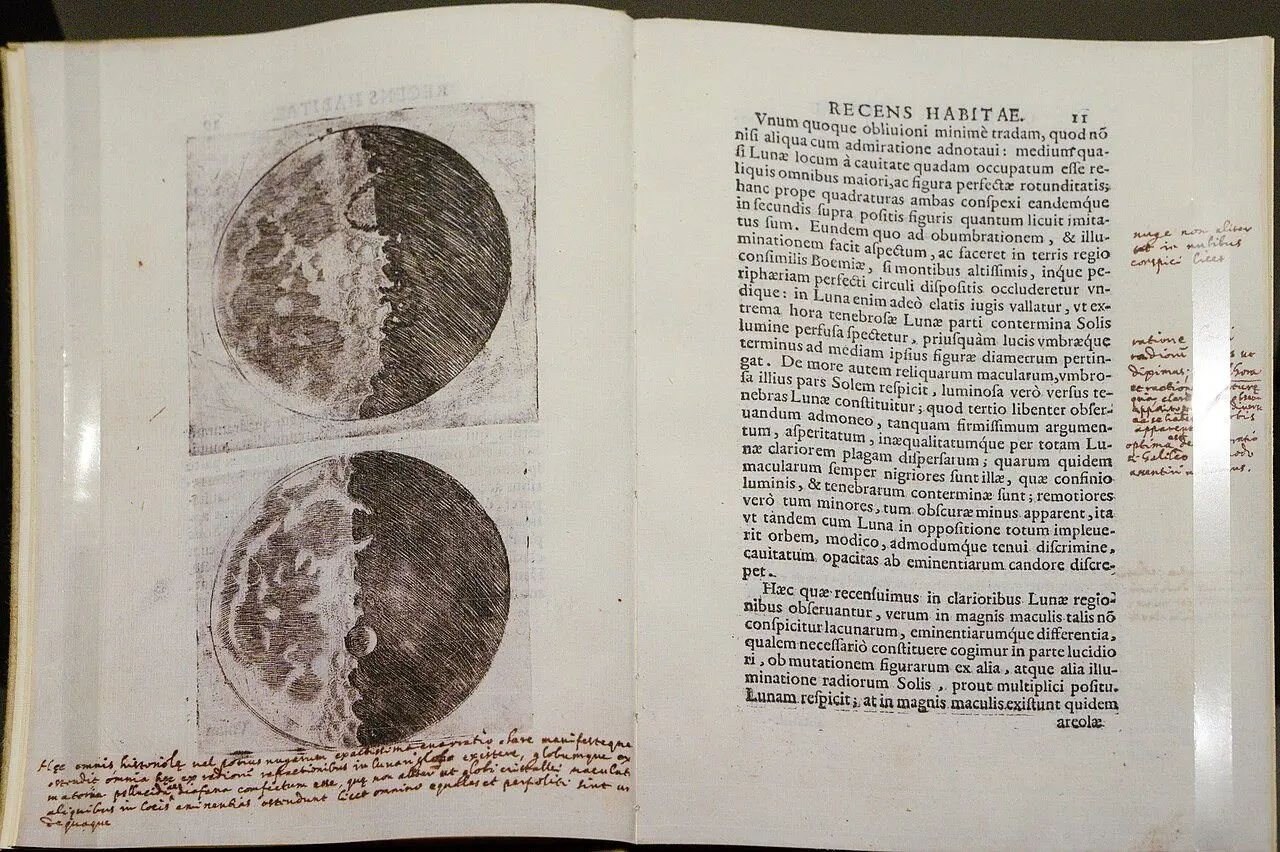
Then, in 1609, came the instrument that changed everything. Hearing reports of a Dutch "spyglass," Galileo built his own telescopes, grinding the lenses himself until he could magnify twenty or thirty times. He did what no one had done before: he pointed one at the night sky and wrote down what he saw. The Moon, he found, was not a perfect celestial sphere but a world of mountains and craters. The Milky Way dissolved into countless individual stars. And Jupiter, he discovered, had four moons of its own circling it, proving that not everything in the heavens revolved around the Earth. He published these wonders in 1610 in a little book called Sidereus Nuncius, the Starry Messenger, and became famous across Europe almost overnight.
Fame brought trouble. Galileo championed the Copernican idea that the Earth moves around the Sun, and in 1616 the Church declared that idea false. He wrote his great Dialogue Concerning the Two Chief World Systems in 1632 anyway, was tried by the Inquisition in 1633, found guilty of heresy, and forced to recant. He spent his final years under house arrest near Florence, going blind in 1637 but still dictating his last masterpiece on motion and mechanics, published in 1638. He died on January 8, 1642, the very year Isaac Newton was born, as if the torch were being passed.
Galileo matters for more than the telescope. He insisted that the book of nature is written in the language of mathematics, and that experiment, not authority, decides what is true. Every scientist who tests an idea against the evidence is, in a real sense, his student. Four hundred and sixty-two years after his birth in Pisa, we are still reading from the book he opened.
Photo: Zde, CC BY-SA 4.0 (via Wikimedia Commons).