The Bay of Pigs: Three Days That Shook the Cold War
On April 17, 1961, some 1,400 CIA-trained Cuban exiles stormed ashore at the Bay of Pigs — and within three days the invasion had collapsed.
They went in before dawn, and by the third day it was over.
Just after midnight on April 17, 1961, frogmen slipped ashore at the Bahía de Cochinos — the Bay of Pigs — on Cuba's southern coast. Behind them came the ships of Brigade 2506: some 1,400 Cuban exiles, trained and armed by the CIA in Guatemala, sailing home to overthrow Fidel Castro.
The plan had been born under President Eisenhower, after Castro's revolution turned openly toward Moscow and began seizing American-owned property. The idea was simple: land a brigade of motivated exiles, seize a beachhead, set up a provisional government, and watch the Cuban people rise up. President John F. Kennedy inherited the plan, had deep doubts about it — and approved it anyway, on the condition that no American forces take part.
Almost everything that could go wrong did. Two days before the landing, CIA-supplied B-26 bombers struck Cuban airfields but failed to destroy Castro's small air force. The landing beaches turned out to be ringed with coral reefs that wrecked landing craft and slowed the unloading to a crawl. The swampy ground bogged down the advance. And the expected popular uprising never materialized.
Castro took personal command of the counterattack. His remaining aircraft sank a supply ship and drove off the rest of the little invasion fleet — stranding the brigade ashore with dwindling ammunition. Then Kennedy, watching the operation unravel on the world stage, made the decision that sealed its fate: he withheld the American air support the CIA's plan had counted on. Without it, the exiles were outgunned and outnumbered.
By April 20 — three days after the landing — it was over. Nearly 100 members of Brigade 2506 were dead, including four American airmen. The survivors, well over a thousand men, were captured, paraded before cameras, and imprisoned. Many were eventually ransomed and returned to the United States.
The Bay of Pigs was a humiliation that reshaped the Cold War. Kennedy took full public responsibility for the failure. But Castro, triumphant, drew even closer to Moscow; within eighteen months, Soviet nuclear missiles would be discovered in Cuba, bringing the world to the brink in the Cuban Missile Crisis. The failed invasion taught Washington a lesson it would not forget: in the nuclear age, even small wars could have enormous consequences.
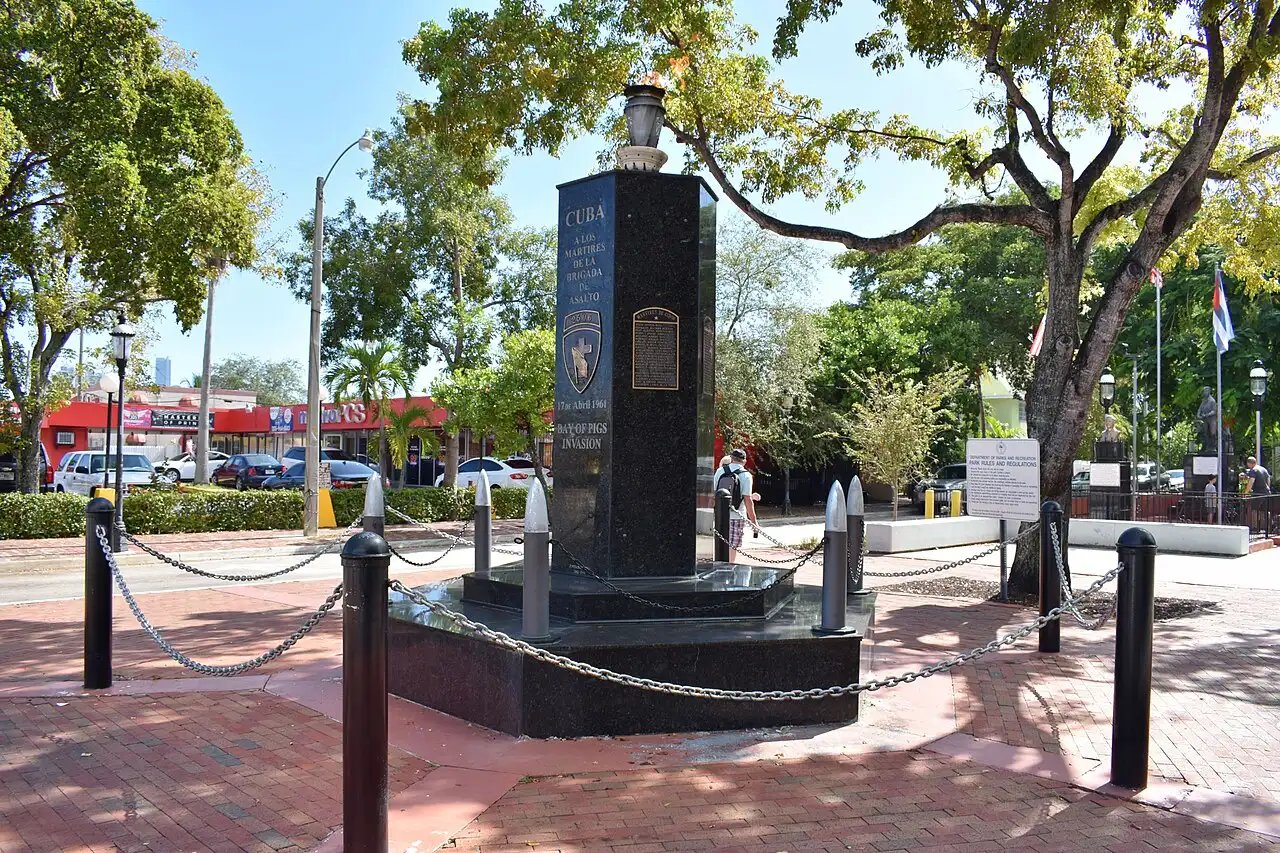
In Miami's Little Havana, a monument still burns an eternal flame for the men who died at Playa Girón — exiles who sailed home to free their country, and never came back.
Photo: Tamanoeconomico, CC BY-SA 4.0 (via Wikimedia Commons).