Benjamin Franklin's Final Edition
Benjamin Franklin died at home in Philadelphia on April 17, 1790, at 84 — and some 20,000 mourners turned out for the printer who had helped invent a nation.
He wrote his own epitaph at 22. It took him 62 more years to earn it.
Benjamin Franklin died at his home in Philadelphia on April 17, 1790. He was 84 years old — ancient by the standards of his time — and he had been, by turns, a runaway printer's apprentice, a bestselling almanac writer, a scientist who tamed lightning, the colonies' most celebrated diplomat, and the oldest signer of both the Declaration of Independence and the Constitution.
The end came from a lung ailment his doctors called a "pleuritic attack." His daughter Sarah sat with him, and when she suggested he shift in bed to breathe more easily, he reportedly answered: "A dying man can do nothing easy." Those were his last reported words.
Franklin had arrived in Philadelphia as a 17-year-old runaway from Boston with almost nothing. He built a printing empire, retired at 42, and then — as if starting a second life — became the most famous American in the world. His experiments with electricity made him a scientific celebrity across Europe. As America's minister to France, he charmed the court of Louis XVI into bankrolling the Revolution; without French money, ships, and soldiers, the war for independence might well have been lost. He negotiated the 1783 Treaty of Paris that ended it.
At 81, the oldest delegate to the Constitutional Convention, he was carried into the sessions in a sedan chair, too gouty to walk. When the bitterly divided delegates finally reached agreement, it was Franklin who urged them all to sign. Asked afterward what kind of government the convention had created, he is said to have replied: "A republic, madam — if you can keep it."
In his final years he turned his formidable pen against slavery, petitioning Congress for its abolition as president of the Pennsylvania Abolition Society. He did not live to see it end — but few men did more to create the nation that eventually would.
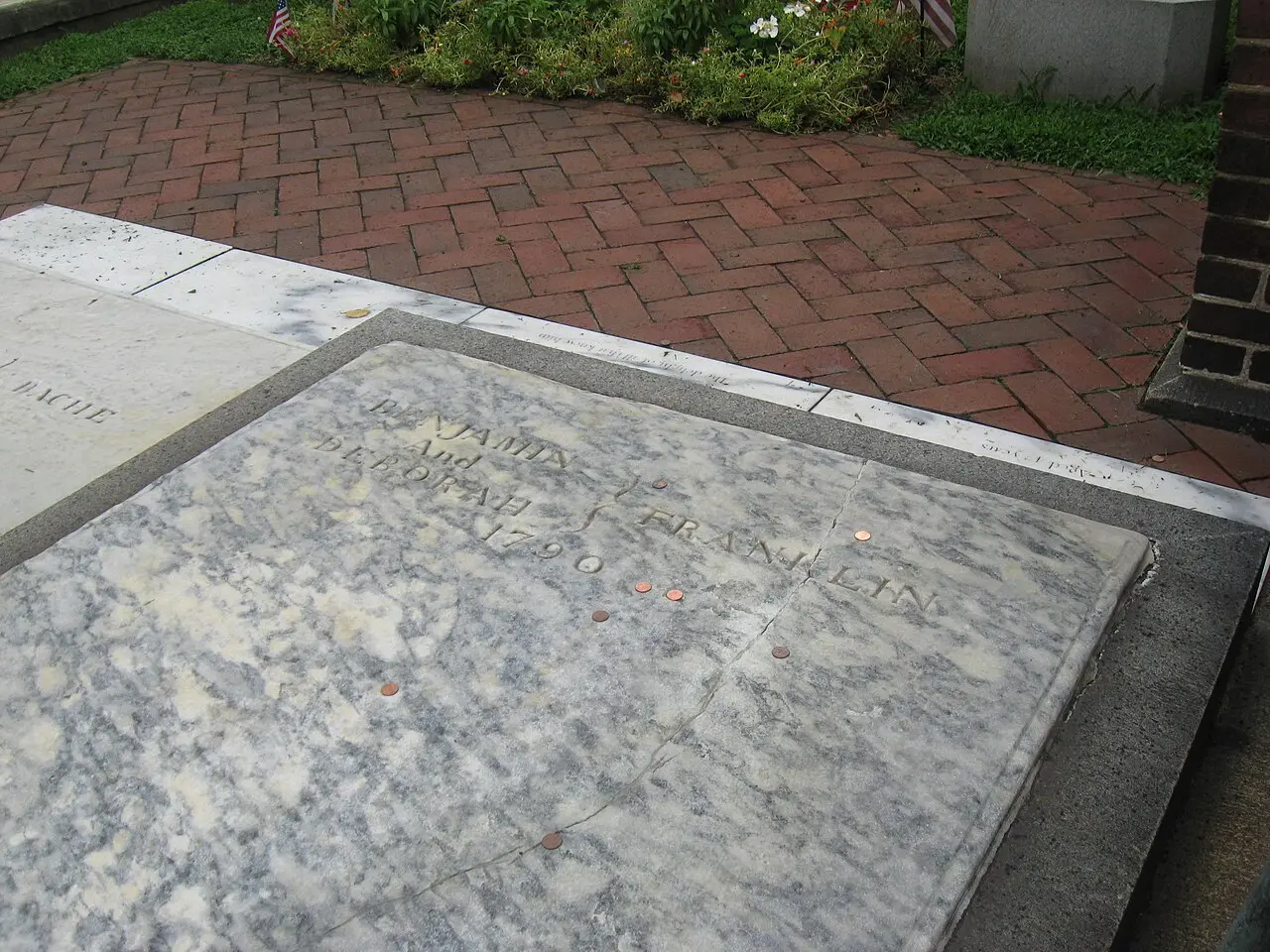
Some 20,000 people — an enormous crowd for a city of that era — followed his coffin to Christ Church Burial Ground, where he was laid beside his wife Deborah. And that epitaph, written by a 22-year-old printer with more wit than prospects?
"The Body of B. Franklin Printer; Like the Cover of an old Book, Its Contents torn out, And stript of its Lettering and Gilding, Lies here, Food for Worms. But the Work shall not be wholly lost: For it will, as he believ'd, appear once more, In a new & more perfect Edition, Corrected and Amended By the Author."
His will, characteristically practical, ordered something plainer for the actual stone: "Benjamin and Deborah Franklin." But the book metaphor was the truer one. Few lives have ever gone through so many editions.
Photo: Nandaro, CC BY-SA 3.0 (via Wikimedia Commons).