The 19th Star: Indiana Joins the Union
On December 11, 1816, President James Madison signed the resolution admitting Indiana as the 19th state of the Union.
It took a war, a new capital, and three tries on the same December day. On December 11, 1816, Indiana finally became a state.
The road was long. The Indiana Territory had been created in 1800 from the Northwest Territory, and its people soon chafed at rule from afar — resenting territorial officials they saw as corrupt and taxes they saw as too high. The territory first petitioned for statehood in 1811, but Congress was consumed by the drift toward the War of 1812 and did nothing. In 1813, the territorial capital moved from Vincennes to the tiny southern town of Corydon. In 1815, the territorial assembly petitioned Congress again — and was again left waiting. As local historians note, each of these milestones fell on December 11. So did the final one.
1816 was the breakthrough year. On April 19, President Madison signed the Enabling Act authorizing Indiana Territory to form a state government. Forty-three delegates gathered at Corydon on June 10 and, in nineteen days, wrote Indiana's first constitution, with Jonathan Jennings presiding and William Hendricks as secretary. On August 5, voters elected Jennings the territory's first governor — he was inaugurated November 7 — and chose Hendricks as the state's first representative to Congress; the first General Assembly met on November 4. The territory counted more than 64,000 residents, comfortably above the 60,000 required for statehood.
Congress moved swiftly at the end. A Senate committee reported a statehood resolution on December 4; the Senate passed it on December 6 and the House on December 9. On December 11, 1816, President James Madison signed it: Indiana was the 19th state of the Union.
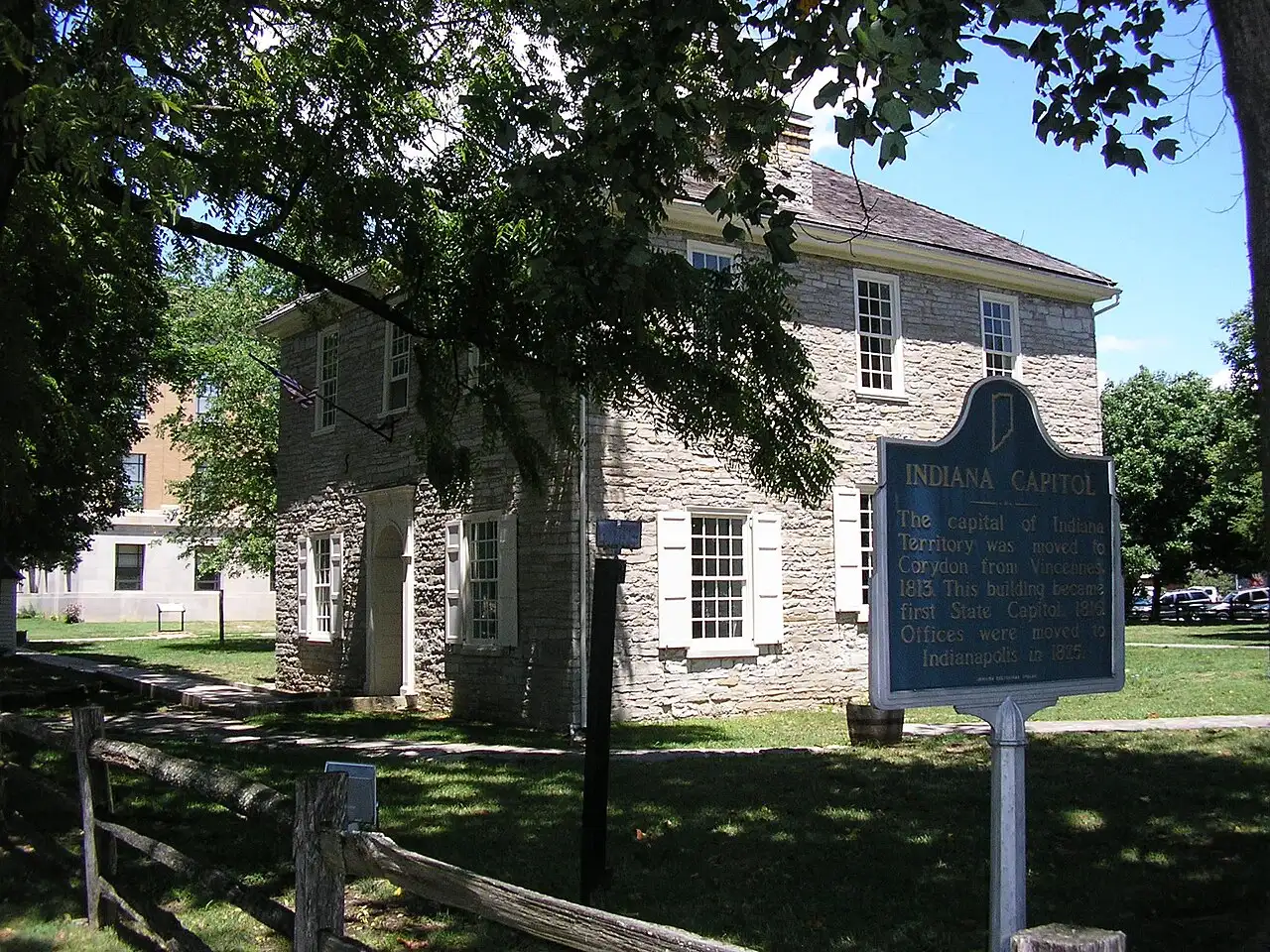
Corydon became Indiana's first state capital, serving from 1816 to 1825 — the little stone capitol building still stands today, a museum of the state's beginnings, and the great Constitution Elm, where tradition says the delegates worked, is still a landmark. The capital moved to Indianapolis in 1825, but every December 11 is still celebrated across the state as Statehood Day.
It matters because Indiana was the Northwest Ordinance's promise working exactly as designed: a territory grows, writes a constitution, and joins the Union as an equal. From 64,000 settlers in 1816 to a state of millions, it all began with a signature on a December day. Hoosiers still mark the occasion each year with Statehood Day celebrations at the Statehouse in Indianapolis.
Photo: W.marsh, CC BY-SA 3.0 (via Wikimedia Commons).