Sunday Island: Columbus Names Dominica
On November 3, 1493, Columbus sighted a mountainous Caribbean island on a Sunday and named it Dominica — Latin for the Lord's Day.
He had sailed with seventeen ships and more than a thousand men — the largest fleet yet to cross the Atlantic. And on a Sunday morning in November 1493, Christopher Columbus raised the first island of his second voyage and gave it the day's name.
Columbus had departed Cádiz, Spain, on September 25, 1493, barely seven months after returning from his first voyage with news of lands across the ocean. This time he came not to explore but to colonize: soldiers, priests, farmers, and craftsmen, with horses, seeds, and livestock. After five weeks at sea, the fleet made landfall in the Caribbean.
On Sunday, November 3, 1493, Columbus sighted a rugged, mountainous island rising steeply from the sea. Because it was the Lord's Day — dies Dominica in Latin — he named it Dominica. It was the first island he claimed on this voyage, and the naming began a busy week: in the days that followed, the fleet would encounter Guadeloupe, Antigua, and Puerto Rico, among others.
The island the Spaniards called Dominica was home to the Kalinago people, who had themselves displaced earlier inhabitants and fiercely resisted European settlement. That resistance, combined with the island's steep terrain and lack of gold, meant Spain never established a lasting colony there — a rarity in the Caribbean. Instead, Dominica became a contested prize between France and Britain for two centuries, changing hands repeatedly before settling as a British colony.
The Kalinago survived there as nowhere else in the Caribbean. Today, Dominica is home to the last remaining community of the Kalinago people, living on a reserve granted on the island's rugged east coast — descendants of the islanders who watched strange sails appear off their shores that Sunday morning in 1493.
Columbus never set foot on Dominica's beaches; his fleet sailed on after sighting it. But the name he gave it stuck for more than five centuries. The Commonwealth of Dominica became independent in 1978, and every year the island still celebrates its discovery day in early November — a reminder that some names, once given, are never taken back.
The island Columbus named for a Sunday is still known as the Nature Island of the Caribbean — mountainous, rainforested, and home to the sisserou parrot, found nowhere else on earth.
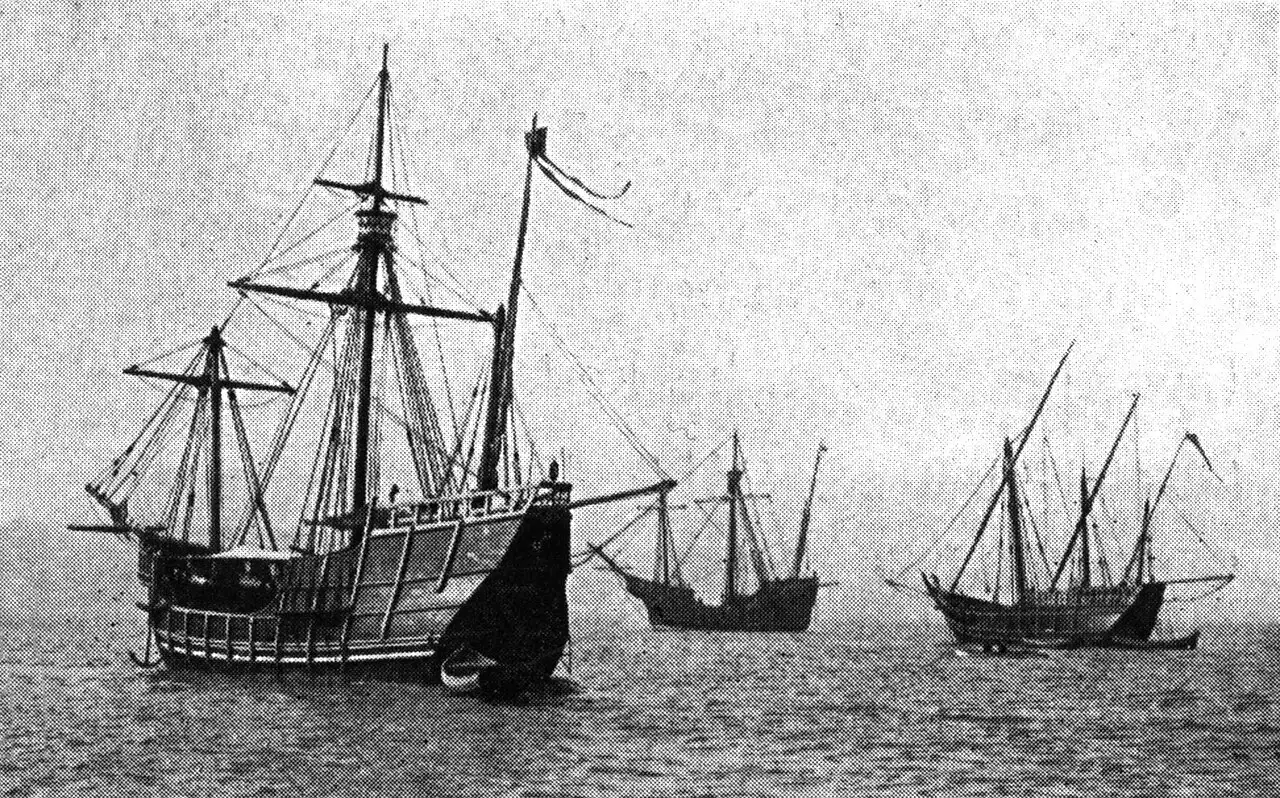
The ships above are full-size replicas built for Chicago's 1893 World's Columbian Exposition — an echo, four hundred years later, of the vessels that carried Columbus across the ocean.
Photo: E. Benjamin Andrews, public domain (via Wikimedia Commons).