A Country Born for a Canal: Panama's Independence
On November 3, 1903, Panama broke away from Colombia with American warships offshore — a new nation born to make the Panama Canal possible.
The revolution was over in a day, and the warships were already waiting offshore. On November 3, 1903, Panama declared its independence from Colombia — and the most famous ditch in history finally got its country.
Panama had been part of Colombia for more than eighty years, and its isthmus — the narrow neck of land between two oceans — had tempted canal-builders for centuries. The French had tried in the 1880s and failed catastrophically, losing the company and some 20,000 workers to disease and debt. By 1903, the United States was determined to succeed where France had not, and President Theodore Roosevelt had negotiated a treaty with Colombia for a canal zone.
Colombia's senate said no. That rejection set everything in motion. A French engineer and investor from the failed French effort, Philippe Bunau-Varilla, threw his weight behind Panama's separatists. He met their leader, Manuel Amador Guerrero, in New York, helped fund the revolt, and — most importantly — had Washington's ear. When Panama rose on November 3, American warships were conveniently stationed off both coasts, and Colombian troops sent to crush the rebellion were blocked from landing.
It worked with astonishing speed. The new republic was proclaimed in Panama City with barely a shot fired. The United States recognized Panama within days, and Amador became its first president. Barely two weeks later, on November 18, Bunau-Varilla — acting as Panama's ambassador, though he was French — signed the Hay–Bunau-Varilla Treaty, granting the United States permanent control of a ten-mile-wide Canal Zone.
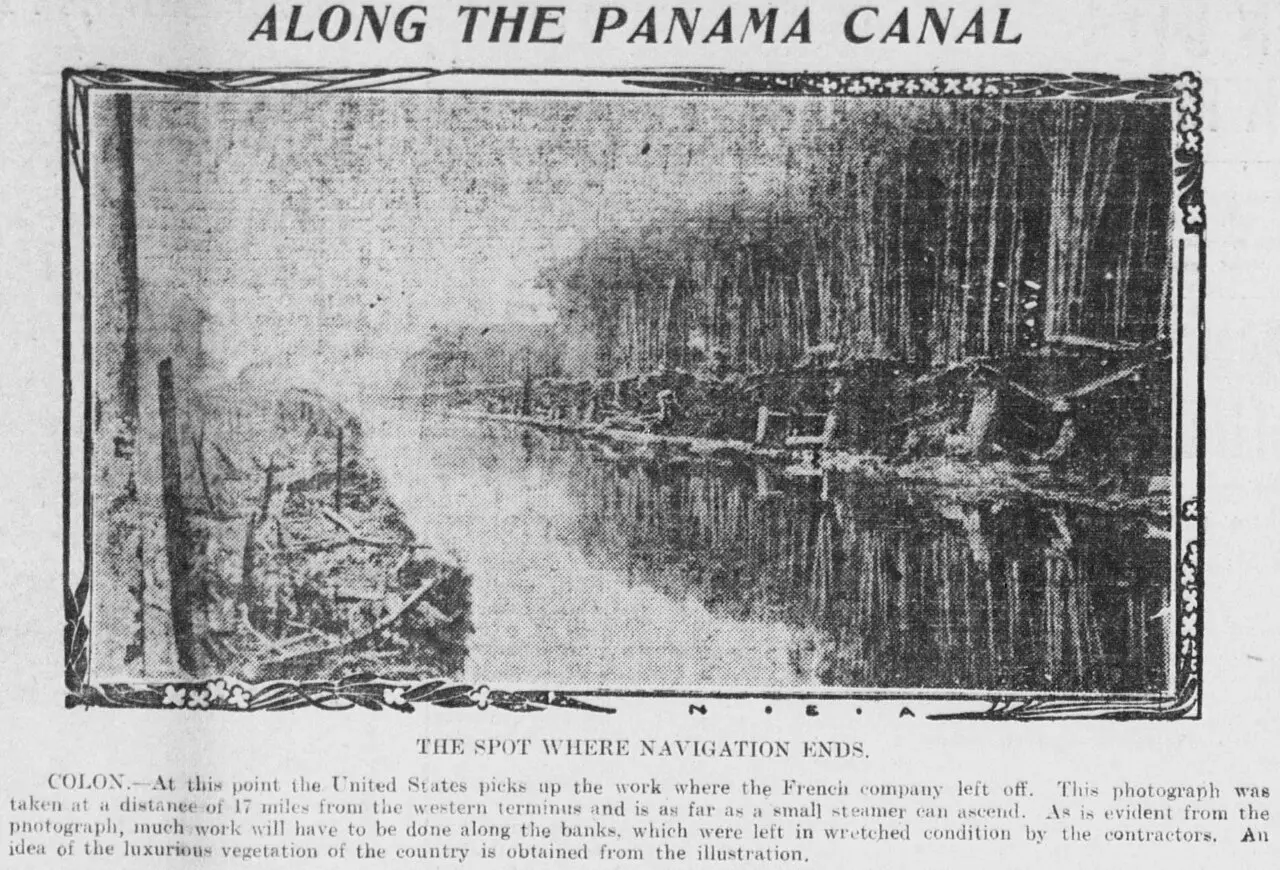
The photograph above, published the following year, shows what the Americans inherited: the abandoned French diggings, "the spot where navigation ends," with the jungle already reclaiming the works. Under American direction, with the mosquito-borne diseases that had doomed the French finally understood and controlled, the canal was completed in 1914 — one of the great engineering feats of the age.
Panamanians have always had mixed feelings about their founding. Independence was real, but it was midwifed by a foreign power pursuing its own interests, and the Canal Zone became an American enclave for the better part of a century. It was not until treaties signed in 1977, taking full effect on the last day of 1999, that Panama gained complete control of the canal.
Still, every November 3rd, Panama celebrates Separation Day — the birthday of a nation that exists, in no small part, because the world needed a shortcut between two oceans.
Photo: unknown photographer, public domain (via Wikimedia Commons).