'Pinkeltje': The Day Philips Showed the World the Compact Disc
On March 8, 1979, Philips demonstrated a tiny silver disc in Eindhoven — and music was never the same again.
The room went quiet in a way no one had ever heard before.
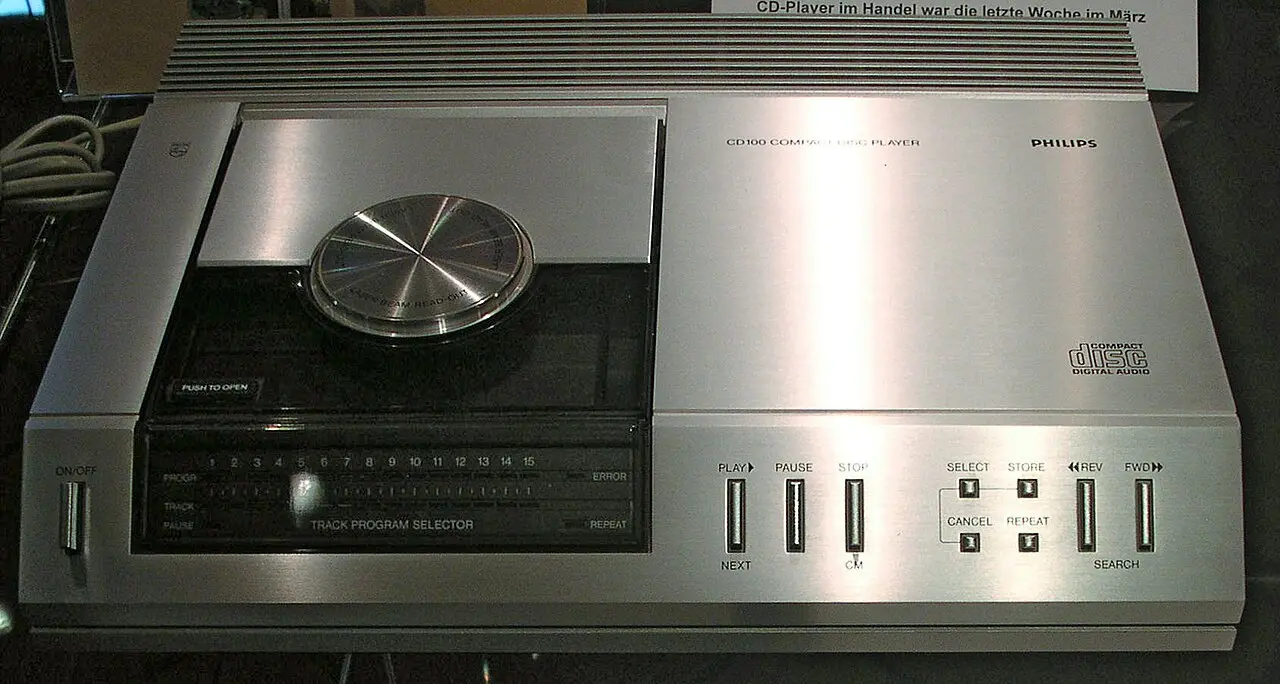
On March 8, 1979, the Dutch electronics company Philips invited about 300 journalists to its works in Eindhoven, the Netherlands, for the world premiere of a new medium. On stage, Joop Sinjou, head of Philips' Compact Disc laboratory, held up a small silver disc just 11.5 centimeters across — and played music from it. The demonstration system's total lack of background noise, even in the silent pauses between musical passages, stunned the audience. One audio expert wrote that the silence was "particularly dramatic." The engineers had nicknamed their little prototype player "Pinkeltje," after a tiny dwarf from a Dutch fairy tale.
The compact disc was the marriage of two technologies: the laser, which could read information from a disc without touching it, and digital encoding, which turned sound into numbers. Instead of a diamond needle dragging through a vinyl groove — wearing it down a little with every play, picking up every scratch and speck of dust — a wafer-thin laser beam scanned microscopic pits in the plastic. No contact meant no wear. No groove meant no hiss, no crackle, no pops. For listeners raised on vinyl and cassette, it sounded like the future.
Philips knew it needed allies. Sony had been developing similar technology, and rather than fight a format war, the two companies cooperated on a single standard — settling on a 12-centimeter disc, reportedly sized to hold Beethoven's entire 74-minute Ninth Symphony. The partnership worked: in 1982 Sony released the CDP-101, the first commercial CD player, and by 1988 compact discs were outselling vinyl albums.
The CD didn't just change music; it changed computing. A disc that could hold an album could hold data — about 800 megabytes, compared to roughly 1 megabyte on the floppy disks of the era. The CD-ROM carried encyclopedias, software, and video games; later came the DVD and the Blu-ray, children of the same idea. Streaming has since eclipsed the silver disc, but the principle Philips demonstrated that day in Eindhoven — that the world's information could be pressed into pits of light-readable plastic — underlies the entire digital age.
Pinkeltje, the fairy-tale dwarf of a prototype, grew up fast. Within a decade of that March 8 demonstration, the compact disc had conquered the world's living rooms, and the crackle of vinyl became a nostalgia instead of a necessity.
Photo: Norbert Schnitzler, public domain (the Philips CD100, the first commercial CD player, 1982 — descendant of the 1979 "Pinkeltje" prototype).