MH370: The Plane That Vanished on March 8, 2014
Malaysia Airlines Flight 370 took off for Beijing on March 8, 2014, with 239 people aboard — and became aviation's greatest mystery.
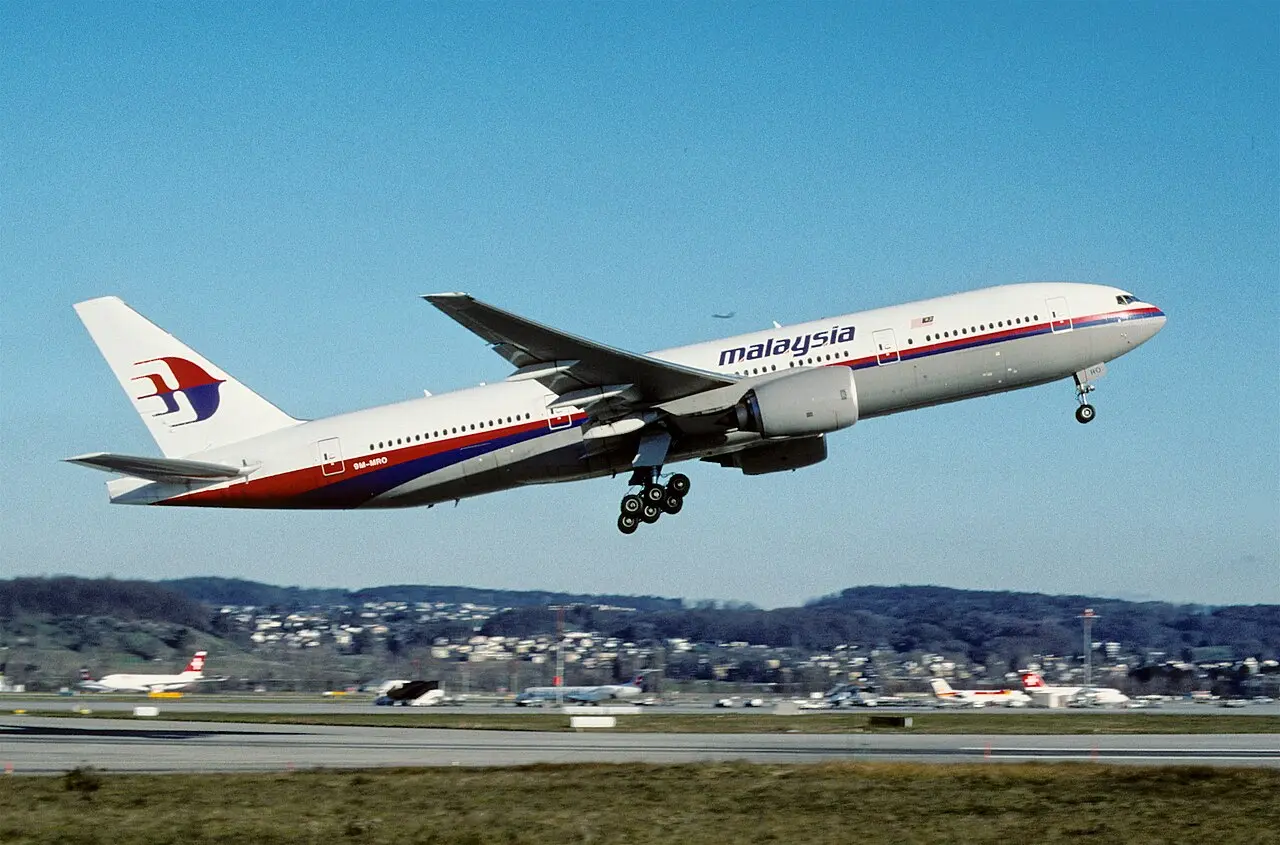
At 12:41 on the morning of March 8, 2014, Malaysia Airlines Flight 370 lifted off from Kuala Lumpur, bound for Beijing with 227 passengers and 12 crew aboard. Less than an hour later, it had vanished — and more than a decade later, it still hasn't been found.
The flight began routinely. At 1:19 a.m., the cockpit's last voice transmission reached air traffic control: "Good night, Malaysian three seven zero" — words suggesting nothing out of the ordinary. Minutes later the aircraft's transponder stopped responding, and the plane disappeared from civilian radar over the South China Sea. But Malaysian military radar kept tracking it: the jet had turned sharply west, flown back across the Malay Peninsula, and headed out over the Andaman Sea — the opposite direction from Beijing.
For hours after that, the silent aircraft kept talking to a satellite. Automated hourly "handshakes" between the plane and an Inmarsat communications satellite continued until 8:11 a.m. — more than seven hours after takeoff. Analysis of those faint signals indicated the plane had flown south, deep over the remote Indian Ocean, far from any land, until its fuel ran out. On March 24, Malaysian officials announced that the flight had ended in the southern Indian Ocean, with no survivors.
What followed was the largest search in aviation history. Twenty-five countries joined the hunt across nearly three million square miles of ocean. Australia led a years-long underwater search of 120,000 square kilometers of remote seabed — one of the most difficult stretches of ocean on Earth — and found nothing. Then, on July 29, 2015, a piece of the plane's wing, a flaperon, washed up on Réunion Island in the western Indian Ocean, thousands of miles from the search zone. French investigators confirmed it came from MH370 — the first physical proof of the plane's fate. A handful of other debris fragments have since been found along African coastlines, but the main wreckage has never been located.
The cause of the disappearance remains undetermined. Investigators have weighed mechanical failure, hijacking, and crew involvement, but no theory has been proven. In January 2015, Malaysia formally declared the disappearance an accident. Private search efforts — including a 2018 "no find, no fee" expedition by the marine robotics firm Ocean Infinity — have come up empty, though Malaysia announced in late 2025 that Ocean Infinity would try again with new underwater technology.
For the families of the 239 people aboard, the mystery is a wound that never closes. For aviation, it was a reckoning: the disappearance forced the industry to confront how a modern airliner, tracked by satellites and radar, could simply vanish — and pushed regulators toward requiring more frequent position reporting from aircraft over remote oceans.
MH370 remains widely called the greatest mystery in aviation history: a ghost flight that turned an ordinary red-eye into an enduring question mark on the map.
Photo: Aero Icarus, CC BY-SA 2.0 (the Boeing 777 registered 9M-MRO — the aircraft that operated Flight MH370 — taking off from Zurich, 2003).