
Pickett's Charge: The High-Water Mark of Gettysburg
On July 3, 1863, some 12,500 Confederates marched across open ground at Gettysburg in Pickett's Charge — and the tide of the Civil War turned.
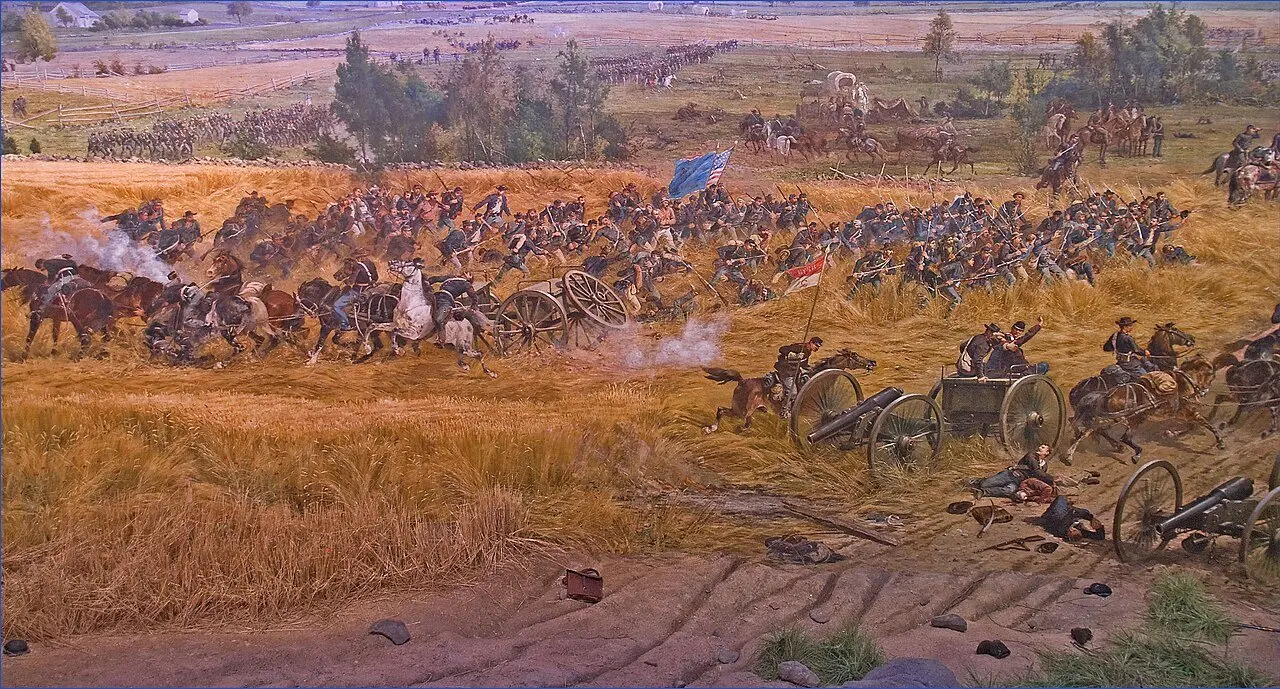
On the afternoon of July 3, 1863, some 12,500 Confederate soldiers stepped out of the woods along Seminary Ridge in Pennsylvania, dressed their lines, and began walking toward the Union army nearly a mile away across open farmland. What followed became one of the most famous episodes in American military history.
It was the third day of the Battle of Gettysburg. General Robert E. Lee's Army of Northern Virginia had battered both flanks of the Union line the day before and failed. Lee gambled that the Union center, on Cemetery Ridge, must be weakened — and he ordered a massive frontal assault to break it. The night before, at a council of war, Union commander George Meade had predicted exactly that, and reinforced his center.
First came the artillery: one of the largest cannonades of the war, as Confederate guns tried to soften the Union line. Then, in the afternoon, nine brigades of infantry — three divisions under Lt. Gen. James Longstreet, including the division of Maj. Gen. George Pickett, whose name the attack would carry — marched across the open ground into waiting cannon and rifle fire. The men crossed fences and fields in good order, flags flying, while Union artillery tore gaps in their ranks.
A few hundred Confederates reached the stone wall at a bend in the Union line called the Angle, briefly breaking through in desperate hand-to-hand fighting. But they could not hold, and no reinforcements followed. The charge collapsed. More than half of the men who made the attack were killed, wounded, or captured.
That farthest point of advance — the Angle, at the stone wall on Cemetery Ridge — is remembered as the "high-water mark of the Confederacy." Lee's invasion of the North was over. On the Fourth of July, his battered army began its long retreat to Virginia, and the Confederacy would never again mount a major invasion of Northern soil.
The three days at Gettysburg cost between 46,000 and 51,000 casualties on both sides — more than any battle in American history to that point. Four months later, President Abraham Lincoln would stand on that same ground to dedicate a cemetery for the Union dead, delivering the Gettysburg Address and giving the war's staggering cost a new birth of meaning.
Years later, when someone asked Pickett why his charge had failed, the general is said to have answered: "I've always thought the Yankees had something to do with it."
Photo: Ron Cogswell, CC BY 2.0 (via Wikimedia Commons).