Peace in the Desert: Israel and Jordan Sign a Treaty
On October 26, 1994, Israel and Jordan signed a treaty ending 46 years of war — only the second Arab-Israeli peace ever made.
In a stretch of desert between Eilat and Aqaba, two old enemies sat down at a table on October 26, 1994, and ended a war that had lasted 46 years.
Israel and the Hashemite Kingdom of Jordan had been in a formal state of war since 1948 — through the Arab-Israeli war of that year, the Six-Day War of 1967, and decades of tension along the world's most closely watched border. Yet behind the public hostility, the two countries' leaders had been talking in secret for years. Both sides had come to the same conclusion: the enmity served neither of them.
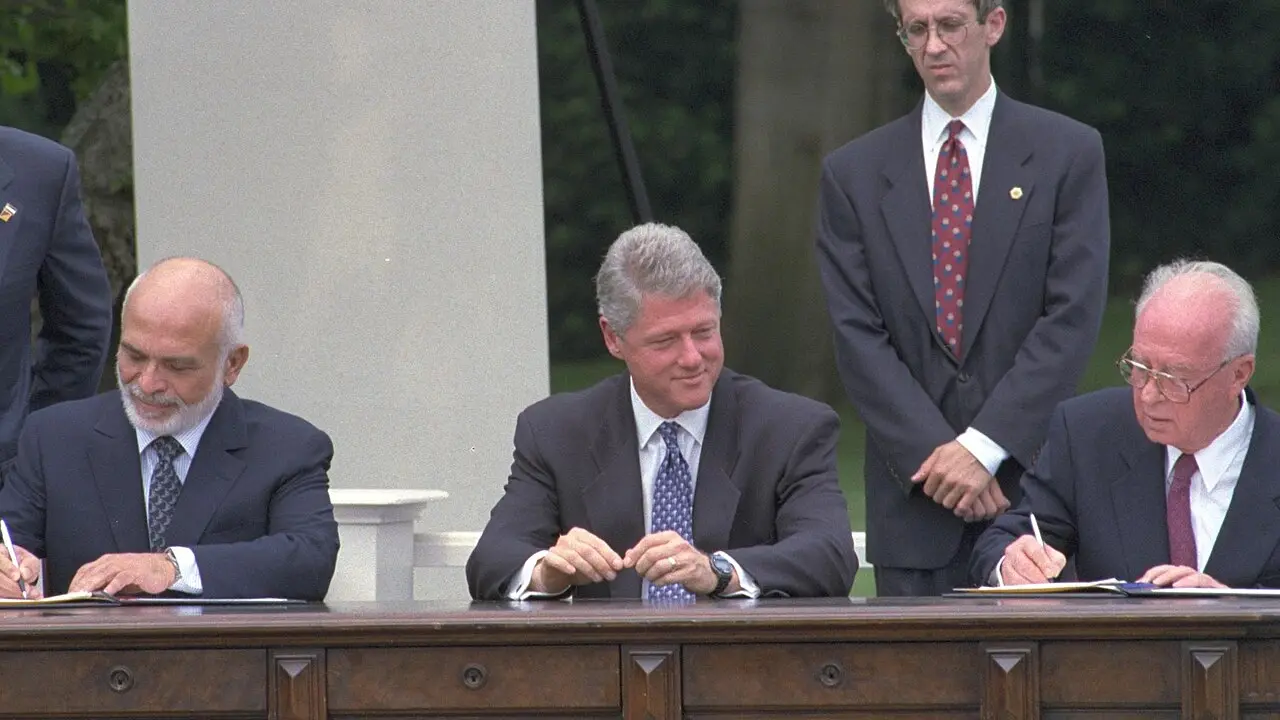
The breakthrough came in the summer of 1994, in the afterglow of the Oslo Accords between Israel and the Palestinians. On July 25, Israeli Prime Minister Yitzhak Rabin and Jordan's King Hussein met on the White House lawn with President Bill Clinton and signed the Washington Declaration, formally ending the state of war between their countries. That declaration set off three months of intense negotiations over the hard details: borders, land, and — in the parched Middle East, the most precious issue of all — water.
The treaty they produced was signed on October 26, 1994, at the Arava border crossing in the desert south of the Dead Sea, before some 4,500 guests, with Clinton looking on. The prime ministers of the two countries signed the document itself: Yitzhak Rabin for Israel and Abdelsalam al-Majali for Jordan. When the signatures were dry, 10,000 balloons in the colors of the two nations' flags were released into the desert sky.
The treaty did far more than declare peace. It drew the international boundary between the two countries and returned disputed land to Jordan — roughly 380 square kilometers. It divided the waters of the Yarmouk and Jordan rivers and created a joint committee to manage them. It established full diplomatic relations, opened the door to trade and tourism, and committed each country never to let its territory be used as a staging ground for attacks on the other. Jordan also secured recognition of its special role in caring for Muslim holy sites in Jerusalem.
Jordan became only the second Arab country, after Egypt in 1979, to make peace with Israel. The move was not universally applauded — it was condemned by the PLO and by militants on both sides — but it held. A year later, Rabin was assassinated by an Israeli extremist opposed to the peace process; King Hussein attended his funeral in Jerusalem, a gesture of personal grief that spoke volumes about how far the two men had come.
The peace that followed has often been described as a "cold peace" — correct, durable, but never warm. Yet more than three decades on, the treaty still stands: the border is quiet, the water still flows according to the agreement, and the two countries cooperate on security every day. In a region where grand bargains usually collapse, the desert handshake of October 26, 1994, remains one of the rare ones that endured — proof that even a 46-year war can end with pens instead of guns.
Image: King Hussein of Jordan (left) and Israeli Prime Minister Yitzhak Rabin (right) sign the Washington Declaration on the White House lawn on July 25, 1994, as U.S. President Bill Clinton looks on — the declaration that ended the state of war and paved the way for the peace treaty signed that October. Photo by Yaakov Saar / Israel Government Press Office, CC BY-SA 3.0 (via Wikimedia Commons).