Nine Hours on the Beach at Dieppe
On August 19, 1942, nearly 5,000 Canadians stormed the French port of Dieppe in a raid that became Canada's bloodiest day of World War II.
It was over in nine hours — and it became the bloodiest single day in Canadian military history.
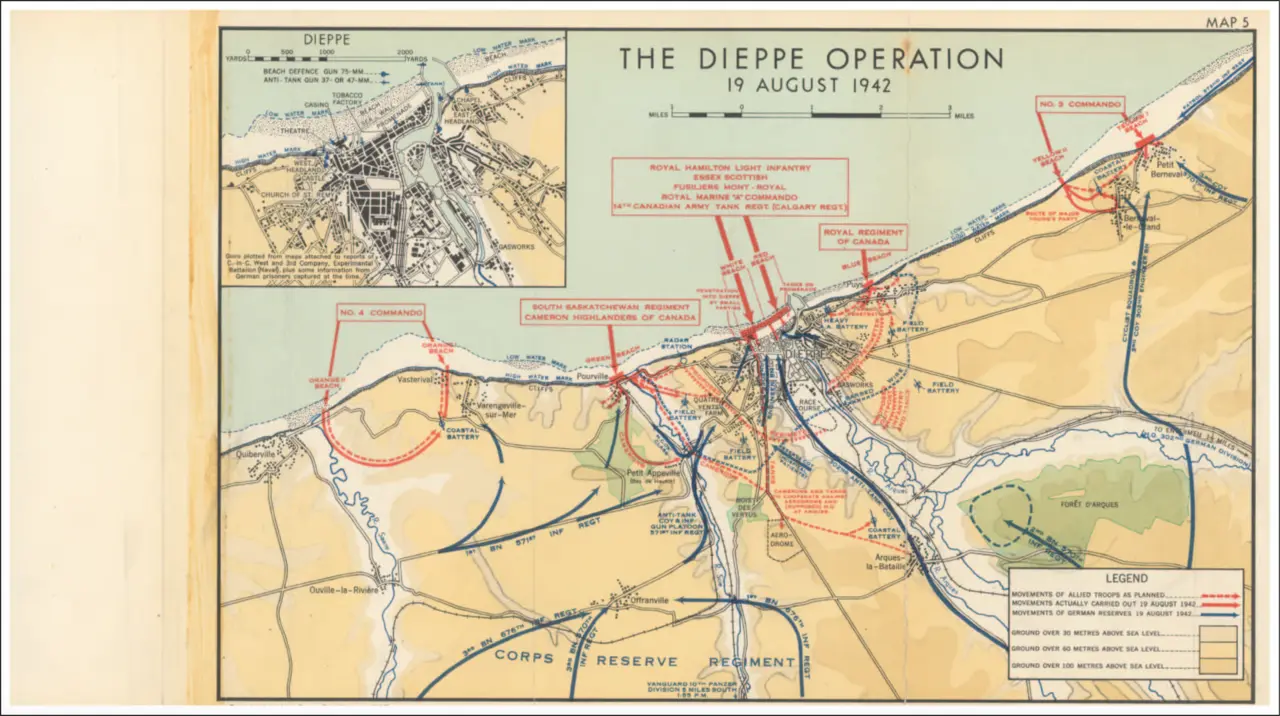
Shortly after 5 a.m. on August 19, 1942, the men of Canada's 2nd Infantry Division, commanded by Major-General J.H. Roberts, came ashore on the beaches around Dieppe, a German-held port on the French Channel coast. With them were about a thousand British commandos and fifty American Rangers. The operation was called Jubilee: seize the port, hold it for a matter of hours, smash the defenses, gather intelligence, and get out. The Allies wanted to test whether a defended port could be taken from the sea, to give the public a victory, and to show the Soviet Union — bleeding on the Eastern Front — that a second front was coming.
Almost nothing went as planned. The element of surprise was lost early. Tanks of the Calgary Regiment bogged down on the steep shingle beach and sat as helpless targets. Infantry pinned against the seawall faced withering fire from cliffs and buildings the planners had believed were lightly held. Air cover proved inadequate, and the naval bombardment was too light to crack the concrete defenses. Only one landing force fully achieved its objective; everywhere else, the attack stalled within sight of the town.
By mid-morning, Roberts faced the truth and ordered the withdrawal. Landing craft went back in under fire to pull the survivors off the beaches. When the last boats left, the toll was staggering: of the roughly 4,963 Canadians who had embarked, 3,367 — nearly seven in ten — were killed, wounded, or captured. More than 900 were dead and nearly 2,000 were prisoners of war. The RAF lost 106 aircraft; the Royal Navy lost 33 landing craft and a destroyer.
Amid the disaster there was extraordinary courage. Three Victoria Crosses were awarded for Dieppe, including two to Canadians: Lieutenant-Colonel Cecil Merritt, who led his men with legendary calm under fire, and the Reverend John Foote, a chaplain who spent hours carrying wounded men to safety and then chose to stay with them into captivity.
Dieppe was a failure, and the men who paid for it deserved better planning. But the hard lessons — about surprise, firepower, intelligence, and never assaulting a fortified port head-on — were studied ruthlessly, and they shaped the planning of the Normandy landings two years later. At the Dieppe Canadian War Cemetery, row upon row of headstones still keeps the morning watch over a raid that lasted nine hours and is remembered forever.
Photo: Canadian Army (Captain C. C. J. Bond), public domain (via Wikimedia Commons).