
America's 31-Pound Answer to Sputnik
On January 31, 1958, Explorer 1 became America's first satellite, launched in just 84 days — and it discovered the radiation belts circling Earth.
The United States was late to the space race, and everyone knew it. When the Soviet Union launched Sputnik 1 in October 1957 — a beeping metal sphere anyone with a radio could hear circling overhead — America's first answer, the Navy's Vanguard rocket, exploded on the launch pad that December. So when an Army rocket called the Jupiter-C lit up a Florida night on January 31, 1958, at 10:48 p.m., carrying a 31-pound satellite called Explorer 1, the whole country was holding its breath.
The breath-holding had been going on for days. High winds had already scrubbed two launch attempts from Cape Canaveral. And the whole project had been a rush job: after Sputnik, the Army Ballistic Missile Agency, the Jet Propulsion Laboratory in California, and physicist James Van Allen of the University of Iowa were thrown together and given about three months to build a satellite and the rocket to carry it. They did it in 84 days.
The satellite itself was modest — a tube a little under seven feet long, built by JPL under director William Pickering and packed with Van Allen's instruments: a Geiger counter to measure cosmic rays, temperature sensors, and a microphone to record micrometeorite impacts. The Jupiter-C, a modified Redstone missile designed by Wernher von Braun's team in Huntsville, Alabama, lofted it into orbit. More than an hour and a half passed before a tracking station in California picked up the signal. JPL's Frank Goddard announced the news with a phrase that made the history books: "We've got the bird."
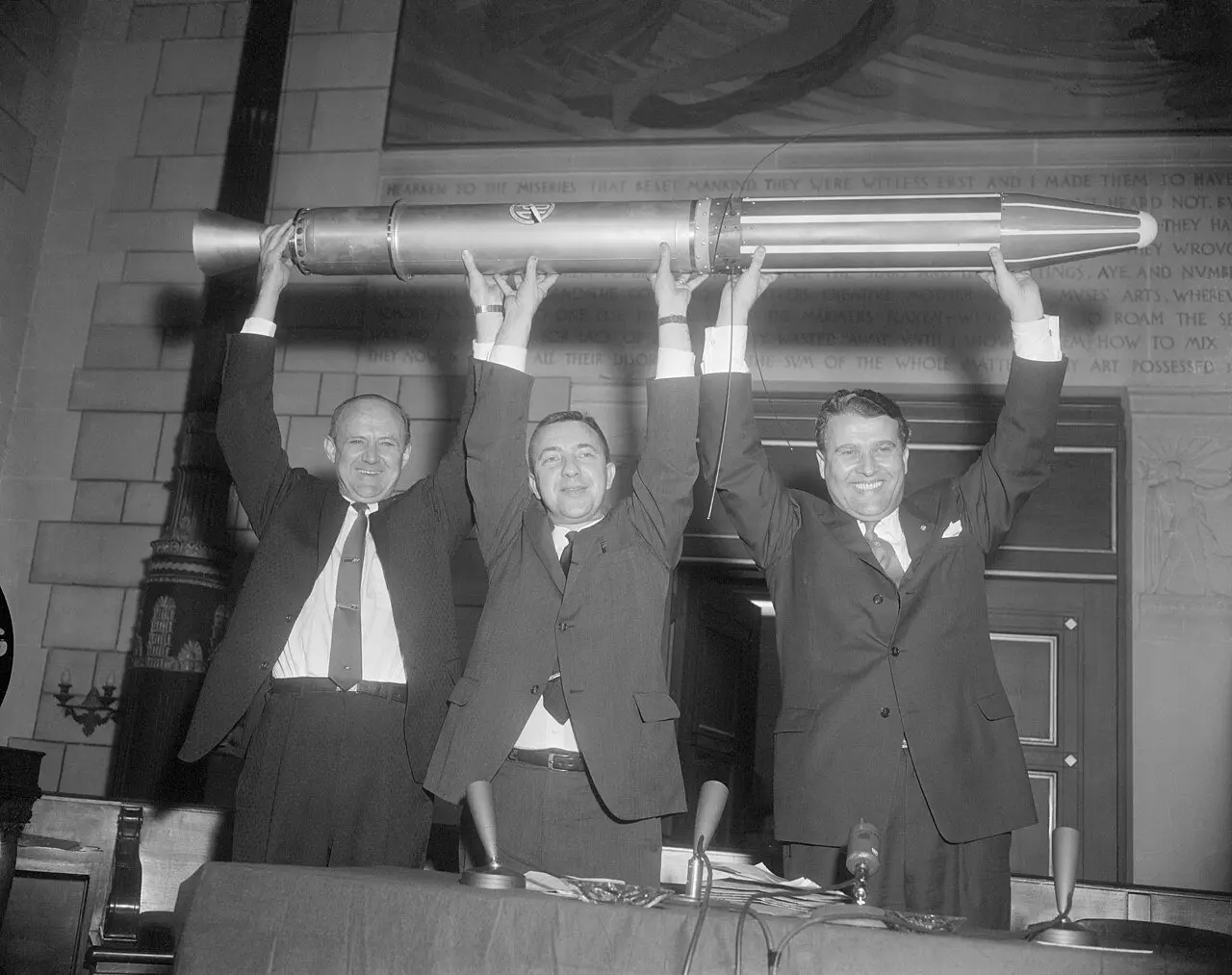
Around 2 a.m., von Braun, Pickering, and Van Allen walked into a press conference at the National Academy of Sciences in Washington, hoisted a full-size model of the little satellite over their heads, and grinned for the cameras — the photograph of that moment became the defining image of the American space age's opening chapter.
Explorer 1 turned out to be more than a morale boost. Its Geiger counter kept reporting strange readings — at times, no cosmic rays at all — until Van Allen realized the instrument was being overwhelmed by intense radiation: Earth was ringed by belts of charged particles trapped by its magnetic field. The Van Allen radiation belts, confirmed by the follow-up satellite Explorer 3, were counted among the great discoveries of the International Geophysical Year.
The little satellite fell silent on May 23, 1958, when its batteries died, but it kept circling Earth for nearly twelve more years — some 58,000 orbits — before burning up on reentry in March 1970. America's space program had begun with a whisper of a beep from something the size of a fence post. It has never really stopped talking since.
Photo: NASA/JPL, public domain (via Wikimedia Commons).