Two Miles That Started It All: The First Harvard–Yale Race
On August 3, 1852, Harvard and Yale rowed the first American intercollegiate sporting event on Lake Winnipesaukee — a two-mile boat race that launched college sports.
College sports in America began as a publicity stunt for a railroad. On August 3, 1852, on the sparkling waters of Lake Winnipesaukee in New Hampshire, the oarsmen of Harvard and Yale lined up for a two-mile boat race — the first intercollegiate sporting event in American history.
The rivalry was young but real. Yale had founded America's first collegiate crew in 1843, when the shell Whitehall arrived in New Haven; Harvard started its boat club a year later. In 1852 Yale issued a formal challenge "to test the superiority of the oarsmen of the two colleges." A publicity-minded agent of the Boston, Concord & Montreal Railroad — eager to sell excursion-train tickets to the lakes — happily sponsored the regatta.
Harvard's Oneida won, pulling ahead of Yale's faster entry, the Shawmut, by a few lengths over the two-mile course. (Yale had entered a second boat as well.) The winners received a pair of black-walnut oars, silver-inscribed, presented by General Franklin Pierce — who the next year would become the 14th president of the United States. Those 1852 trophy oars remain the oldest intercollegiate athletic prize in North America.
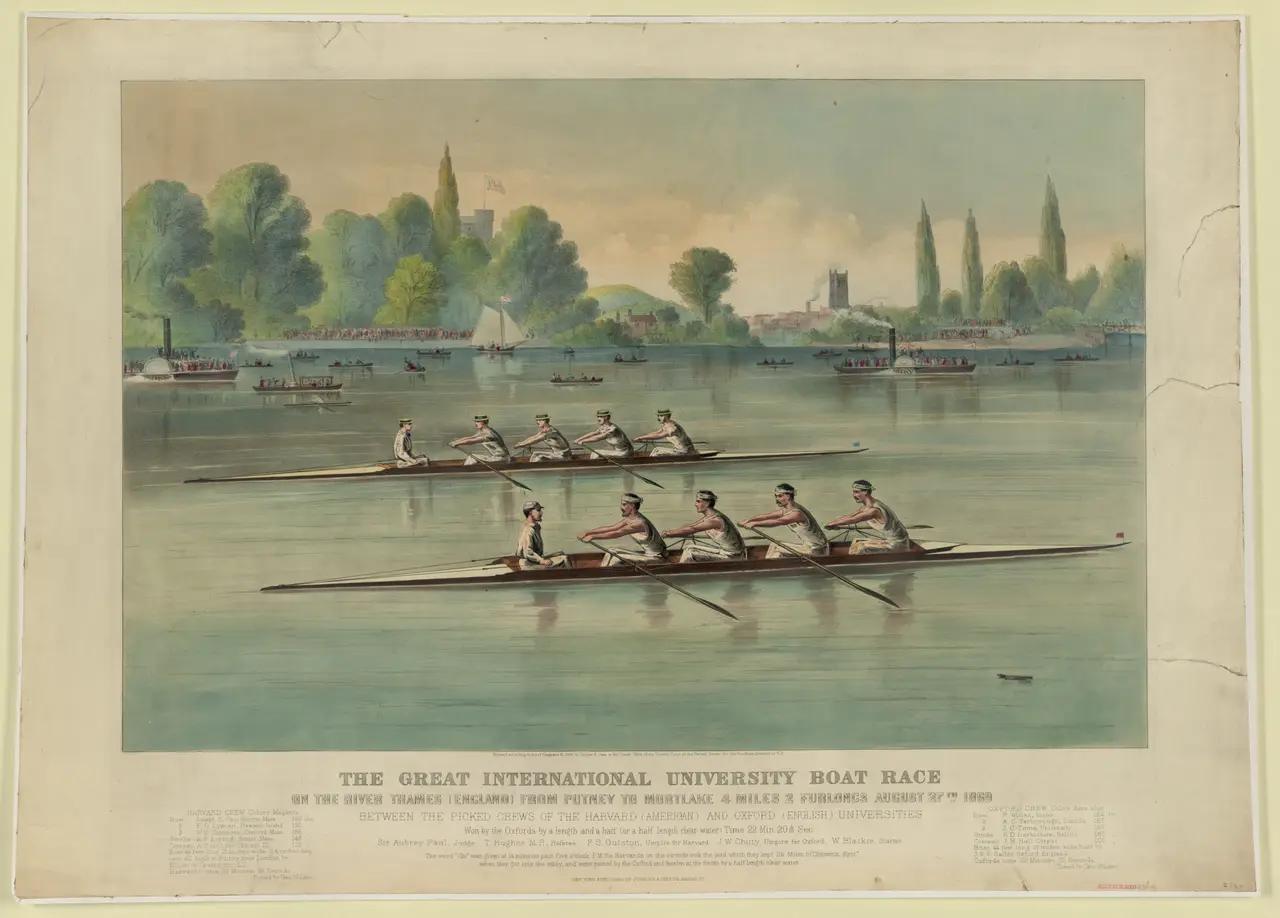
Nobody that day imagined what they had started. The race was rowed again in 1855, and has been held nearly every year since 1859 — making it America's oldest collegiate athletic competition, older than college football's famous "Game" by 23 years. The course stretched to three miles, then four; the venue moved to the Thames River at New London, Connecticut, where both schools built permanent training camps. Harvard's crew would go on to race Oxford on the Thames in 1869, carrying American rowing onto the world stage.
From March Madness to the College Football Playoff, the multibillion-dollar universe of American college sports traces its ancestry to a summer afternoon in 1852, when a few dozen young men in wooden shells raced two miles across a New Hampshire lake — mostly so a railroad could sell train tickets.
Today the Harvard-Yale Regatta is still rowed every June on the Thames River at New London, Connecticut, over a four-mile varsity course, the longest collegiate race in the world. Harvard leads the all-time series, and the 1852 trophy oars, the oldest prize in American college sports, remain in Cambridge. The boats, the river, and the stakes have all grown, but the spirit of that first two-mile dash has never left.
Print: Currier and Ives, public domain (via Wikimedia Commons).