
90 Degrees North: The Nautilus Slips Under the Pole
On August 3, 1958, the nuclear submarine USS Nautilus became the first vessel in history to reach the North Pole, traveling submerged beneath the Arctic ice.
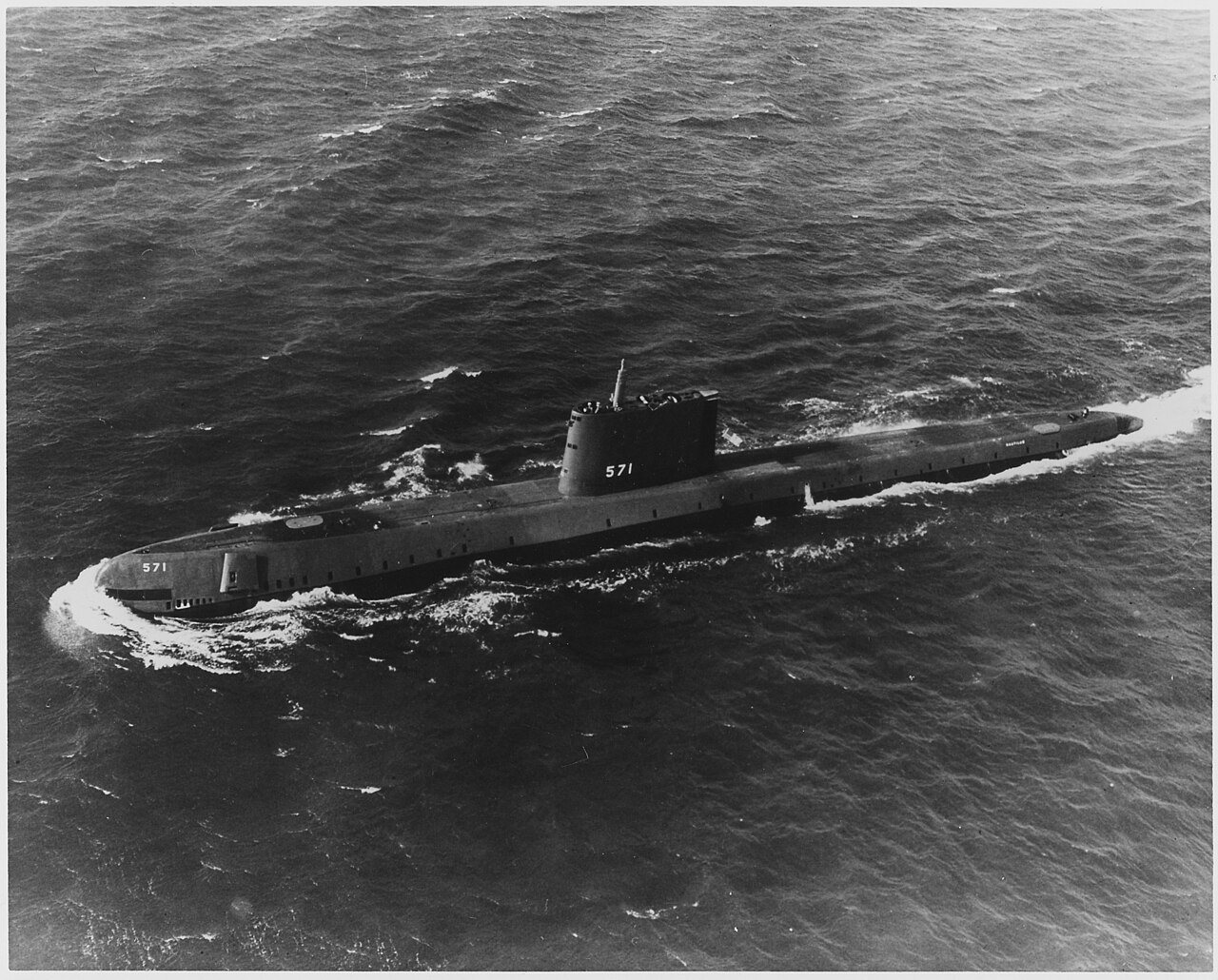
Late on the night of August 3, 1958, 116 men crowded into the control room of a submarine gliding through black water beneath the Arctic ice cap. Far above them lay a frozen wasteland no ship had ever crossed. Their commander, William R. Anderson, picked up the microphone and announced to his crew: "For the world, our country, and the Navy — the North Pole." The USS Nautilus had just become the first watercraft in history to reach the geographic North Pole.
The Nautilus — SSN-571 — was herself a marvel. Conceived under the relentless drive of Captain Hyman G. Rickover, the "Father of the Nuclear Navy," she was the world's first nuclear-powered submarine. Her keel was laid by President Harry S. Truman in Groton, Connecticut, on June 14, 1952; First Lady Mamie Eisenhower christened her on January 21, 1954; and she was commissioned that September. On January 17, 1955, she signaled the historic message "Underway on nuclear power." Her reactor needed no air and almost never needed refueling, so unlike diesel-electric submarines, she could stay submerged for months at a time — the perfect ship for a voyage no one had dared attempt.
The mission, code-named Operation Sunshine, was ordered by President Dwight D. Eisenhower as a technological answer to the Soviet Union's Sputnik satellite, launched the previous October, which had badly shaken American confidence. The plan: sail from the Pacific to the Atlantic by passing directly beneath the North Pole. Nautilus departed Pearl Harbor on July 23, 1958, under top-secret orders. An early attempt through the Bering Strait was turned back by deep drift ice in the shallow water; the crew waited at Pearl Harbor for better conditions, then set course north again. She submerged in the Barrow Sea Valley on August 1, navigated by a special inertial guidance system, and at 11:15 p.m. Eastern time on August 3, her navigator logged the spare, electrifying entry: "Nautilus, 90°N, 19:15U, 3 August 1958, zero to North Pole."
She kept going, surfacing northeast of Greenland after 96 hours and 1,590 nautical miles beneath the ice — the first submerged voyage around the top of the world. A helicopter whisked Commander Anderson to Washington, where on August 8 Eisenhower presented him with the Legion of Merit and announced the crew had earned a Presidential Unit Citation, the first ever awarded in peacetime.
The voyage proved American undersea superiority, opened the Arctic to decades of scientific exploration, and gave a nervous nation exactly the triumph it needed. Decommissioned in 1980, the Nautilus now rests as a museum ship in Groton, Connecticut — the ship that sailed where no ship had sailed before, without ever coming up for air.
Photo: U.S. Navy (via the National Archives), public domain (via Wikimedia Commons).