The Woman Who Stole the Car and Invented the Road Trip
On August 5, 1888, Bertha Benz quietly drove her husband's unproven invention 106 kilometers to Pforzheim — proving to the world that the automobile could actually travel.
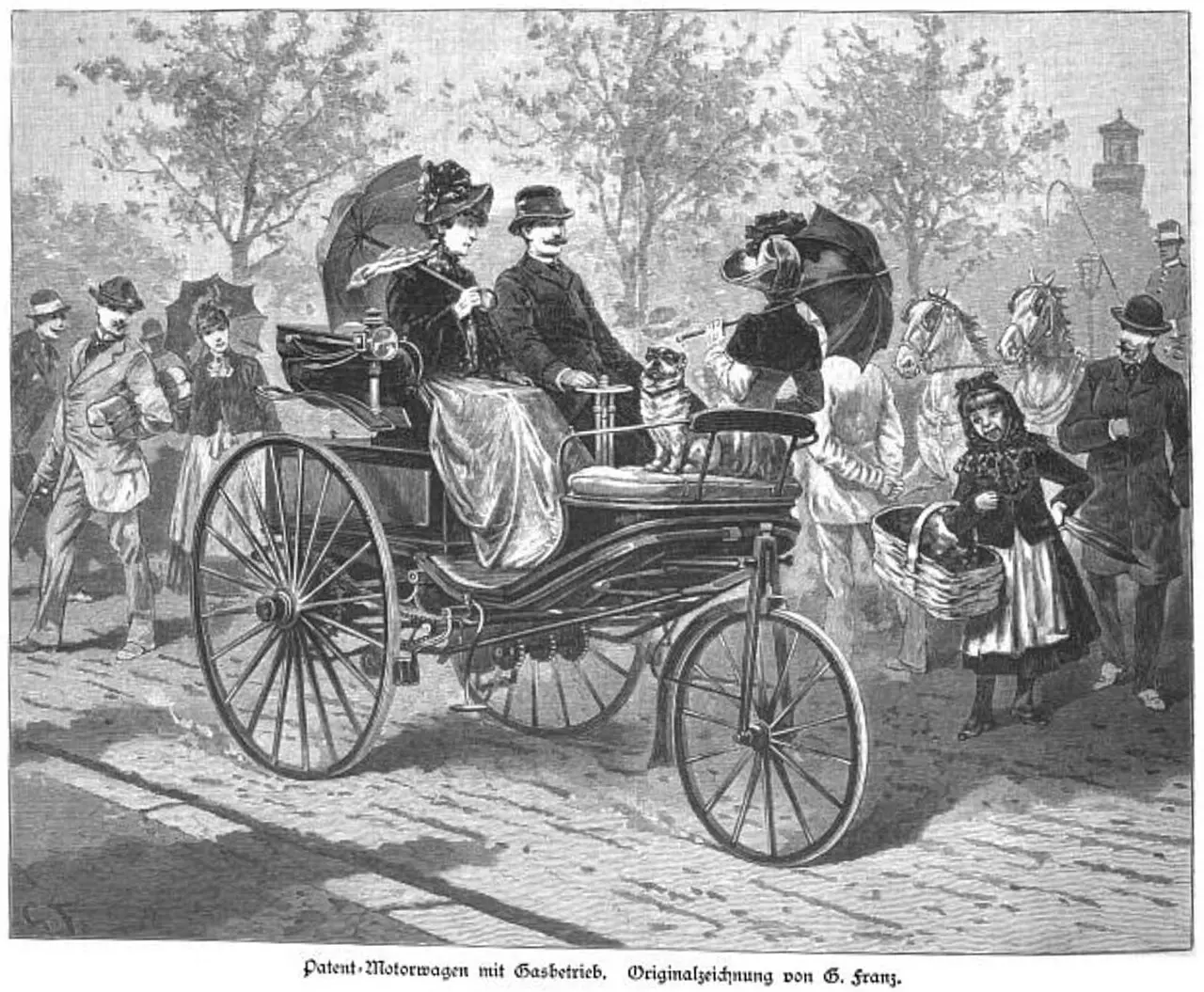
Before dawn on August 5, 1888, in the German city of Mannheim, a 39-year-old woman crept out to her husband's workshop, woke her two teenage sons, and drove off in his car. She did not ask permission. She left a note. And by nightfall, she would change transportation history.
The woman was Bertha Benz, wife of inventor Karl Benz. Two years earlier, Karl had patented the Benz Patent-Motorwagen — a three-wheeled, gasoline-powered machine, protected under Imperial Patent No. 37435 — but he had never tested it over any real distance. His cautious trial runs stayed close to the workshop, and his brilliant invention was going nowhere, commercially or otherwise. Bertha, who had invested heavily in the enterprise, had watched two years of hesitation and apparently reached a conclusion about whose nerve was the limiting factor.
So that morning she set off with her sons Eugen, fifteen, and Richard, thirteen, on a 106-kilometer journey south to visit her mother in Pforzheim. The ostensible purpose was a family visit. The real purpose was to prove the car could travel.
The road fought back at every turn. The engine burned ligroin, a petroleum solvent, and the car carried only a 4.5-litre supply in its carburetor — there were no filling stations in 1888, because no long-distance automobile journey had ever been attempted. In the town of Wiesloch, Bertha walked into the Stadt-Apotheke, the town pharmacy, and bought its entire stock of ligroin. That pharmacy is remembered today as the world's first petrol station.
Then came the repairs. A blocked fuel pipe was cleared with her long hatpin. A frayed ignition wire was insulated with her garter. A stretched drive chain needed a blacksmith's help. And when the long downhill slopes wore the wooden brake blocks dangerously thin, she stopped at a shoemaker and had leather nailed onto them — improvising what amounted to brake linings.
Crowds gathered along the way, some frightened by the horseless machine. Bertha left Mannheim around dawn and reached Pforzheim after nightfall, announcing the achievement to her husband by telegram. She drove back to Mannheim the next day.
The publicity was exactly what she had intended. Bertha reported everything to Karl — every breakdown, every fix — and he improved the design, adding a gear for climbing hills and better brake linings. Orders followed: the Model III made its debut to the wider world at the 1889 World's Fair in Paris, and about twenty-five Motorwagens were built between 1886 and 1893.
Bertha Benz did not invent the automobile — but in a single day she invented the road trip, the test drive, and automotive marketing. Since 2008, the 194-kilometer Bertha Benz Memorial Route has been an officially recognized route of industrial heritage, retracing her tracks from Mannheim to Pforzheim. The first person to drive an automobile a significant distance was not an engineer or a racer. It was a determined mother of two, running on nerve and pharmacy-bought fuel.
Photo: G. Franz, 1888, public domain (via Wikimedia Commons).