
The Tower That Refused to Fall: Work Begins at Pisa, August 9, 1173
On August 9, 1173, workers laid the foundations of Pisa's cathedral bell tower — a project whose famous lean was almost its undoing, then became its glory.
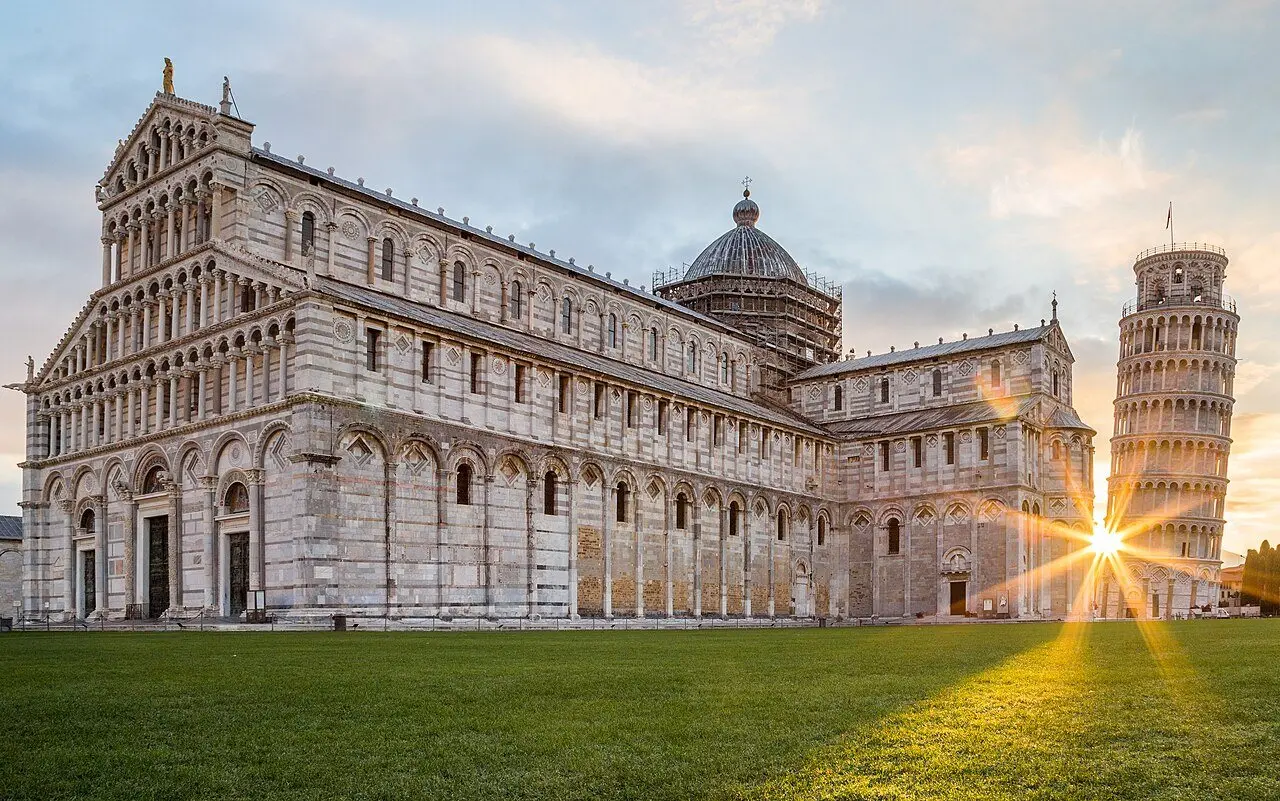
On August 9, 1173, workmen in Pisa, Italy, began laying the foundations of a grand new bell tower for the city's cathedral. The tower was meant to stand tall and straight in the Piazza dei Miracoli — the "Square of Miracles" — as a proud symbol of a wealthy republic. Nobody involved could have guessed that the building's great flaw would become its great fame.
The trouble started early. By 1178, with only a few floors built, the tower began to sink into the soft, sandy ground beneath it. Its foundations were a mere three meters deep — fine for ordinary soil, disastrous for the river silt the builders had chosen. Construction ground to a halt, and because Pisa was soon tangled in wars with Genoa, Lucca, and Florence, the pause stretched for the better part of a century.
That long delay turned out to be the tower's salvation. The soil had time to settle, and when work resumed in the 13th century, the builders pressed on with a bold solution: they simply kept building, curving the upper floors slightly back against the tilt to compensate. The tower was finished in the mid-1300s with its bell chamber — crooked, complete, and still standing.
The tower was built to ring. Its bell chamber holds seven bells tuned to a musical scale. The largest, L'Assunta — "The Assumption," cast in 1654 by Giovanni Pietro Orlandi — weighs about 3,620 kilograms, nearly four tons. The oldest, La Pasquereccia, was cast in 1262, a century before the chamber existed; once named La Giustizia — "The Justice" — its tolling announced capital executions, including Count Ugolino's in 1289.
Another legend grew around the tower in the 1590s, when Galileo Galilei — then teaching mathematics at the University of Pisa — was said to have dropped cannonballs of different masses from its top to prove they fall at the same rate. The story comes only from a 1654 biography by his pupil Vincenzo Viviani, published after both died. Most historians call it a thought experiment: none of Galileo's own writings mention the drop, and his real experiments used inclined planes and pendulums.
For eight centuries the lean kept growing. By 1990 it had reached 5.5 degrees — about five meters off the vertical — and the Italian government closed the tower to the public, fearing collapse. An international rescue followed: engineers fastened cables, stacked counterweights, and carefully extracted soil from beneath the high side. By 2001 the tilt had been eased back to just under 4 degrees, the tower reopened, and monitors watch it still.
The 1990 closure was not the first rescue attempt — only the first to work. An 1838 excavation around the base let water spout from the ground, worsening the tilt. In 1934, Mussolini had engineers drill the foundations and pour in 200 tons of concrete to make it a fit symbol for Fascist Italy; the tower lurched farther south. After Italy's 1964 appeal, drilling attempts in 1966 and 1985 were aborted when they increased the lean. The 1989 collapse of Pavia's Civic Tower — killing four — forced the 1990 closure.
In 1987, the square joined the Piazza del Duomo UNESCO World Heritage Site, alongside the cathedral, baptistery, and cemetery. In World War II the tower nearly became a casualty: Americans suspected German observers inside, and an artillery strike was averted only when U.S. Army Sergeant Leon Weckstein, sent to confirm, refused to call in the guns.
Who designed it? That remains a genuine mystery — a 2001 study points to the architect Diotisalvi, but the true author's name is lost to the 12th century. What is certain is this: a tower that should have failed became one of the most photographed buildings on Earth, drawing millions to Pisa. The lean was a mistake. The survival is the marvel.
Photo: MHoser, CC BY-SA 4.0 (via Wikimedia Commons).