The Night the World Lost Its Princess
In the early hours of August 31, 1997, Diana, Princess of Wales, died from injuries in a Paris car crash — and an unprecedented wave of grief swept the world.
Just after midnight in Paris, Diana, Princess of Wales, left the Ritz hotel with her companion Dodi Fayed, hoping to slip quietly to his apartment. A swarm of paparazzi on motorcycles was waiting. About three minutes later, inside the Pont de l'Alma tunnel, their driver lost control at high speed and struck a concrete pillar.
Dodi Fayed and the driver, Henri Paul, were killed in the impact. Diana, 36 years old, was rushed to the Pitié-Salpêtrière hospital, where she died of her injuries in the early hours of August 31. Her bodyguard, Trevor Rees-Jones, was the sole survivor, seriously injured.
At first the world blamed the paparazzi hounding the car — and the chase was real. But the investigations that followed told a fuller, grimmer story. A French judicial inquiry concluded in 1999 that Henri Paul, the Ritz's deputy head of security, had lost control while intoxicated and under the influence of prescription drugs, and held him solely responsible. In 2008, a British inquest returned a verdict of unlawful killing, citing the grossly negligent driving of both Paul and the pursuing paparazzi. One quiet detail haunted the reports: none of the car's occupants had been wearing seat belts.
What followed was unlike anything in living memory. An international outpouring of grief — mountains of flowers outside Kensington Palace, crowds lining the streets — and a televised funeral on September 6 watched by an estimated 2.5 billion people. Her sons were 15 and 12. The royal family's restrained public response drew sharp criticism, and the institution would spend years reckoning with the gap between the palace and the public.
Diana was buried privately on a small island in a lake at Althorp, her family's estate in Northamptonshire. Conspiracy theories about the crash persisted for years, but the French investigation and Britain's Operation Paget inquiry both dismissed them, standing by the finding of a drunk, speeding driver pursued by photographers.
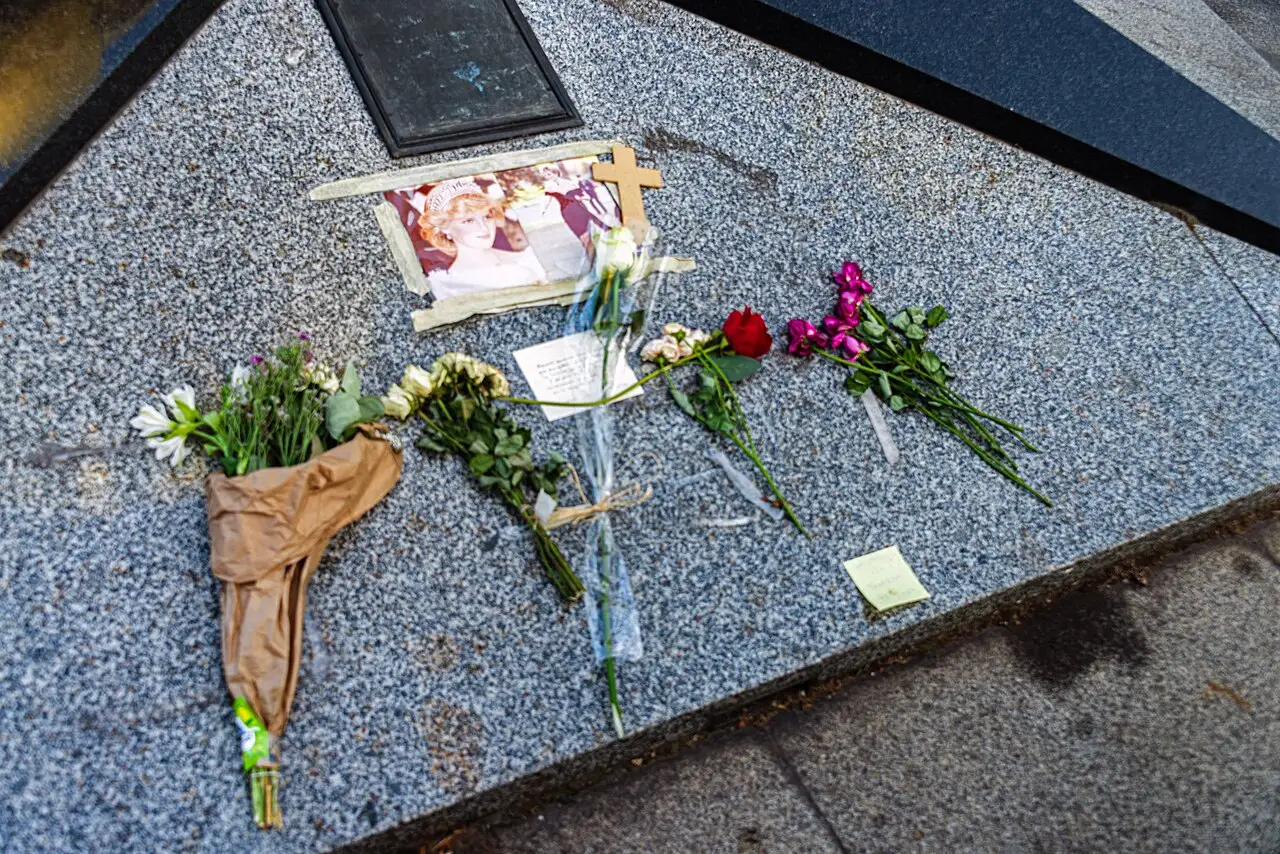
Above the tunnel where she died stands the Flame of Liberty, a full-size replica of the Statue of Liberty's torch. It was never meant as a memorial to Diana — but it became one anyway, covered in flowers, photographs, and messages. Nearly three decades on, people still leave them.
Diana had been the most photographed woman in the world for sixteen years. Born Lady Diana Spencer, she married the Prince of Wales at St. Paul's Cathedral in July 1981 in a ceremony watched by hundreds of millions. The marriage produced two sons and endless headlines, and it ended in divorce in 1996. She had spent the summer of 1997 vacationing in the French Riviera before arriving in Paris the day before the crash, planning a quiet evening at Dodi Fayed's apartment on the Rue Arsène Houssaye.
The morning after, her former husband Prince Charles flew to Paris with Diana's sisters to accompany her coffin home, draped in the Royal Standard, to the Chapel Royal at St. James's Palace. Her funeral on September 6 began with a procession from Kensington Palace to Westminster Abbey, the streets lined with mourners many rows deep.
The grief was genuine, and so was the anger. The press that had hounded Diana for years was blamed; then the driver; then, in darker corners, conspiracies. Mohamed Al-Fayed, Dodi's father, insisted the crash had been orchestrated by British intelligence on royal orders — claims dismissed by both the French investigation and Britain's Operation Paget inquiry, which found no evidence for them.
What endured was a changed relationship between the monarchy and the public. The palace learned, painfully, that reserve could read as coldness. And Diana's sons grew up to carry her causes — William and Harry both becoming patrons of the charities she championed. The princess the tabloids had chased became, in death, the one figure the whole world seemed to agree on: mourned by billions, remembered in flowers that still appear, year after year, at a golden flame above a Paris tunnel.
Photo: Daniel Case, CC BY-SA 4.0 (via Wikimedia Commons).