Seven Shouts of "Merdeka!"
On August 31, 1957, Tunku Abdul Rahman proclaimed Malaya's independence at Stadium Merdeka as a crowd of thousands roared "Merdeka!" — freedom — seven times.
At the stroke of midnight, in the darkened Selangor Club Padang in Kuala Lumpur, the Union Jack came down and a new flag went up. Young members of the Malay, Chinese, and Indian parties that formed the government stood in darkness for two minutes to mark the moment. Then, as the new flag rose, they shouted "Merdeka!" — freedom — seven times.
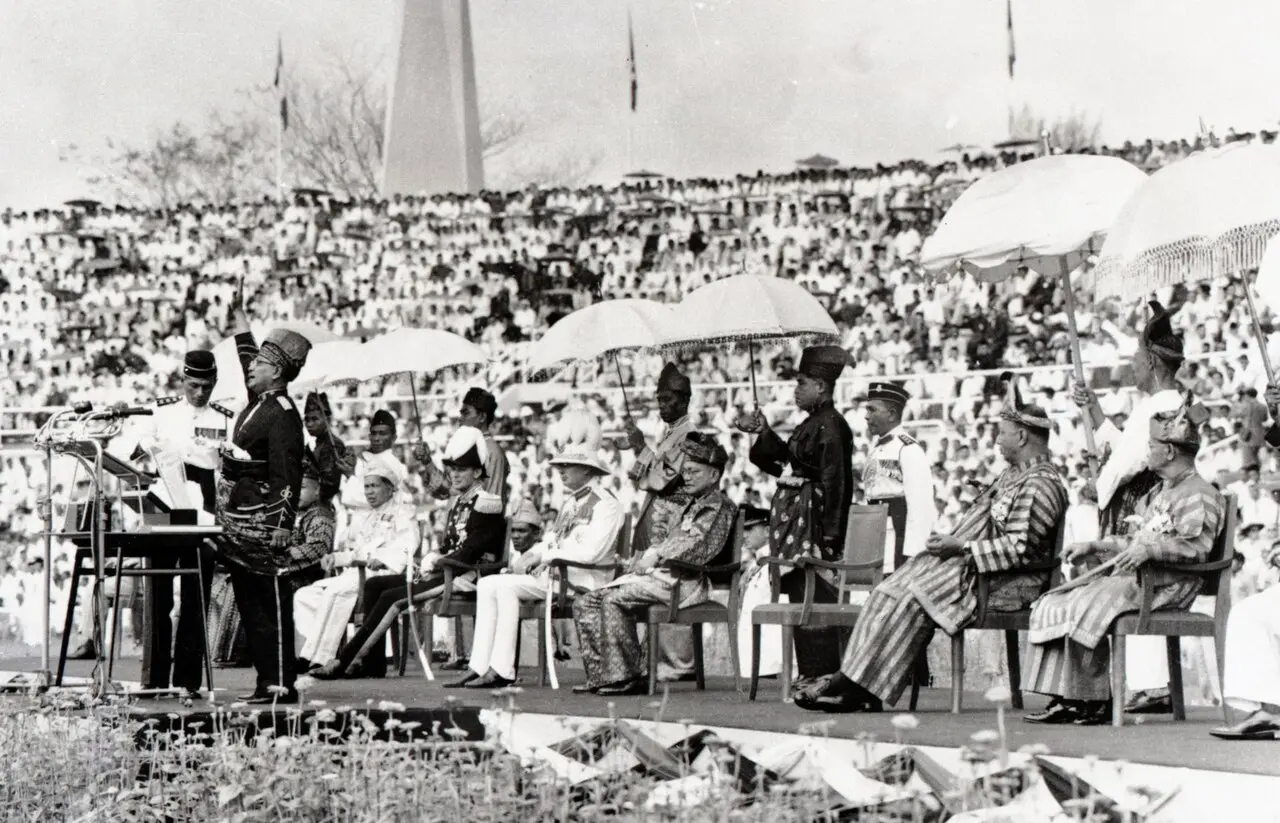
That midnight handover was the quiet prelude. The proclamation came that morning at Stadium Merdeka — Independence Stadium — before thousands of citizens, the Malay rulers in their ceremonial dress, and foreign dignitaries. At 9:30 a.m., Tunku Abdul Rahman, the Federation of Malaya's first chief minister, read the declaration of independence aloud, his voice carrying across the packed stands.
The road to that stadium had run through London. In 1956, Tunku led a Malayan delegation to negotiate independence terms with the British government, and the Alliance Party's string of election victories had convinced London that self-rule was viable. Even the date was chosen with care: Tunku and his colleagues sought the counsel of Syeikh Abdullah Fahim, a respected religious scholar, who declared August 31, 1957 an auspicious day — am khair atana, "a good year has come to us." The next fitting date, he said, would have been five years later.
The proclamation ended British protection over nine Malay states and British rule in the Straits Settlements of Malacca and Penang. Malaya became an independent, democratic federation within the Commonwealth, and Tunku became its first prime minister.
Every August 31 since, Malaysia has celebrated Hari Merdeka — Independence Day — with parades, fireworks, and cultural performances. (It is a different holiday from Malaysia Day on September 16, which marks the 1963 formation of the larger federation of Malaysia.)
The seven shouts in the dark that night have echoed for nearly seventy years: a country that won its freedom not on a battlefield, but at a negotiating table and in a stadium, by acclamation.
The symbolism was everywhere that day. Stadium Merdeka itself had been officially opened only the day before, on August 30, built for the occasion. The next morning it held a crowd that spilled across every seat. When Tunku finished reading the proclamation, the roar of "Merdeka!" rolled across the field seven times.
The days that followed were a blur of firsts. On September 1, Tuanku Abdul Rahman of Negeri Sembilan was installed as the first Yang di-Pertuan Agong, the elected king. On September 2, Malaya was admitted as the 88th member of the United Nations. The first Merdeka Tournament football competition kicked off. A new nation was assembling its institutions at speed.
Tunku Abdul Rahman would lead the country through its most consequential decade. In 1961 he proposed the larger federation that became Malaysia in 1963, joining Malaya with Singapore, Sabah, and Sarawak — and he made the wrenching decision in 1965 to expel Singapore from the federation to preserve stability. He remains known to Malaysians as the Father of Independence.
What August 31, 1957 proved — to Malaya, to Britain, and to colonized peoples everywhere — was that an empire could end without a war. No shots were fired for Merdeka. It was won at a negotiating table in London, blessed by a scholar in Penang, and sealed by seven shouts in a Kuala Lumpur stadium.
Photo: Government of the Federation of Malaya, public domain (via Wikimedia Commons).