The Night Rome Burned
On the night of July 18, 64 AD, a fire broke out in shops near the Circus Maximus and burned for nine days, destroying nearly three-quarters of ancient Rome.
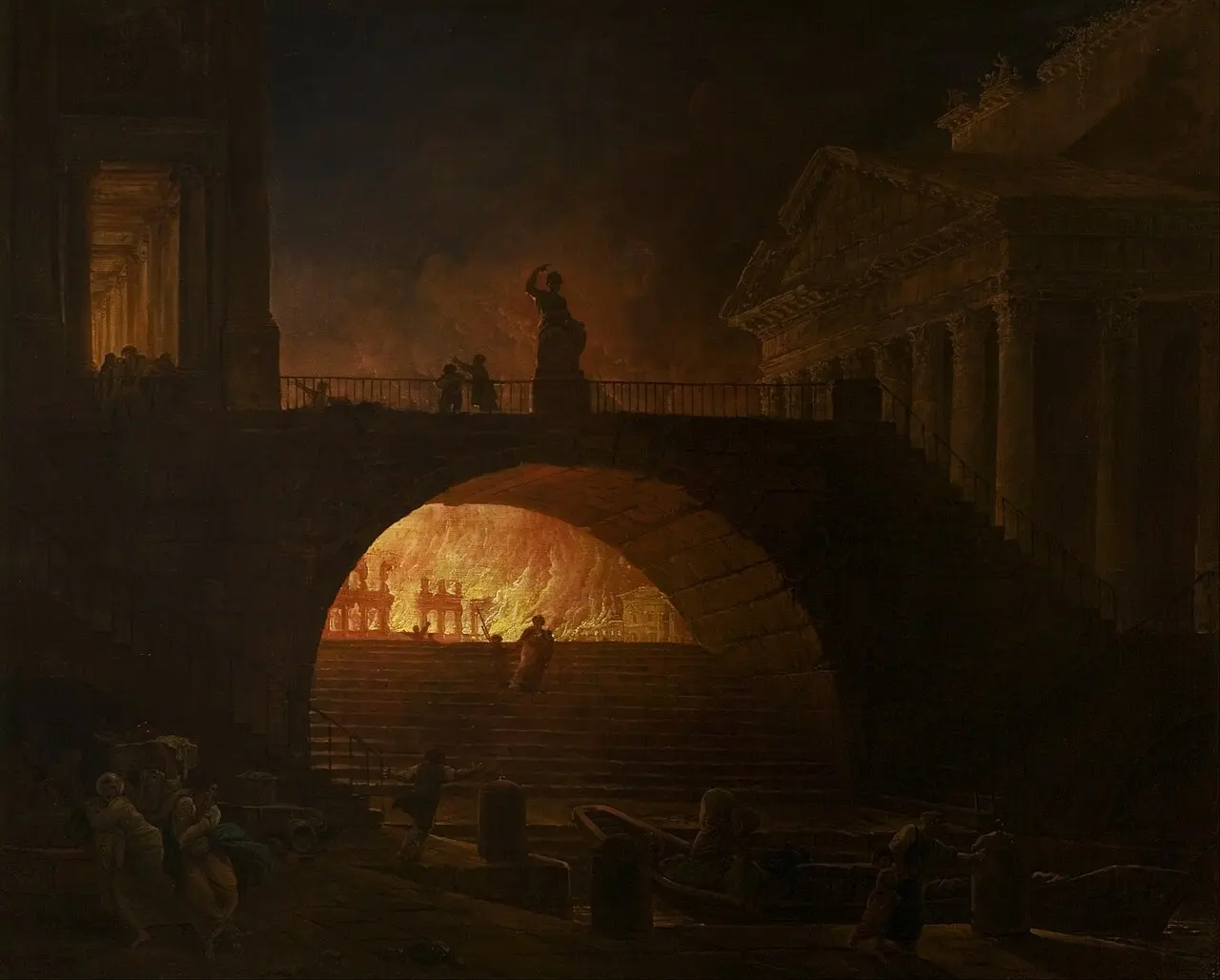
It started in the shops. On the night of July 18 in the year 64, a fire broke out among the merchants' stalls clustered around Rome's Circus Maximus, the great chariot stadium at the foot of the Palatine Hill. Rome was a city of wood — wooden floors, wooden balconies, wooden staircases packed into crowded apartment blocks — and a dry summer wind was blowing. Within hours, the shops were gone. Within days, the city was fighting for its life.
The Roman historian Tacitus, writing a generation later, described a nightmare that ran for six days. The flames raced through narrow streets faster than people could flee, and the city's professional firefighters, the vigiles, were overwhelmed. Just as the fire seemed under control, it reignited and burned for three more days. When it was finally out, the damage was almost beyond comprehension: of Rome's fourteen districts, three were completely destroyed, seven were severely damaged, and only four escaped largely untouched. The death toll was never reliably counted — the records of that week simply didn't survive — but the homeless numbered in the hundreds of thousands.
And then came the rumors. The emperor Nero was thirty miles away at Antium when the fire started — Tacitus is explicit about that — and he rushed back to organize relief, opening his palaces and public buildings to the homeless and arranging emergency food supplies. But suspicion that Nero had ordered the fire to clear land for his own building projects spread anyway. The famous story that he "fiddled while Rome burned" is a myth piled on a myth: the violin wouldn't be invented for another fourteen centuries. What Tacitus actually reports is that Nero sang about the fall of Troy while watching the flames.
Cornered by the rumors, Nero did something monstrous: he blamed Rome's small Christian community for the fire, launching the empire's first persecution of Christians. It was a cynical piece of scapegoating — punish a powerless minority to quiet the mob — and it set a pattern that would repeat across history.
The fire also rebuilt Rome in a literal sense. On the land cleared by the flames, Nero raised his enormous Domus Aurea, the "Golden House," a palace complex so vast it included an artificial lake. After Nero's death, that lake was drained — and on its bed, his successors built the Colosseum, the arena that would become the symbol of Rome itself.
The Great Fire is remembered as a disaster, but it's really a story about how cities and leaders behave under pressure — the relief effort and the rebuilding on one hand, the scapegoating on the other. Nearly two thousand years later, the lesson still holds: in a crisis, it's worth watching what leaders do for the victims, and what they do to the vulnerable.
Image: The Fire of Rome (1785) by Hubert Robert, public domain via Wikimedia Commons.