The Island That Traded 150 Years of Empire for Independence
On September 21, 1964, Malta became an independent nation, ending a century and a half of British rule over the island fortress of the Mediterranean.
Few nations have been fought over like Malta — and on September 21, 1964, this tiny Mediterranean island finally took its future into its own hands.
Malta's story is a parade of empires. Phoenicians, Romans, Arabs, Normans, the Knights of St. John — and, from 1813, the British, who turned the island into a mighty naval fortress. During World War II, Malta endured one of the heaviest sustained bombardments of the war, as Axis bombers tried to starve the island into surrender between 1940 and 1943. The Maltese held on. In April 1942, King George VI awarded the George Cross — Britain's highest civilian honor — to the entire island, "to the island fortress of Malta, its people and defenders." The cross still appears on Malta's flag today.
But wartime loyalty fed postwar ambition. Across the British Empire, the mood was shifting, and Malta's own movement for self-rule gathered force. The island's politicians negotiated hard: Malta's economy had been built around the British military presence, and independence meant building a new future on tourism and trade. After years of talks, the British Parliament passed the Malta Independence Act in 1964, and in May of that year Maltese voters approved a new constitution in a referendum, with about 54.5 percent voting yes.
On September 21, 1964, the Crown Colony of Malta became the independent State of Malta — a constitutional monarchy with Queen Elizabeth II as its sovereign and the Nationalist Party's George Borg Olivier as prime minister. Borg Olivier, whose party had led Malta's government since 1962, had spent years negotiating for exactly this outcome. The Queen visited her newest realm in November 1967, the only visit she ever made as Queen of Malta. That December, the new nation took its seat at the United Nations. A decade later, on December 13, 1974, Malta declared itself a republic within the Commonwealth; the last British forces departed in 1979. The island went on to join the Council of Europe in 1965 and, in 2004, the European Union — a small nation of under half a million people holding its own seat at Europe's tables.
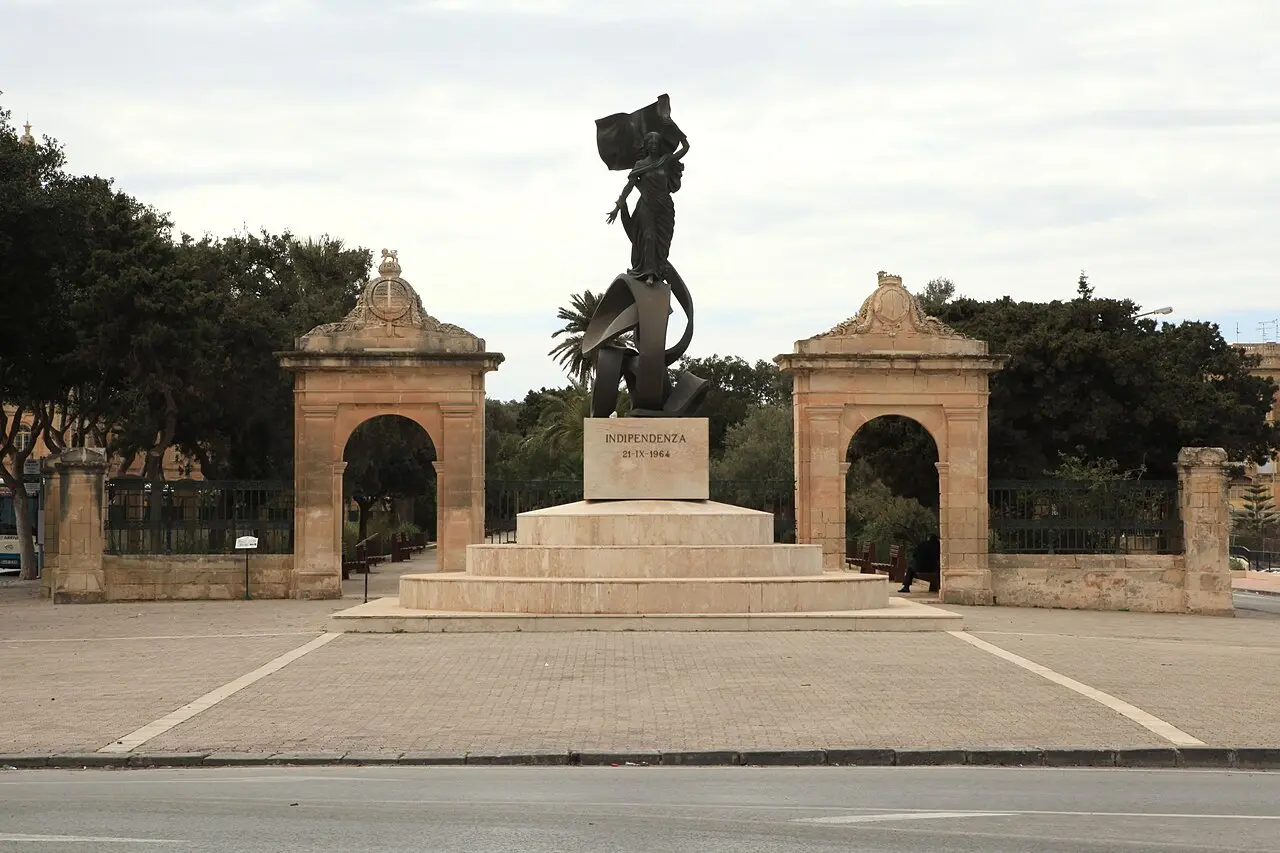
Today, September 21 is celebrated as Independence Day — Jum l-Indipendenza — one of Malta's five national holidays. In Floriana stands a monument to the moment: a figure of Malta breaking free, holding the national flag aloft, inscribed with the date 21-IX-1964.
The island that every empire wanted ended up belonging to the people who had defended it longest. After 150 years under the British flag, Malta finally flew only its own.
Photo: Frank Vincentz, CC BY-SA 3.0, via Wikimedia Commons.