The Handshake That Shook the World
On September 13, 1993, Yitzhak Rabin and Yasser Arafat shook hands on the White House lawn after the signing of the Oslo I Accord, the first agreement between Israel and the PLO.
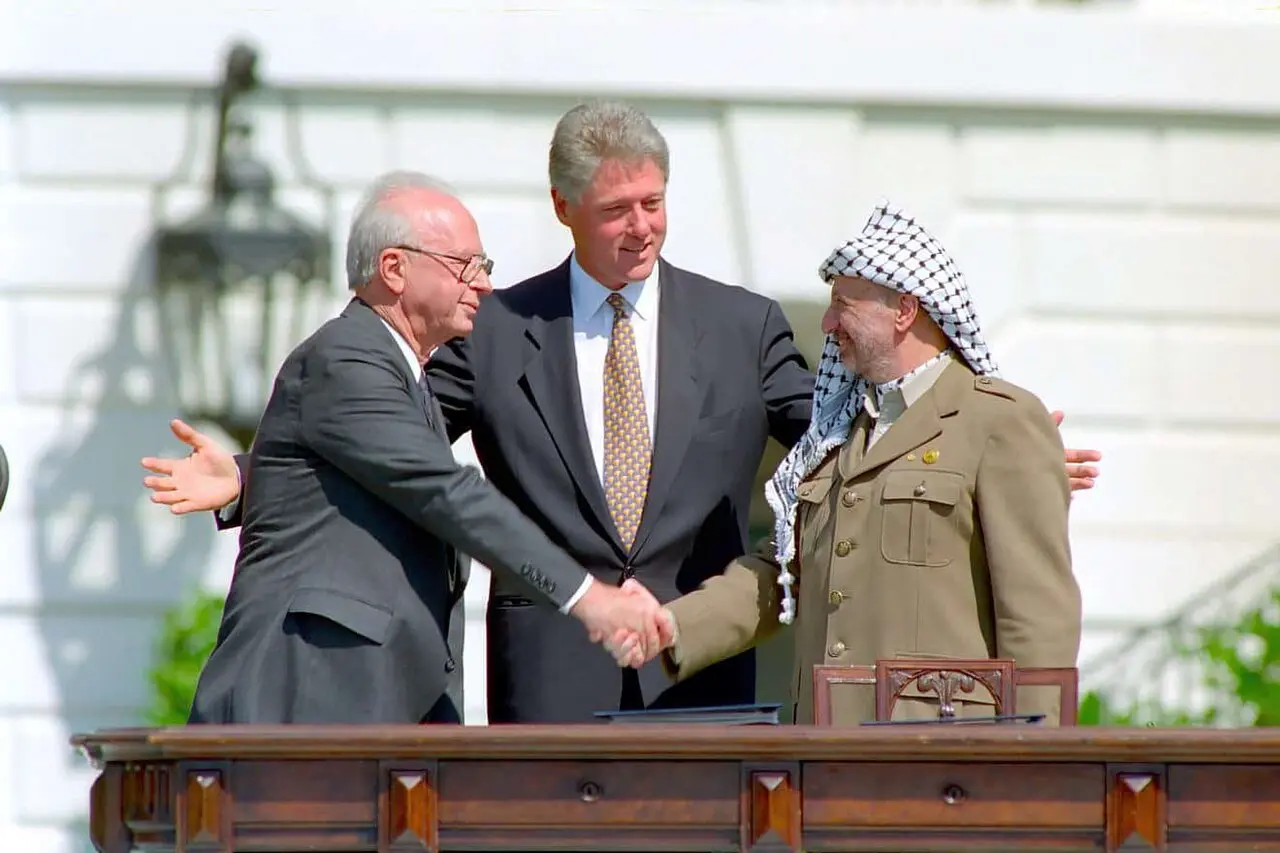
For decades, they had refused to even speak each other's names in public. On a bright September afternoon in 1993, they shook hands on the most famous lawn in America.
The two men were Yitzhak Rabin, the prime minister of Israel, and Yasser Arafat, the chairman of the Palestine Liberation Organization. Between them stood President Bill Clinton, an arm around each man's shoulders, smiling broadly. The image flashed around the world within the hour.
The handshake sealed the Oslo I Accord — formally, the Declaration of Principles on Interim Self-Government Arrangements — the first agreement ever signed between Israel and the PLO. It was the fruit of months of secret back-channel talks held in and around the Norwegian capital, where Norwegian facilitators shuttled between Israeli and Palestinian negotiators who, officially, were not even supposed to be talking. For years Israel had treated the PLO as a terrorist organization beyond the pale; the PLO had refused to recognize Israel's right to exist.
The deadlock broke with two short letters exchanged days before the ceremony. On September 9, Arafat wrote to Rabin recognizing Israel's right to exist in peace and security and renouncing terrorism. The next day, Rabin replied, recognizing the PLO as the representative of the Palestinian people. With mutual recognition on paper at last, the agreement itself could be signed.
The accord was deliberately a beginning, not an ending. It laid out a five-year interim period leading toward Palestinian self-government, starting with the Gaza Strip and the West Bank town of Jericho, from which Israeli forces would withdraw. The hardest questions — Jerusalem, borders, refugees, the shape of a final peace — were all deferred to later negotiations. Few of the thousands watching on the lawn, or the millions watching on television, dwelled on the fine print that afternoon.
The signatures themselves belonged to others: Israel's foreign minister Shimon Peres and the PLO's Mahmoud Abbas signed the document, with the American and Russian foreign ministers looking on. But the moment the world remembers is the handshake. Rabin, the former general who had spent his career fighting Israel's wars, took the hand of the man he had long refused to recognize — with the president of the United States holding the two of them together.
The following year, Rabin, Peres, and Arafat shared the Nobel Peace Prize. The accord created the Palestinian Authority and, for the first time in history, put Israelis and Palestinians on a negotiated path toward resolving their conflict.
Why does it matter? A handshake does not end a conflict, and the lasting peace the Oslo process promised never arrived. Rabin himself was assassinated two years later by an Israeli extremist opposed to the accords. But September 13, 1993, proved something that had seemed impossible only months before: that enemies who would not speak to each other could sit down, recognize each other, and sign their names to the same page. Every negotiation since has started from ground that handshake broke.
Photo: Vince Musi / The White House, public domain (via Wikimedia Commons).