The Genius Born in a Tuscan Hill Town
On April 15, 1452, Leonardo da Vinci was born in the Tuscan hill town of Vinci — the illegitimate son of a notary who became the most versatile genius of the Renaissance.
In a farmhouse in the Tuscan hills, in the small hours of April 15, 1452, the most versatile mind in Western history was born — and nobody noticed.
Leonardo da Vinci entered the world "at the third hour of the night," as his grandfather dutifully recorded, in Vinci — or possibly the nearby hamlet of Anchiano — a hill town about 35 kilometers from Florence. He was born out of wedlock to Ser Piero da Vinci, a Florentine notary, and a peasant woman named Caterina. His full birth name was simply Leonardo di ser Piero da Vinci: Leonardo, son of Ser Piero, from Vinci. The exact house is still debated; the traditional account, from local oral tradition, puts it in Anchiano.
He spent his first five years with his mother in that hamlet, then moved into his father's household in Vinci, living with his grandparents and his uncle Francesco, surrounded by the Tuscan countryside he would sketch all his life. His schooling was informal — Latin, geometry, a little mathematics — and in his own notes he recorded only two childhood memories: a kite that dropped from the sky to hover over his cradle, its tail feathers brushing his face, which he took as an omen; and a dark cave he found while exploring the mountains, before which he stood torn between terror of what might lurk inside and curiosity to know.
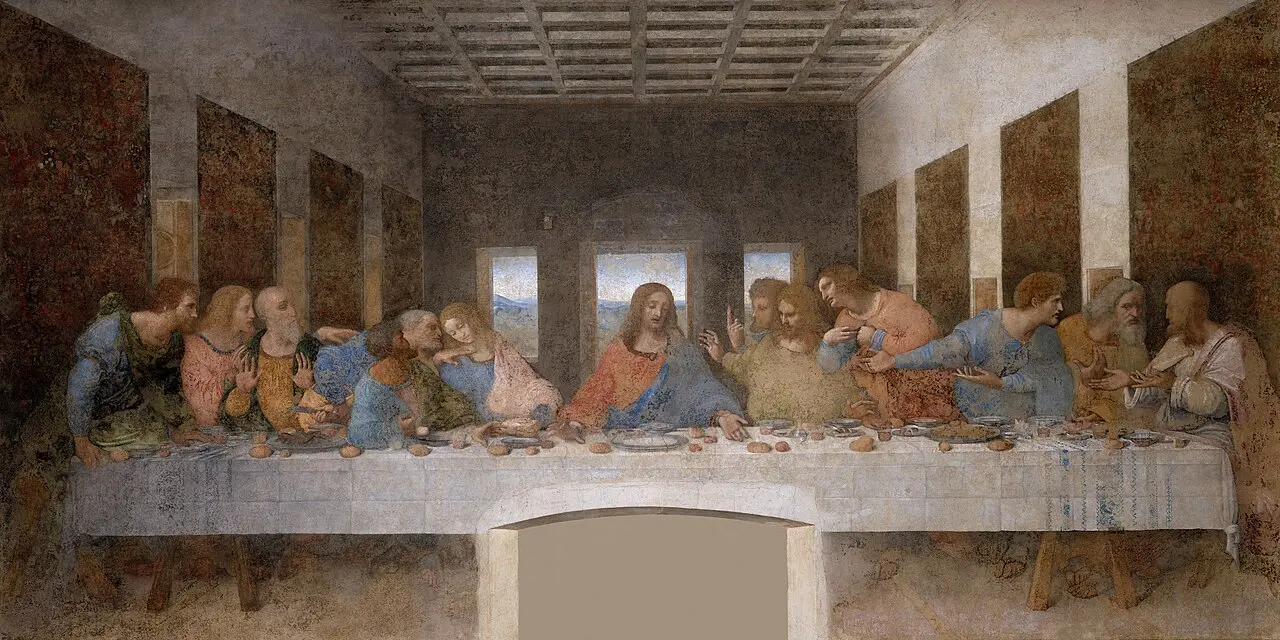
At fourteen or fifteen, his father apprenticed him to Andrea del Verrocchio, the leading sculptor and painter of Florence. By twenty he was enrolled in the painters' guild of Saint Luke; by 1478 he was an independent master. Then came Milan, the Sforza court, and the works that made him immortal: The Last Supper, painted on the wall of a Milanese convent in the 1490s; the Mona Lisa, carried with him for years and never quite finished; and some 2,500 surviving notebook pages of anatomy, engineering, optics, hydraulics, and flying machines — discoveries he never published, and which therefore changed no one's science but his own.
He spent his final years in France as the honored guest of King Francis I, living at the Château de Cloux near Amboise, and died there on May 2, 1519. Art historians call him the father of the High Renaissance, but the title undersells him: painter, sculptor, architect, engineer, anatomist, inventor — no one before or since has been so gifted at so many things.
From an illegitimate birth in a Tuscan farmhouse to the most famous smile on Earth: Leonardo's life is the great proof that genius can arrive unannounced, anywhere — even at the third hour of the night, on April 15, 1452.
Photo: Leonardo da Vinci, public domain (via Wikimedia Commons). A restored view of The Last Supper — shown as an illustration, not an image of the artist or his birthplace.