The Fleet That Sailed for India and Found Brazil
On April 22, 1500, Pedro Álvares Cabral's India-bound fleet sighted Brazil and claimed it for Portugal, setting the course for the only Portuguese-speaking nation in the Americas.
On the morning of April 22, 1500, lookouts on a Portuguese flagship spotted something no European map showed: a mountain rising out of the western Atlantic. The fleet's commander, Pedro Álvares Cabral, had left Lisbon six weeks earlier with thirteen ships and some 1,200 men, bound for the spice markets of India. Instead, he was about to hand Portugal the largest country in South America.
Cabral was never supposed to be anywhere near South America. King Manuel I had chosen the nobleman, then in his early thirties, to follow up Vasco da Gama's history-making 1498 voyage around Africa to Calicut. The fleet sailed from the mouth of the Tagus on March 9, 1500, swinging far southwest into the Atlantic to catch the winds and currents of the volta do mar — the great looping route Portuguese navigators had perfected. Whether that swing carried the ships farther west than planned by accident, or because Portugal already suspected land lay there, historians still debate.
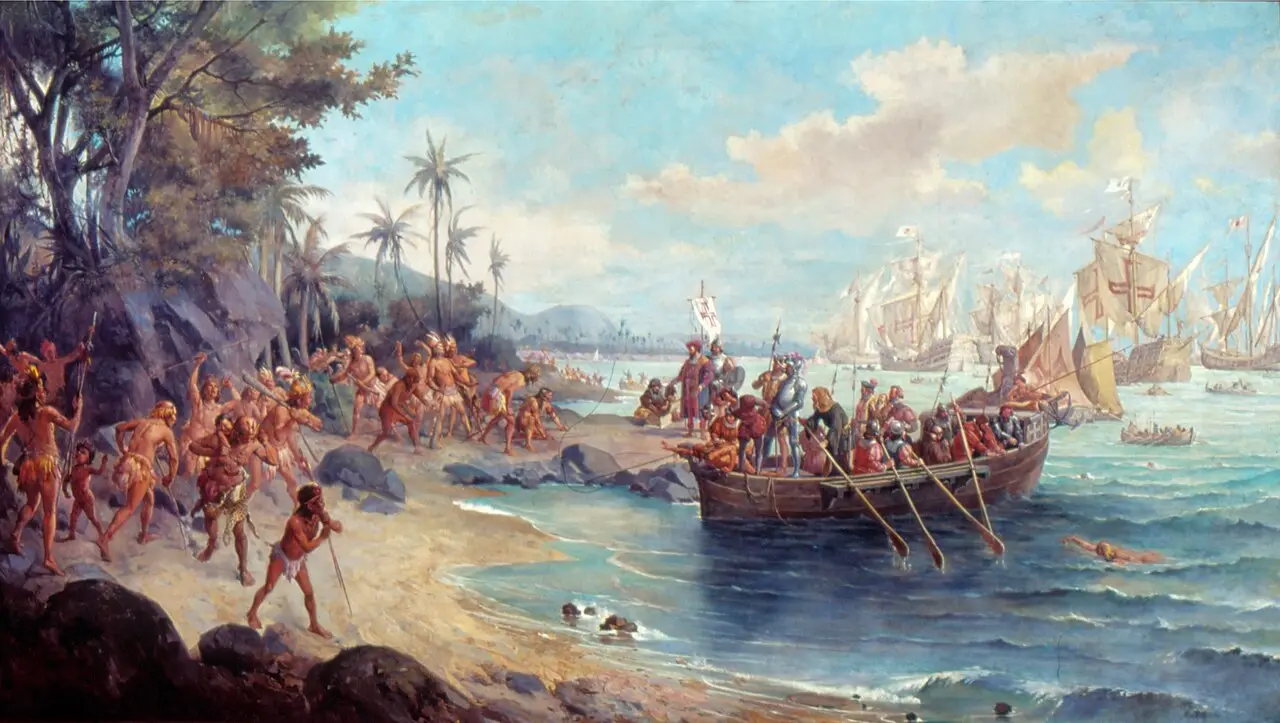
What is certain is what happened next. The mountain the lookouts sighted — Cabral named it Monte Pascoal — rose over the coast of what is now the Brazilian state of Bahia. Thinking he had found an island, Cabral named it Ilha de Vera Cruz, the Island of the True Cross, and claimed it for Portugal. Sailing north along the coast, the fleet anchored in a sheltered bay he called Porto Seguro, the Safe Harbor. The ships would remain about eight days, trading peacefully with the Tupiniquim people who came down to the shore, while the Franciscan friar Frei Henrique Soares de Coimbra celebrated Mass on the beach — the first Catholic Mass in what would become Portuguese America.
Cabral could not linger. India was the prize, and on May 2 the fleet sailed on, leaving behind a supply ship carrying the news to Lisbon — including the famous letter of Pero Vaz de Caminha, dated May 1, 1500, describing the new land, its people, and its parrots in vivid detail. It remains one of the founding documents of Brazilian history. And under the 1494 Treaty of Tordesillas, which had divided the unknown world between Spain and Portugal, the new territory fell on Portugal's side of the line anyway.
A word about the word "discovery." The land Cabral claimed was already home to numerous Indigenous peoples, and a Spanish expedition under Vicente Yáñez Pinzón had touched the Brazilian coast that January — the oldest confirmed European landing there. Many Brazilians today call April 22 the day of the invasion, not the discovery. Both things are true at once: it was a beginning for Portugal, and an ending for the world that had been there first.
That eight-day stopover bent the history of a hemisphere. Portugal poured settlers, sugar plantations, and enslaved Africans into the territory, and the result is the Brazil we know: the only country in the Americas that speaks Portuguese, a culture forged — from samba to feijoada — in the collision that began on a beach at Porto Seguro.
Photo: Oscar Pereira da Silva, public domain (via Wikimedia Commons).