
The Day the Planet Got a Voice: The First Earth Day
On April 22, 1970, some 20 million Americans took to the streets in the first Earth Day, launching the modern environmental movement.
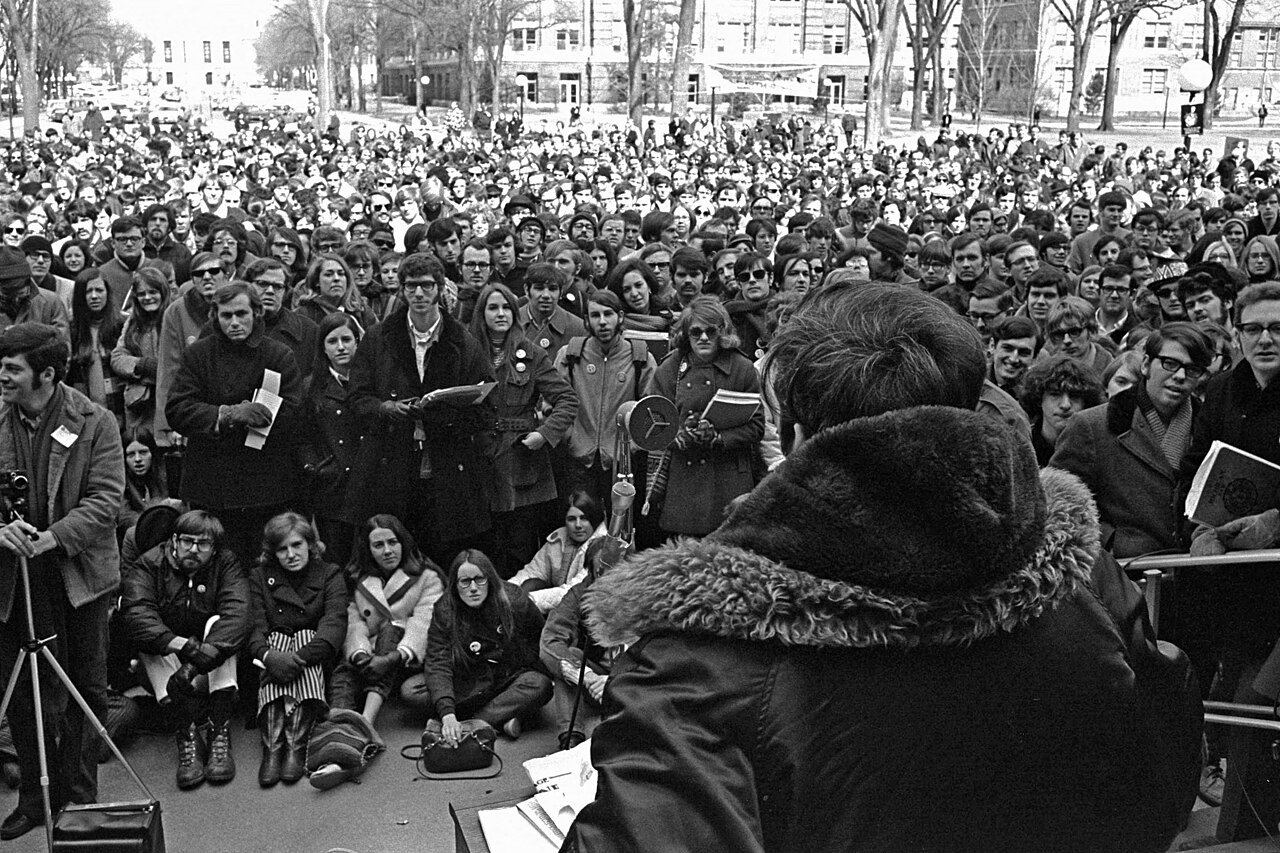
On a Wednesday morning in April 1970, New York City did something unthinkable: it closed Fifth Avenue to cars. Students marched down highways in Takoma, Washington, on horseback. From 2,000 college campuses to 10,000 schools to hundreds of towns, an estimated 20 million Americans — roughly one in ten people in the country — gathered for the first Earth Day.
The idea belonged to Senator Gaylord Nelson of Wisconsin. For most of the 1960s, Nelson had watched the country's air grow filthy and its rivers catch fire — literally. The Cuyahoga River in Cleveland had burned more than once from the oil and industrial waste coating its surface, and a massive oil spill off California's coast in January 1969 had coated beaches in crude. In 1963 he had even convinced President John F. Kennedy to tour the country talking about conservation. Nothing moved the needle.
Then, in 1969, Nelson noticed the antiwar teach-ins sweeping college campuses and had a thought: why not teach-ins for the environment? That September he charged his staff with organizing nationwide campus teach-ins for the following spring. They would be grassroots, not top-down. To run the effort they recruited a 25-year-old Harvard law student and activist, Denis Hayes, as national coordinator, and California Republican Congressman Pete McCloskey signed on as co-chair.
April 22 was chosen for practical reasons, not symbolic ones — it fell on a Wednesday between spring break and final exams, when the most students would be on campus. When critics noted it was also Vladimir Lenin's birthday, Nelson replied that it was also the birthday of the "first environmentalist," Saint Francis of Assisi.
Nobody expected what happened. "The reason Earth Day worked is that it organized itself," Nelson later told the New York Times. "The idea was out there and everybody grabbed it."
The political payoff was swift and real. By the end of 1970, the United States had a brand-new Environmental Protection Agency and the landmark Clean Air Act. Within three years came the Clean Water Act and the Endangered Species Act. Concern for the environment, once a fringe issue, had leapt to the top of public opinion — one 1971 poll found 78 percent of Americans willing to pay to clean up their air and water.
Today Earth Day is observed by more than a billion people in some 180 countries. It began with a senator, a student, and a Wednesday in April.
Photo: University of Michigan School for Environment and Sustainability, CC BY 2.0 (via Wikimedia Commons).