The British Museum Opens Its Doors to the World
On January 15, 1759, the British Museum opened in a Bloomsbury mansion as the world's first free national public museum, founded on a doctor's 71,000-object collection.
On January 15, 1759, a handful of ticket-holding Londoners climbed the steps of a 17th-century mansion in Bloomsbury and walked into history. The British Museum had opened its doors — the world’s first free national public museum.
The museum owed its existence to one man’s collecting habit and one Parliament’s ambition. Sir Hans Sloane, a physician, naturalist, and president of the Royal Society, had spent a lifetime amassing some 71,000 objects: books, manuscripts, coins, plants, and curiosities from around the world. When he died in 1753, he bequeathed the collection to the nation in exchange for a payment of £20,000 to his heirs, on the condition that it be kept together and open to public view.
Parliament accepted. The British Museum Act of 1753 founded the museum and paid for Montagu House — a grand old mansion on Great Russell Street — with money raised by a public lottery. In January 1759 the trustees opened it to “all studious and curious persons.”
But “free” came with strings attached. Visitors had to apply in writing and be approved; admission was by ticket only; and guests were escorted through the rooms by museum officers rather than allowed to wander freely. The trustees were openly nervous about the lower classes — no drunks allowed — and the staff were forbidden from accepting tips. It was a democratic ideal filtered through 18th-century snobbery, and the rules would not be truly relaxed until the 1830s.
Inside, the first galleries were dominated by Sloane’s library on the ground floor and his natural history specimens on the floor above. The collection soon grew: Parliament added the Cotton and Harleian manuscript collections, and in 1772 the museum bought its first great trove of antiquities. Montagu House eventually proved too small; it was demolished and replaced by the grand neoclassical building, designed by Sir Robert Smirke, that stands on the site today.
The idea outgrew its building, too. The natural history collections spun off into what is now the Natural History Museum in 1881, and the library became the British Library in 1973. But the principle laid down on that January day — that a nation’s treasures belong to everyone, free of charge — became the template for public museums around the world.
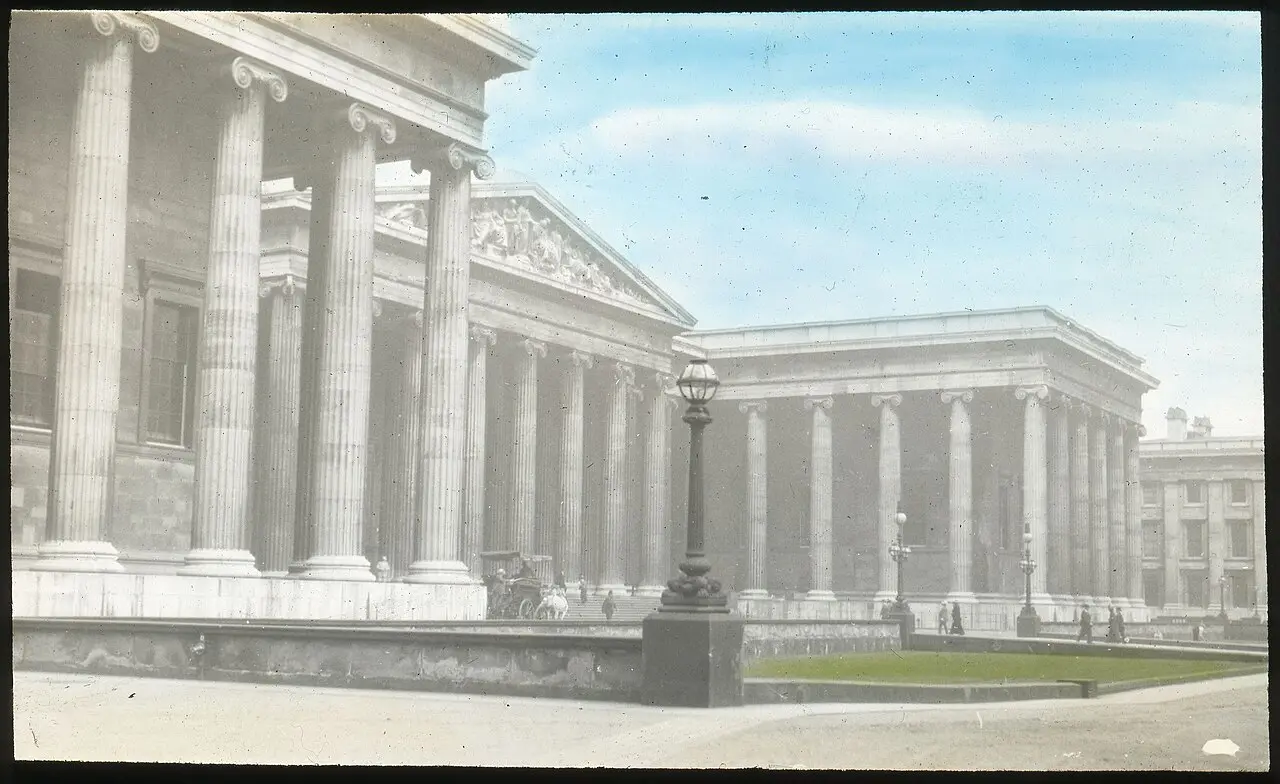
Photo: Edmund F. Arras, public domain (via DPLA and Wikimedia Commons). Illustrative rather than contemporaneous: a hand-colored 1913 lantern slide of the museum’s front courtyard; the 1759 museum opened in Montagu House, which was replaced by the present building in the 19th century.