The Book That Changed the World
On November 24, 1859, Charles Darwin's On the Origin of Species went on sale in London — 1,250 copies that sold out on the first day.
On Thursday, November 24, 1859, London booksellers put a new volume on their shelves: On the Origin of Species by Means of Natural Selection. It cost fifteen shillings and argued — politely, methodically, devastatingly — that all living things are related by descent, shaped over eons by natural selection. The first printing of 1,250 copies sold out that very day.
Its author, Charles Darwin, had been sitting on the idea for more than twenty years. His voyage aboard HMS Beagle had given him his first clues; reading Thomas Malthus on population in 1838 had given him the mechanism. But Darwin, a cautious man, kept his notebooks private while he amassed evidence.
He was forced into the open in June 1858, when a letter arrived from the naturalist Alfred Russel Wallace, working in the Malay Archipelago — describing, independently, the same theory of evolution by natural selection. Darwin's friends Charles Lyell and Joseph Hooker arranged for Wallace's paper and Darwin's own notes to be read together before London's Linnean Society on July 1, 1858, and then urged Darwin to write the whole thing up. What he produced, at his home at Down House in Kent, was the book he called an "abstract" of a much larger work: some 155,000 words, aimed not at specialists but at the reading public.
The publishers had offered it to booksellers two days earlier, at John Murray's autumn sale on November 22 — and every available copy was snapped up. Mudie's, the great circulating library, took 500 alone. Darwin was stunned by the appetite for his dangerous idea.
The book detonated across Victorian society. Darwin kept revising: a second edition of 3,000 copies followed in January 1860, and by the fifth edition of 1869 he had adopted Herbert Spencer's phrase "survival of the fittest." Six editions appeared in his lifetime, each answering the critics.
Darwin kept one explosive topic nearly out of the book altogether: human beings, whose origin was left to a single coy hint that light would be thrown on man's history. He saved that argument for his 1871 work, The Descent of Man. For the rest of his life he continued experimenting at Down House — with climbing plants, earthworms, and pigeons — publishing book after book until his death in 1882.
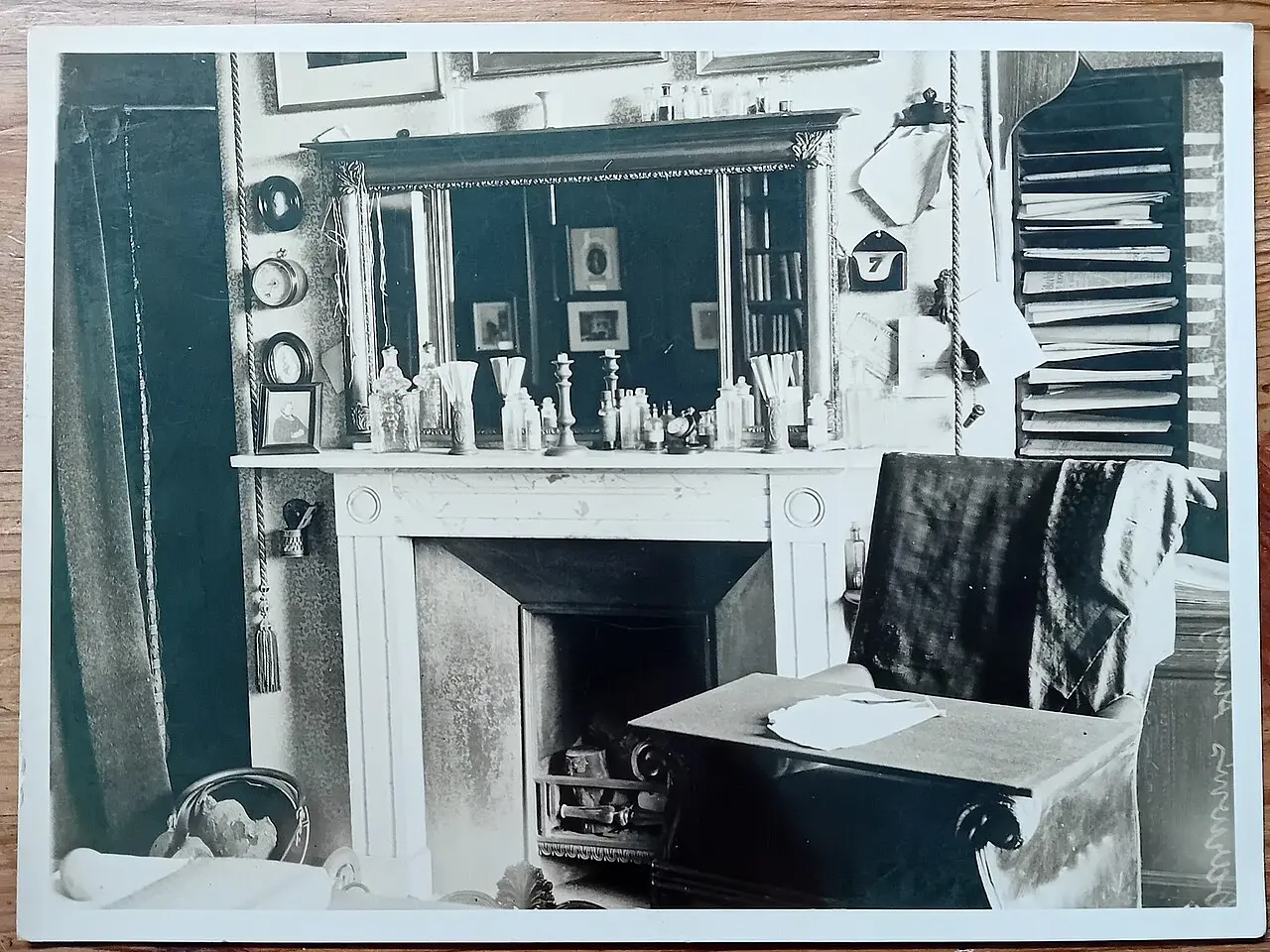
The idea he published on a November Thursday in 1859 — that humans, finches, and barnacles all share common ancestors — became the foundation of modern biology. The photograph above shows the study at Down House where much of it was written.
Photo: unknown photographer, public domain (via Wikimedia Commons).