
LBJ Signs the Civil Rights Act of 1964
On July 2, 1964, President Lyndon B. Johnson signed the Civil Rights Act, outlawing segregation and employment discrimination across America.
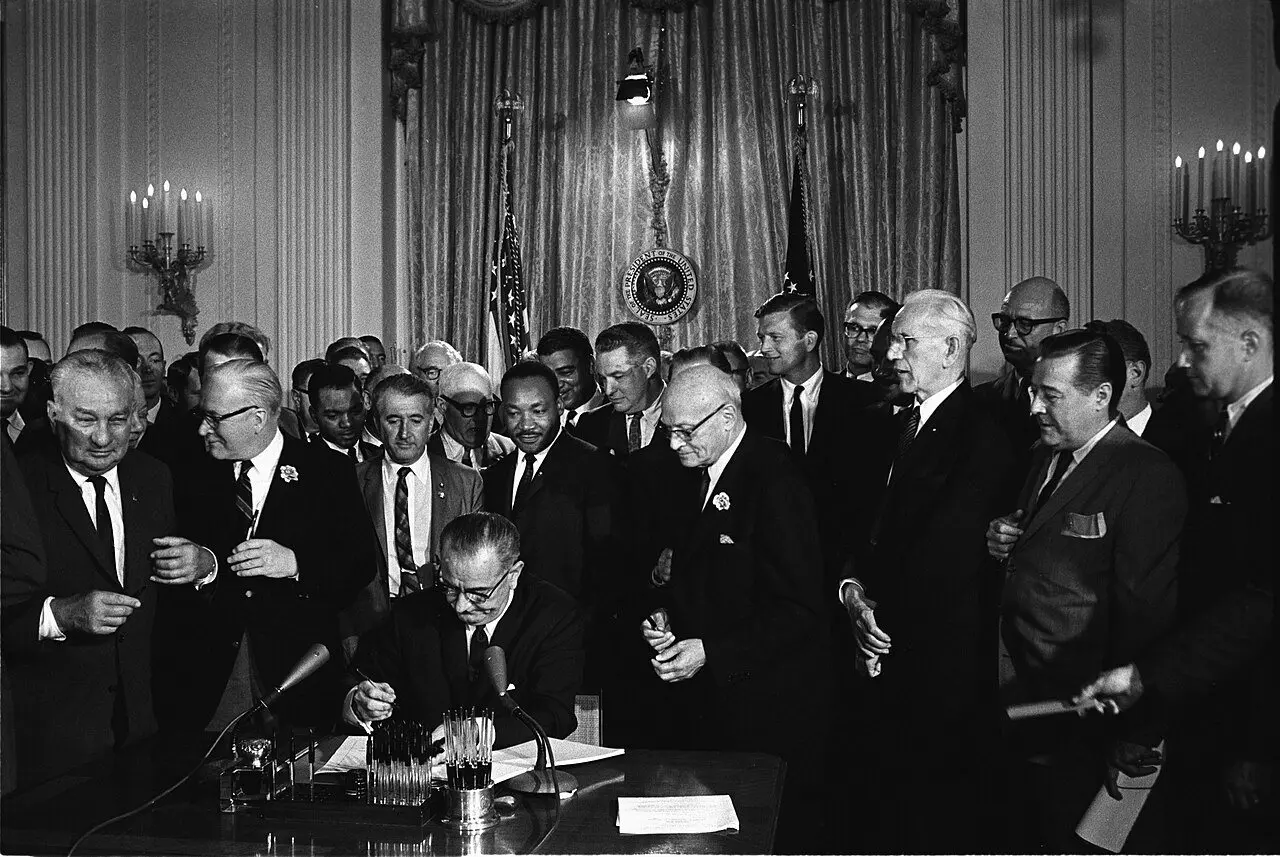
The cameras were rolling in the East Room of the White House on the evening of July 2, 1964, when President Lyndon B. Johnson picked up a pen and signed the most sweeping civil rights law since Reconstruction. Standing directly behind him, looking over his left shoulder, was the Rev. Dr. Martin Luther King Jr.
The road to that desk ran through Birmingham, Alabama. In the spring of 1963, television cameras captured police dogs and fire hoses turned on peaceful demonstrators, and the images shocked the nation. On June 11, 1963, President John F. Kennedy went on national television and demanded a strong civil rights bill, calling the issue a moral one: "The heart of the question is whether all Americans are to be afforded equal rights and equal opportunities."
Kennedy's bill stalled in Congress. Then, on November 22, 1963, Kennedy was assassinated in Dallas, and Johnson — a Texan who had mastered the Senate as its majority leader — made the fallen president's bill his own crusade. He enlisted civil rights leaders and key lawmakers from both parties, including Republican Senate leader Everett Dirksen, who broke with his party's Southern wing to call the bill "an idea whose time has come."
The fight was brutal. Southern senators filibustered for 72 days before supporters mustered the votes to cut off debate on June 10. The Senate passed the bill 73 to 27 on June 19, exactly one year after Kennedy had proposed it; the House, which had passed its version 290 to 130 back in February, agreed to the Senate's changes.
The law's eleven titles reached into nearly every corner of American life. It outlawed segregation in public places — restaurants, hotels, theaters. It banned discrimination in employment on the basis of race, color, religion, sex, or national origin, and created the Equal Employment Opportunity Commission to enforce it. It barred discrimination in programs receiving federal money and strengthened protections against school segregation and biased voter registration. For the first time since the Civil War amendments, the federal government had real tools to enforce the promises of the 13th, 14th, and 15th Amendments.
At the signing, Johnson told the nation the law meant that Americans "equal before God shall now also be equal in the polling booths, in the classrooms, in the factories, and in hotels, restaurants, movie theaters, and other places that provide service to the public."
The ink was barely dry before the law was tested — and upheld. The Supreme Court affirmed Congress's power to ban discrimination in public accommodations, and lunch counters and hotels across the South began to open their doors. The act became the foundation for the Voting Rights Act of 1965 and decades of anti-discrimination law; in 2020, the Supreme Court ruled that its ban on sex discrimination in employment also protects gay and transgender workers.
More than sixty years later, the Civil Rights Act of 1964 remains the single most consequential piece of domestic legislation of the twentieth century — the moment the federal government finally put the full weight of the law behind the promise that all Americans are equal.
Photo: public domain (via Wikimedia Commons).