How One Signature Ended France's Religious Wars
On April 13, 1598, King Henri IV of France signed the Edict of Nantes, granting religious toleration to the Huguenots and ending nearly four decades of religious war.
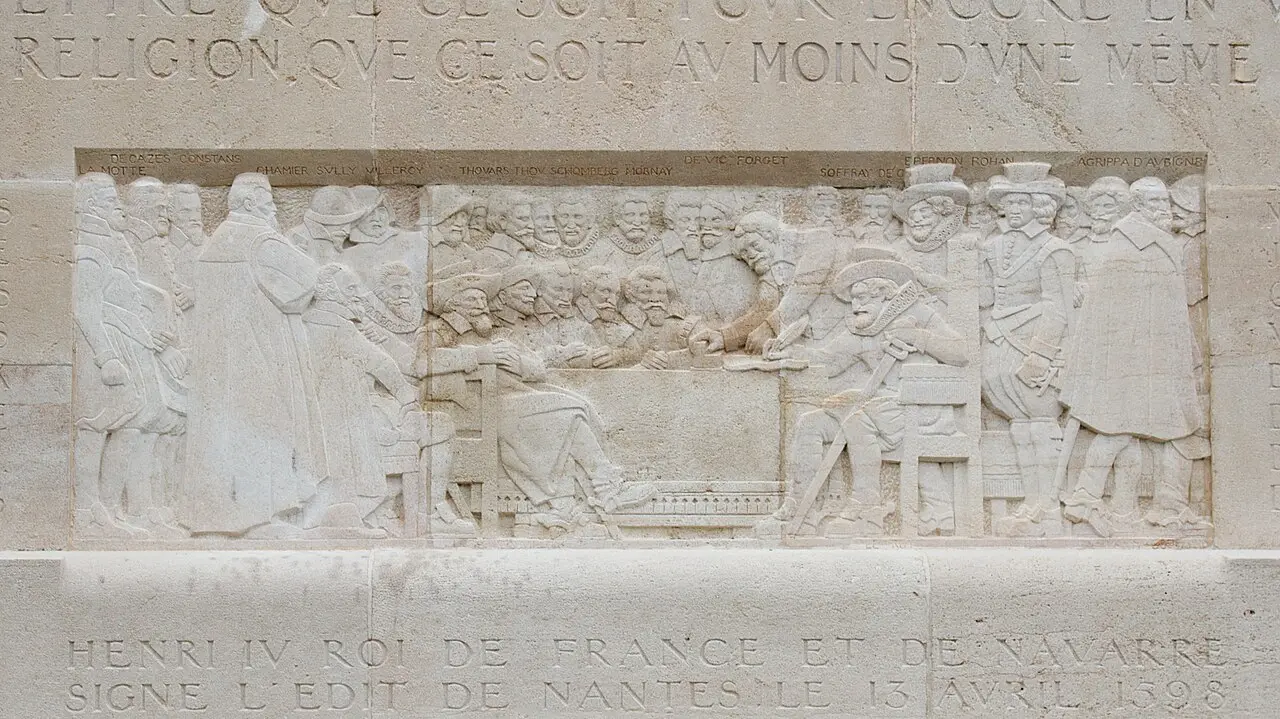
For nearly forty years, France had been killing itself over God.
Catholics and Huguenots — French Calvinist Protestants — had fought a string of religious wars since 1562, a conflict that included the St. Bartholomew's Day Massacre of 1572, when thousands of Huguenots were murdered in Paris and the provinces. By the 1590s the kingdom was exhausted, broke, and bitterly divided. Then, on April 13, 1598, in the Breton city of Nantes, King Henry IV put his name to a document that ended it: the Edict of Nantes.
Henry was an unlikely peacemaker. Born a Protestant and raised among the Huguenots, he had claimed the throne in 1589 but found Catholic France unwilling to accept a heretic king — so in 1593 he converted to Catholicism, a political masterstroke later summed up in the famous phrase attributed to him, "Paris is worth a Mass." Now secure, he turned to settling the religious question that had nearly destroyed his kingdom.
The edict was an enormous, intricate piece of lawmaking: 92 general articles, 56 secret articles, and two royal brevets. Its heart was a radical idea for 16th-century Europe — freedom of conscience. The Huguenots were granted full civil rights: they could hold public worship in specified towns, worship privately in the homes of noblemen, attend schools and universities, and hold any public or royal office. Mixed courts, the Chambres de l'Édit, were created to hear disputes fairly. Protestant pastors would be paid by the state. And for eight years, the Huguenots could keep their fortified strongholds — the places de sûreté — with their garrisons funded by the king himself.
It was not equality as we would understand it. Catholicism was confirmed as the religion of the state, the Catholic Church kept its tithes and holidays, and public Protestant worship was still barred in Paris. But in a century when religious minorities were routinely expelled or executed, it was extraordinary — one of the first decrees of religious tolerance in European history, as the encyclopedias still note.
Getting it accepted was a fight of its own. The Parlement of Paris resisted, and some regional parlements dragged their feet for years before registering the law. But Henry imposed it, and France settled into nearly a century of comparative religious peace — a peace that ended only in 1685, when his grandson Louis XIV revoked the edict with the Edict of Fontainebleau and drove hundreds of thousands of Huguenots into exile.
The edict did not survive, but its idea did. The notion that a state could grant freedom of conscience — that civil peace could rest on tolerance rather than forced unity — became a seed for everything from the Enlightenment to modern human-rights law. On a spring day in Nantes, a king who had changed religions to win a crown signed a paper declaring that his subjects would not have to.
Photo: Clément Bucco-Lechat, CC BY-SA 3.0 (via Wikimedia Commons). Bas-relief on Geneva's Reformation Wall depicting Henri IV signing the Edict of Nantes — shown as an illustration, not a contemporary image of the 1598 signing.