Hollywoodland: The Billboard That Became a Legend
On July 13, 1923, the Hollywood sign was dedicated as a temporary real-estate advertisement that was supposed to last just 18 months.
The most famous sign in the world began as junk mail on a hillside.
In the early 1920s, a real estate syndicate led by Los Angeles Times publisher Harry Chandler, banker General M. H. Sherman, and developers Woodruff and Shoults was selling lots in a new upscale housing development in the Hollywood Hills. They called it Hollywoodland, and on the advice of developer H.J. Whitley — who had already used a giant sign to advertise his own Whitley Heights project — they decided to promote it the loud way.
They hired the Crescent Sign Company. Its owner, Thomas Fisk Goff, designed thirteen letters, each 50 feet tall and 30 feet wide, built from telegraph poles, scaffolding poles, and sheet metal. The poles that held them up were hauled into the hills by mules, since the steepest stretch of the slope couldn't be reached by tractor. Studded with some 4,000 light bulbs, the finished sign flashed in sequence — HOLLY, then WOOD, then LAND — with a searchlight sweeping the sky beneath it to draw the eye from miles away. The whole project cost $21,000, roughly $400,000 in today's money. It was officially dedicated on July 13, 1923, and it was meant to come down after about a year and a half.
But Hollywood had other plans. As the American film industry boomed through the 1920s, the sign appeared in newsreels and photographs seen around the world, and the developers simply left it standing. It outlived the housing development it advertised — and the development's parent company, which went bankrupt in the early 1940s, leaving the sign to rot. By the middle of that decade letters were collapsing; the H was destroyed by wind, vandals, or both. Locals demanded the eyesore be torn down, but the Hollywood Chamber of Commerce stepped in, repaired it, and made a fateful decision: they removed the "LAND" so the sign would represent the district rather than a long-dead subdivision.
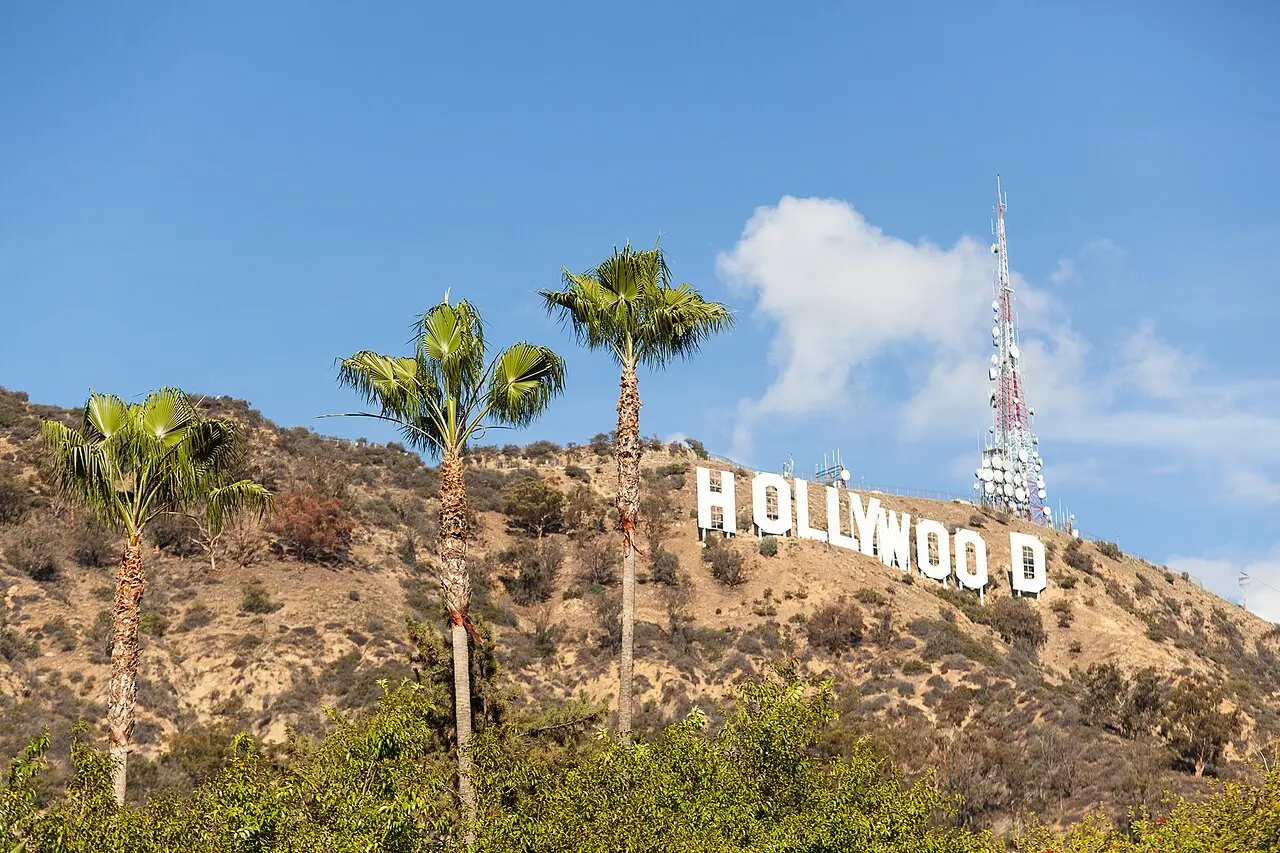
By the 1970s the wooden letters were crumbling again. In a 1978 windstorm the top half of one O fell and another O collapsed completely, leaving a sign that read, improbably, "HuLLYWO D." This time the Chamber of Commerce raised a quarter of a million dollars from celebrity donors and the public and rebuilt the entire sign in steel on concrete foundations — the version that stands today.
The sign was never meant to be permanent, which is exactly why its survival is so remarkable. A temporary billboard became the global symbol of an industry built on dreams — a fitting irony for a town whose whole business is making the temporary feel eternal.
Why it matters: Every city has landmarks. Almost none of them started as an ad for suburban houses, and fewer still survived a century by becoming the thing they advertised.
Photo: DmitryRogozhin via Wikimedia Commons, CC BY-SA 4.0. The photo shows the modern Hollywood sign on Mount Lee above Los Angeles.