
Four Pages, Two Cents: The Birth of The Wall Street Journal
On July 8, 1889, a two-cent, four-page newcomer hit New York’s streets — and grew into America’s newspaper of business.
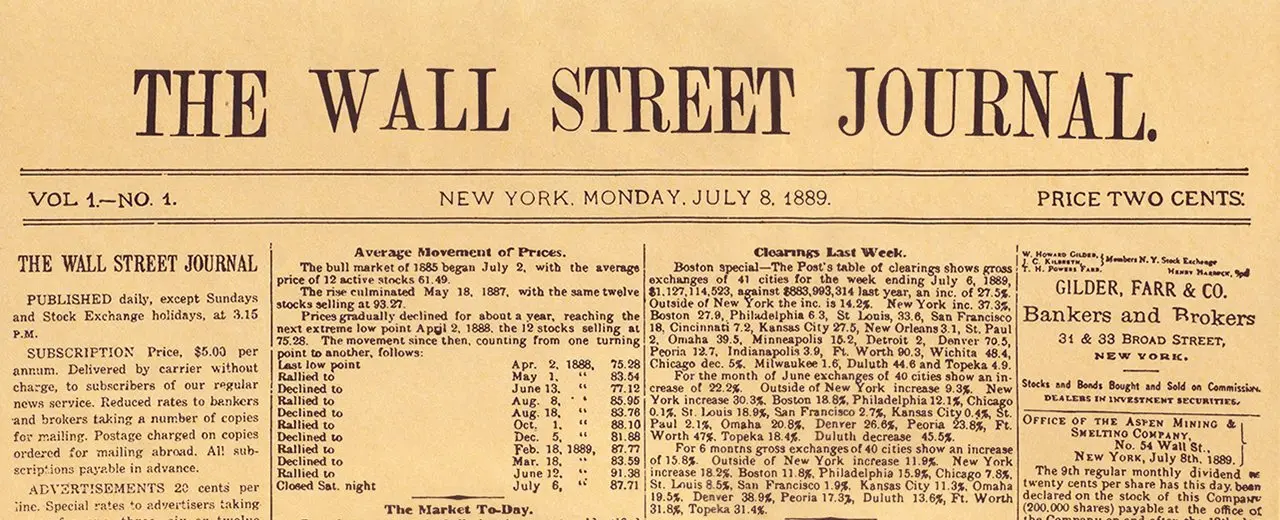
It did not look like much. On July 8, 1889, newsboys on the streets of New York sold a four-page paper for two cents a copy, stamped “Vol. 1 — No. 1.” It was a blow-by-blow chronicle of stock prices and market gossip, dense and dry. But that modest debut issue was the birth of The Wall Street Journal, one of the most powerful news organizations in the world.
The paper’s founders — Charles H. Dow, Edward D. Jones, and Charles Bergstresser — had met as reporters at the Kiernan financial news agency. In 1882 Dow and Jones struck out on their own, founding Dow Jones & Company in the basement of 15 Wall Street, next door to the New York Stock Exchange. Their first product was a stream of brief bulletins, nicknamed “flimsies,” hand-delivered by messenger boys to traders through the day. In 1883 they began collecting the day’s bulletins into a printed afternoon summary called the Customers’ Afternoon Letter.
Beginning July 8, 1889, that letter was renamed The Wall Street Journal. Dow served as its first editor until his death in 1902, and his editorials laid the foundation of Dow theory, the market-analysis framework still taught today. In 1884 he had compiled the first average of selected U.S. stock prices — the ancestor of the Dow Jones Industrial Average, launched in 1896. In 1899 the paper introduced its “Review & Outlook” opinion column, which still runs.
The Journal was not an instant empire. Its early issues were, in one chronicler’s phrase, “a tedious, blow-by-blow account of the day’s business without benefit of editing.” In 1902 the journalist Clarence Barron bought control of the company for $130,000, when circulation was about 7,000. Under Barron and his successors, the paper’s fearless, independent financial reporting found its voice; circulation climbed past 50,000 by the end of the 1920s, and Barron’s weekly was founded in 1921.
Today the Journal is one of America’s newspapers of record, with millions of digital subscribers and 39 Pulitzer Prizes to its name. All of it traces back to that first two-cent issue — proof that a publication doesn’t need a grand entrance to change the world, only the discipline to show up every trading day.
Dow himself had come up through the trade. He took up journalism in his twenties, moved to New York in 1880, and earned his reputation as a financial expert as the paper’s first editor — a post he held from 1889 until his death in 1902. The company also began delivering its news by telegraph in 1889, planting the flag for the real-time financial wires that would later circle the globe.
The Journal’s influence only grew with the American century. It became famous for investigative reporting that held power to account — from the Enron scandal to the investigation that exposed the Theranos fraud — and its coverage on and after September 11, 2001, when its newsroom was evacuated from its downtown offices, earned it a Pulitzer Prize for breaking news. What began as messenger boys running “flimsies” through a trading floor became an institution whose reporters, editors, and opinion pages shape markets and politics worldwide.
Photo: The Wall Street Journal, public domain (via Wikimedia Commons).