Fifty-Five Days Under Siege
On August 14, 1900, an eight-nation army fought its way into Beijing, ending the 55-day siege of foreign legations during China's Boxer Rebellion.
For fifty-five days, they had been waiting to die.
Inside Beijing's Legation Quarter, some 900 foreign soldiers, diplomats, and civilians — along with about 2,800 Chinese Christians who had fled there for protection — were under siege by Boxer militiamen and troops of the Qing imperial army. It was the summer of 1900, and the Boxers, a movement determined to expel foreign influence from China, had converged on the capital with the backing of the Empress Dowager Cixi. Since June 20, the quarter's defenders had held a few blocks of legations, banks, and houses against assaults and mines exploded in tunnels dug beneath their walls, all while food ran out. In the outside world, the besieged had already been given up for dead.
Relief was coming — but it was an odd sort of rescue party. Eight rival empires — Britain, Russia, Japan, France, Germany, the United States, Italy, and Austria-Hungary — had assembled some 20,000 troops and marched from the coast at Tianjin: less a united army than eight national contingents sharing a road while pursuing their own ambitions. Japan fielded the largest and best-organized force; Germany's Kaiser sent his men off with a speech urging them to show no mercy.
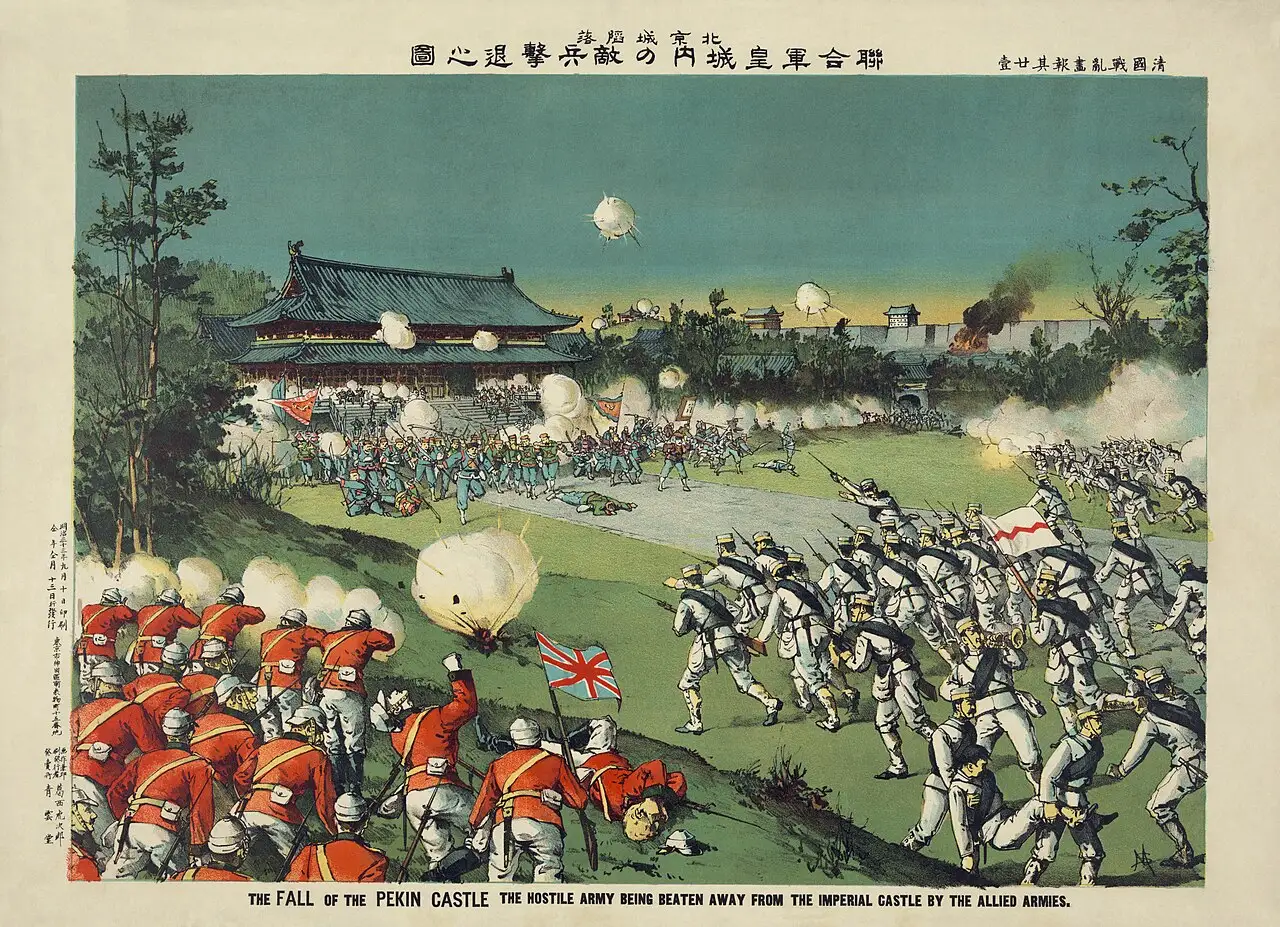
On August 14, the allies reached Beijing, and the relief took on an almost farcical edge: the national columns raced each other through different city gates, every army desperate to claim the honor of the rescue. By the next day the siege was lifted, the Boxers were scattered, and the Qing court — Cixi, the emperor, and the whole government — had fled the Forbidden City for Xi'an.
Victory curdled quickly into vengeance. Allied troops looted palaces, temples, and government offices on an enormous scale, stripping away cultural treasures — including the great Yongle encyclopedia, compiled by 2,100 scholars — and carried out punitive expeditions across the countryside. The settlement, the Boxer Protocol of September 1901, forced China to pay an indemnity of 450 million taels of silver over 39 years and accept foreign troops stationed in Beijing.
The relief of the legations ended the Boxer Rebellion, but it marked something larger: the humiliation hastened the Qing dynasty's decline and deepened a wound — foreign armies looting the capital — that would shape China's politics for a century to come.
Part of the American share of the indemnity was later remitted to fund Chinese students studying in the United States, the Boxer Indemnity Scholarship program, which helped found Beijing's Tsinghua University.
Photo: Japanese woodblock print by Torajirō Kasai, 1900, public domain (via Wikimedia Commons).