
The Pen That Promised Old Age Would Not Mean Poverty
On August 14, 1935, Franklin D. Roosevelt signed the Social Security Act, creating America's safety net for the elderly, the unemployed, and struggling families.
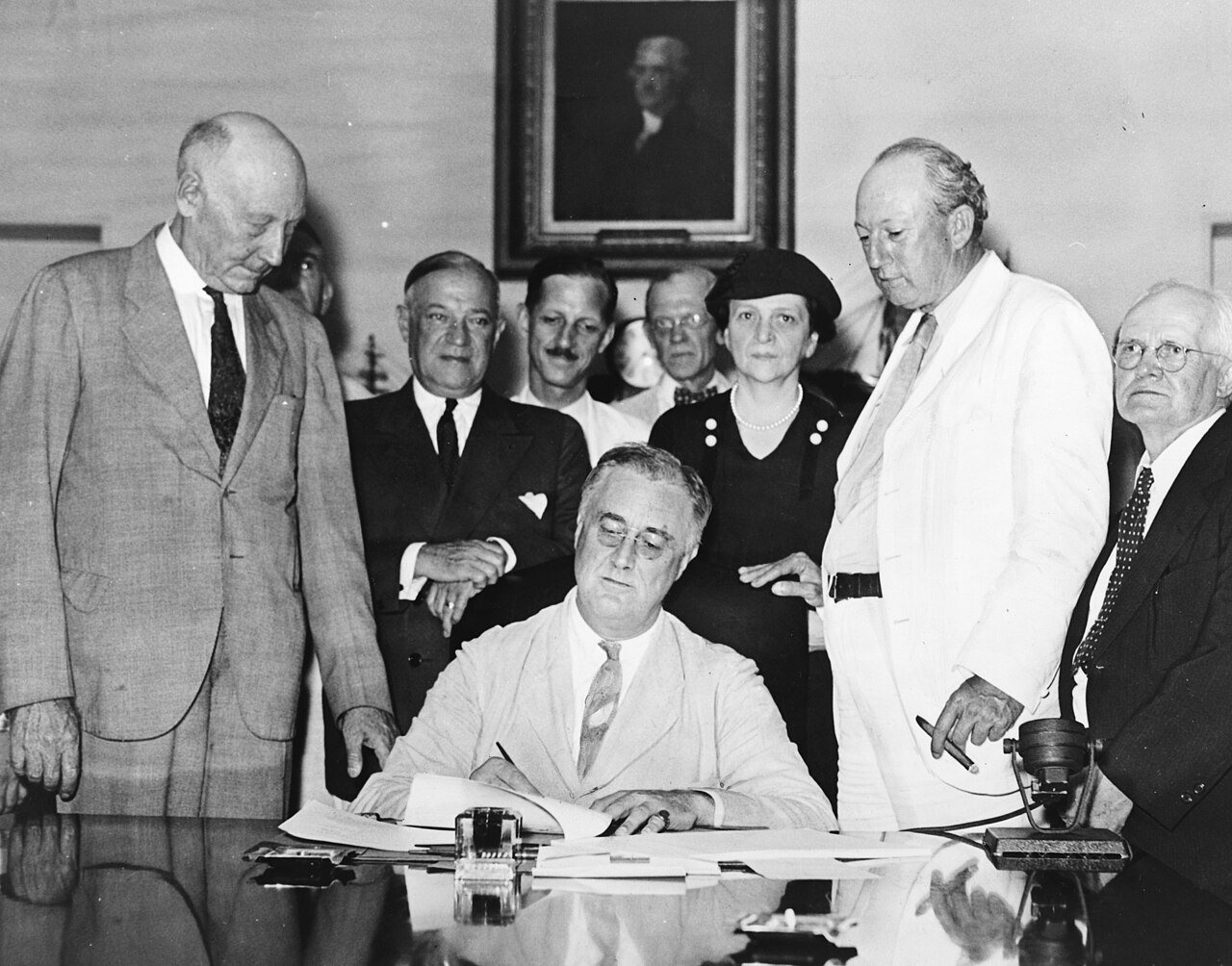
In the summer of 1935, the Great Depression was grinding through its sixth year. Banks had failed by the thousands, a quarter of American workers had no jobs, and among the elderly, poverty rates exceeded 50 percent. For millions of older Americans, old age had become something to dread.
The pressure for action came from below as much as from above. In September 1933, a California physician named Francis Townsend wrote a letter to his local newspaper proposing that every American over 60 receive $200 a month — on the conditions that they retire and spend it within the month — funded by a national sales tax. The idea exploded: some 8,000 Townsend Clubs sprang up with as many as two million members, about a tenth of the nation's seniors. Roosevelt, who had favored old-age insurance since his days as New York's governor, presented his own plan as the practical alternative to Townsend's — and warned his advisers their proposal had to be strong enough to withstand the Townsendites.
On August 14, President Franklin D. Roosevelt picked up a pen and changed that. With members of Congress and his Secretary of Labor, Frances Perkins, gathered around him in the White House, he signed the Social Security Act into law.
The act had been drafted by Roosevelt's Committee on Economic Security under Perkins and passed by Congress as part of the New Deal — the House approved it 372 to 33. It created old-age insurance financed by payroll taxes shared between workers and employers, alongside unemployment insurance and aid to families with dependent children. It was the first time the federal government had promised all its working citizens a measure of economic security in old age — America had been one of the few industrialized nations without any such national system.
The promise had holes. The act excluded farm and domestic workers, along with government employees, the self-employed, and many teachers, nurses, and hospital workers — roughly half the nation's formal labor force stood outside the system. The exclusions fell unevenly: about 65 percent of Black workers were left out, as were job categories dominated by women, reflecting what the Roosevelt library calls "traditional views of family life." Coverage was widened by amendments in 1950 and 1954, and the holes were slowly patched.
The program started small. The first lump-sum payout — to a man named Ernest Ackerman in 1937 — was for 17 cents. The first monthly benefit check, issued in 1940 to Ida May Fuller, was for $22.54. But the idea grew: the Supreme Court upheld the law in 1937, benefits expanded over the decades, and the 1965 amendments added Medicare and Medicaid to the same framework.
Behind the benefits stood an enormous bookkeeping machine. In late 1936, post offices distributed applications for the new account numbers; over the next year more than 35 million cards were issued. The first official record — number 055-09-0001 — belonged to John David Sweeney Jr., a 23-year-old shipping clerk from New Rochelle, New York. The lowest number ever issued, 001-01-0001, went instead to Grace Dorothy Owen of Concord, New Hampshire, whose state was given the first area numbers to honor the Social Security Board's chairman. Tax collection began in January 1937 at one percent of the first $3,000 in wages, with employers paying a matching share.
Today Social Security touches nearly every American family. Nine out of ten Americans aged 65 and older receive benefits, and for millions of retirees it is the difference between independence and poverty. Few laws signed with a single pen stroke have reached so directly into so many lives — and all of it began on an August afternoon in 1935, when the United States decided that growing old should not mean growing poor.
Photo: Social Security Online, public domain (via Wikimedia Commons).