Crowned on Midsummer's Day
On June 24, 1509, Henry VIII and Catherine of Aragon were crowned together at Westminster Abbey in a ceremony England would not repeat for nearly 200 years.
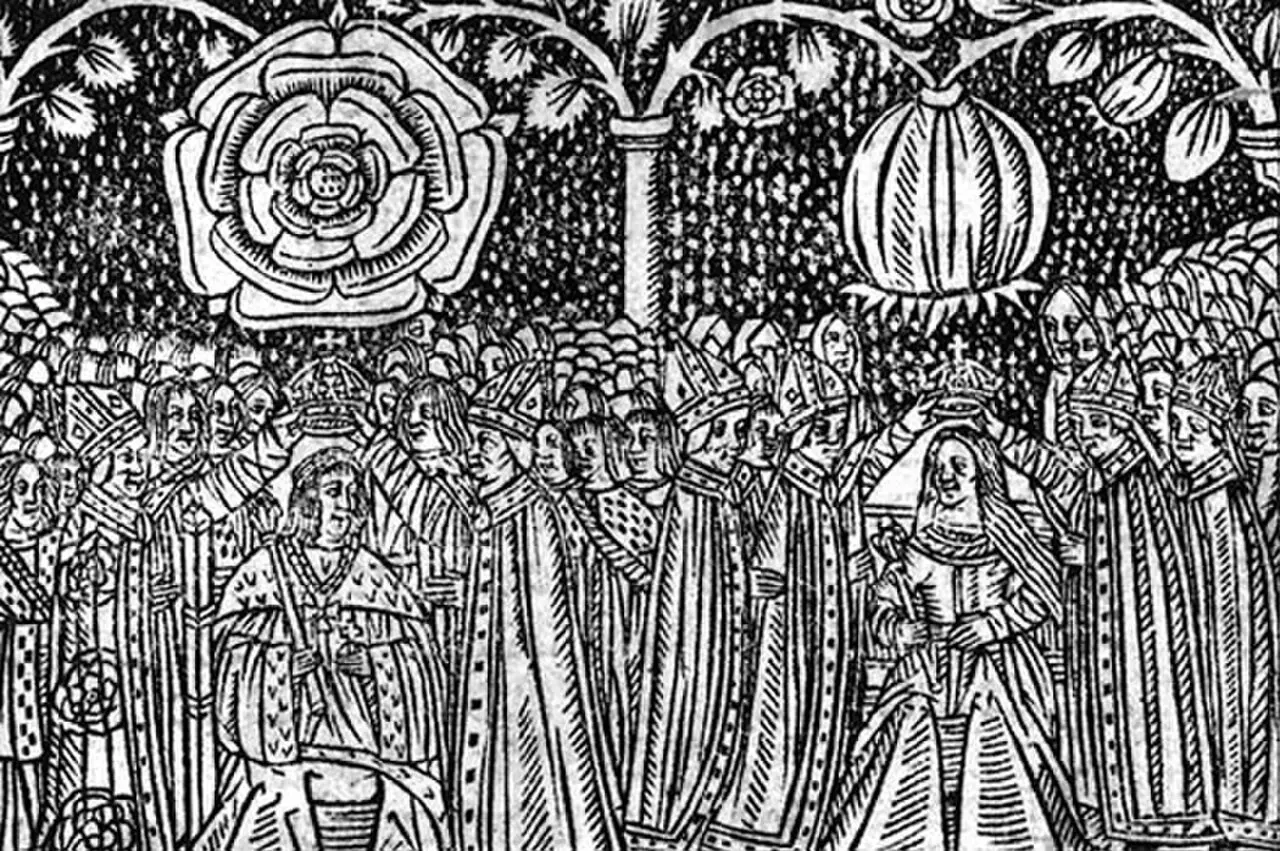
They chose the longest day of the year for the brightest moment of a new reign. On June 24, 1509 — Midsummer's Day — Henry VIII and his queen, Catherine of Aragon, were crowned together at Westminster Abbey in one of the most splendid ceremonies England had ever seen.
Henry had come to the throne just two months earlier, on the death of his father, Henry VII, on April 21. Thirteen days before the coronation, on June 11, he had married Catherine, the daughter of the Spanish monarchs Ferdinand and Isabella and the widow of his elder brother Arthur. A papal dispensation had cleared the way for the union. Now, at midsummer, the young king and his queen would be anointed and crowned side by side before the peers of the realm.
The ceremony was presided over by William Warham, the Archbishop of Canterbury, and it had been organized down to the last detail by the king's grandmother, Lady Margaret Beaufort — the formidable matriarch whose plotting and patronage had helped put the Tudors on the throne a generation before. In a poignant coda, she died just five days later, on June 29, as if her life's work were complete.
The day was a triumph of pageantry and optimism. Courtiers, clergy, and crowds filled the abbey and the streets beyond; the kingdom, exhausted by the careful, tax-hoarding rule of Henry VII, greeted its glamorous young king with genuine hope. A 16th-century woodcut made to commemorate the occasion — the image above, printed in Stephen Hawes's A Joyfull Medytacyon to All Englande — shows the royal couple enthroned beneath their heraldic badges: the Tudor rose for Henry, the pomegranate of Granada for Catherine.
Joint coronations of a king and queen together were rare enough that this one stood alone for generations. Another full-length coronation of a king and queen would not be performed in the British Isles until that of James II and Mary of Modena in 1685 — nearly two centuries later.
Why does a ceremony from 1509 still matter? Because it opened the most famous reign in English history. The golden couple of Midsummer's Day would not stay golden: the marriage that began with such splendor would end in the annulment crisis that broke England from the Catholic Church and set the kingdom on a new religious and political course. Every twist of the Tudor century — the Reformation in England, the rise and fall of queens, the birth of the Church of England — traces back, in some way, to the young man crowned that day.
On June 24, 1509, England celebrated a beginning. It could not know it was also watching the first act of a drama that would consume a lifetime.
Photo: 16th-century woodcut by an unidentified engraver, public domain (via Wikimedia Commons).