
The Sky Exploded Over Siberia: The Tunguska Mystery
On June 30, 1908, a cosmic blast flattened 80 million trees in Siberia — and nobody has ever found what caused it.
Around 7:15 on the morning of June 30, 1908, the sky over Siberia exploded.
Reindeer herders of the Evenki people saw a fireball trailing smoke, then a flash brighter than the Sun, then a roar like thunder. Those nearest the blast were blown into the air and knocked unconscious; their tents and huts were damaged or destroyed. Hundreds of miles away, seismic instruments trembled. And for nights afterward, the skies over Europe glowed so strangely bright that, as one account put it, Londoners could read their newspapers at midnight without a lamp.
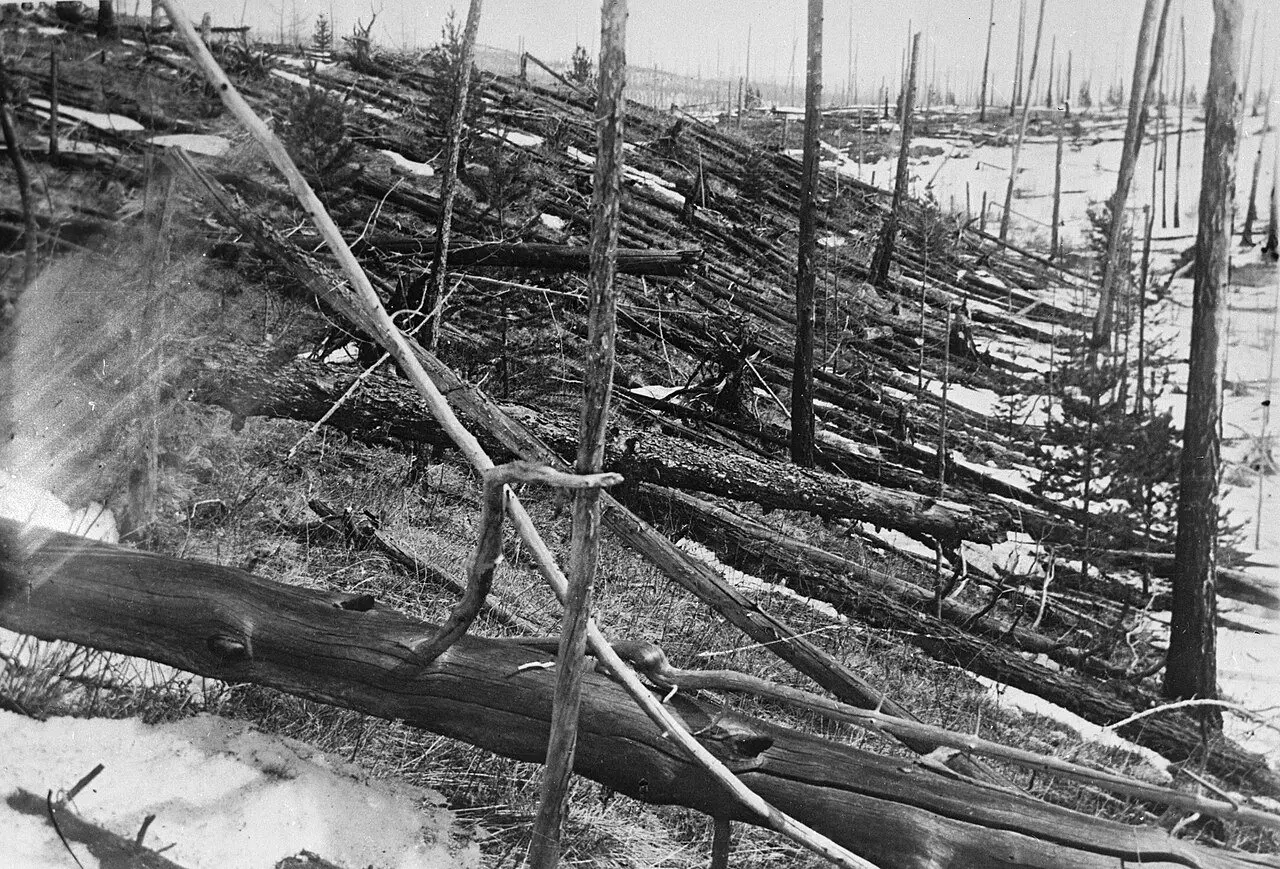
What fell that morning near the Podkamennaya Tunguska River was never found — because it never reached the ground. Scientists now believe a stony asteroid, roughly 50 to 60 meters across and traveling at about 27 kilometers per second, detonated in midair, some 5 to 10 kilometers above the Siberian taiga. The airburst released an estimated 10 to 15 megatons of energy — roughly a thousand times the power of the Hiroshima bomb — flattening some 80 million trees across 2,150 square kilometers in a vast radial pattern. It remains the largest impact event in recorded history.
Remarkably, given the scale of the blast, it appears no one was killed — though a few accounts suggest as many as three people may have died. Had the object arrived a few hours later in Earth's rotation, over a city instead of empty forest, it could have erased a metropolis.
No scientist reached the site for nearly two decades. World War I, the Russian Revolution, and the civil war intervened, and the first expedition — sent by the Soviet Academy of Sciences under mineralogist Leonid Kulik in 1921 — couldn't even get there. Kulik finally reached the epicenter in 1927 and found something astonishing: no crater, no meteorite fragments — just millions of fallen trees, and near the center, trees still standing but stripped bare of branches and bark, exactly as an airburst would leave them.
Debate continues over the details — the precise size, altitude, and composition of the object, with a minority of researchers still favoring a cometary origin. But the verdict is settled enough that June 30 is now observed as International Asteroid Day, a reminder that Earth shares its neighborhood with rocks we cannot yet reliably spot in time.
Tunguska was the warning shot. The question is whether we'll hear it before the next one arrives.
Photo: Leonid Kulik's expedition, May 1929 — public domain via Wikimedia Commons.