A Patent Clerk Rewrites Time: Einstein's 1905 Relativity Paper
On June 30, 1905, a 26-year-old patent clerk's paper on the electrodynamics of moving bodies reached a physics journal and quietly rewrote space and time.
In the spring of 1905, a 26-year-old patent clerk in Bern, Switzerland, was quietly having the most productive year in the history of science.
Albert Einstein worked six days a week as a third-class technical expert at the Swiss Federal Office for Intellectual Property, examining patent applications. In his spare hours he was rewriting physics. The year 1905 would become his annus mirabilis — his "miracle year" — in which he sent a series of papers to the German journal Annalen der Physik that would revolutionize 20th-century thought.
The third of those papers, "Zur Elektrodynamik bewegter Körper" — "On the Electrodynamics of Moving Bodies" — arrived at the journal's offices on June 30, 1905. It was published three months later, and it introduced the world to the special theory of relativity. Einstein started from two simple postulates: that the laws of physics are the same for all observers moving at constant speed, and that the speed of light is constant for everyone, no matter how its source is moving. From those two ideas, everything strange followed.
Strange indeed. Einstein showed that time and space are not the absolute, unchanging stage that Isaac Newton had described — time, Newton had written, "flows equably without relation to anything external" — but are relative to the motion of the observer. Moving clocks run slow; moving objects shrink in their direction of motion; and the mysterious "luminiferous ether," the invisible medium light was supposed to travel through, simply was not needed. The universe did not come with a fixed frame. It came with relationships.
It was only one jewel in the year's crown. In March, Einstein had explained the photoelectric effect — the work that would eventually earn him the 1921 Nobel Prize in Physics. In May came his paper on Brownian motion, proving the reality of atoms and molecules. And that September, a three-page follow-up gave the world E=mc², the most famous equation ever written.
Special relativity underpins the modern world. The GPS satellites guiding your phone must correct for it, because their clocks tick at different rates than clocks on Earth. Particle accelerators, nuclear energy, and our understanding of the cosmos all rest on the foundations Einstein laid in 1905. A patent clerk with a notebook showed that time itself is negotiable — and physics has never looked back.
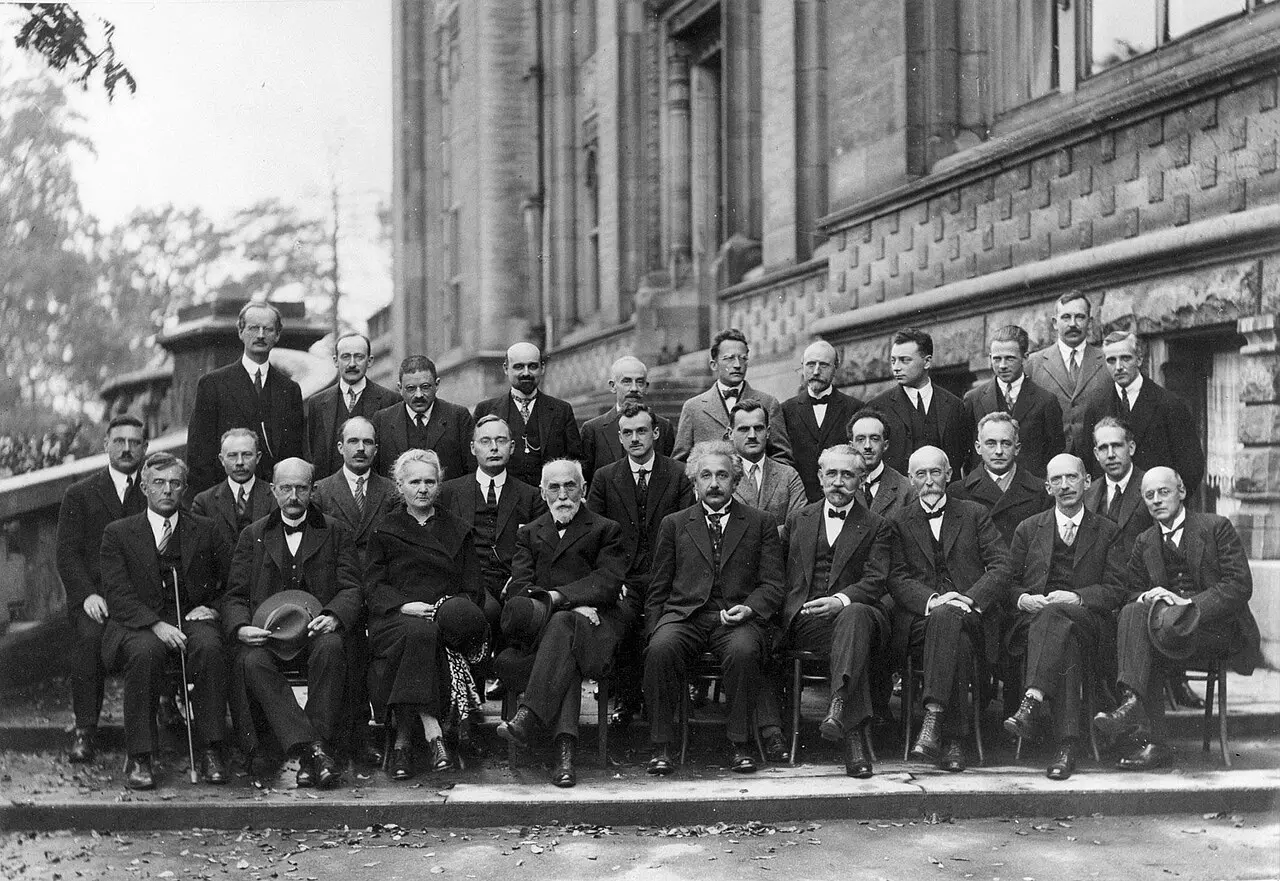
Photo: Benjamin Couprie / Institut International de Physique Solvay — public domain (via Wikimedia Commons).