
The Patent That Invented the Automobile
On January 29, 1886, German engineer Karl Benz filed patent DRP 37435 for a "vehicle with gas engine operation" — the world's first practical automobile.
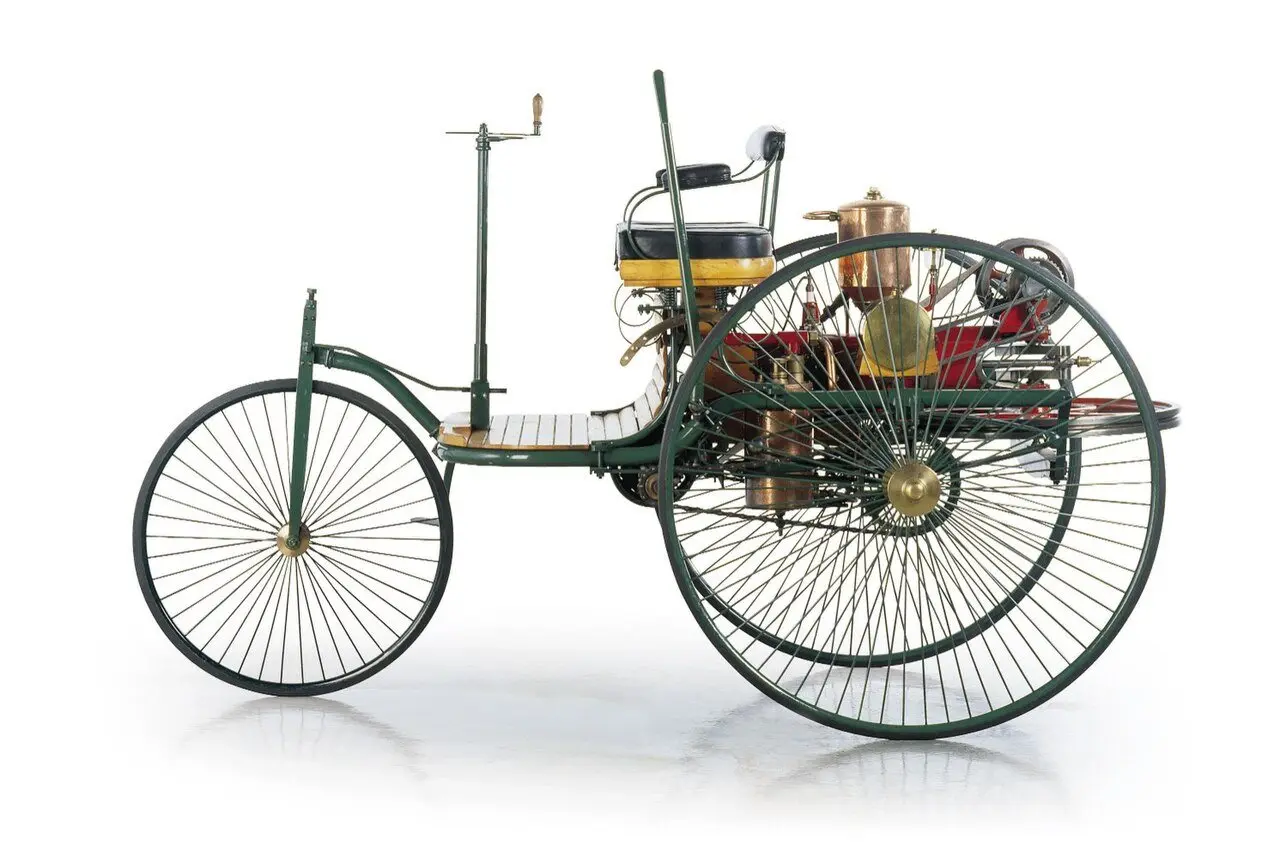
There was nothing sleek about it. It had three spindly wire wheels, a single bench seat, a tiller instead of a steering wheel, and a single-cylinder engine that produced about three-quarters of a horsepower — less power than a modern lawn mower. But on January 29, 1886, when German engineer Karl Benz filed his patent for a "vehicle with gas engine operation," he was inventing something nobody had a name for yet: the automobile.
Benz had spent years building stationary gas engines at his Mannheim company, Benz & Cie., and he believed the future lay in a small, light engine paired with a carriage built around it. The result was the Patent-Motorwagen: a three-wheeled machine with its engine mounted between the rear wheels, power sent to the wheels by belt and chain, and wire-spoked wheels borrowed from bicycle technology — a nod to Benz's love of cycling.
He filed his application on January 29, 1886, and the German patent office granted patent number DRP 37435 that November, backdating it to the filing date. Mercedes-Benz would later call that document "the birth certificate of the automobile." Benz tested his creation on public roads in the early summer of 1886 and drove it publicly on Mannheim's Ringstrasse on July 3 of that year.
The man himself nearly missed how big it was. It was his wife, Bertha Benz, who proved the invention's worth: in August 1888, without telling her husband, she and their two sons Eugen and Richard climbed aboard and drove from Mannheim to Pforzheim — roughly 60 miles — the first long-distance automobile journey in history. The trip made the motorcar famous, drew its first buyers, and proved it was no laboratory curiosity. She had also helped finance the work, though married women of the era could not hold patents, so the patent went in her husband's name.
About 25 Patent-Motorwagens were built between 1886 and 1893, and other inventors — Gottlieb Daimler and Wilhelm Maybach among them — were racing down their own parallel paths. But Benz had been first to the patent office, and the automobile age had its founding document.
Today, that three-wheeled oddity with its lawn-mower power sits in the Deutsches Museum in Munich as the great-grandfather of every car on the road. One piece of paper, filed on a January day in 1886, put the world on wheels.
Photo: DaimlerChrysler AG, CC BY-SA 3.0 (via Wikimedia Commons).