The Day the Roman Empire Finally Fell
On May 29, 1453, Ottoman Sultan Mehmed II captured Constantinople, ending the Byzantine Empire and the last unbroken line of ancient Rome.
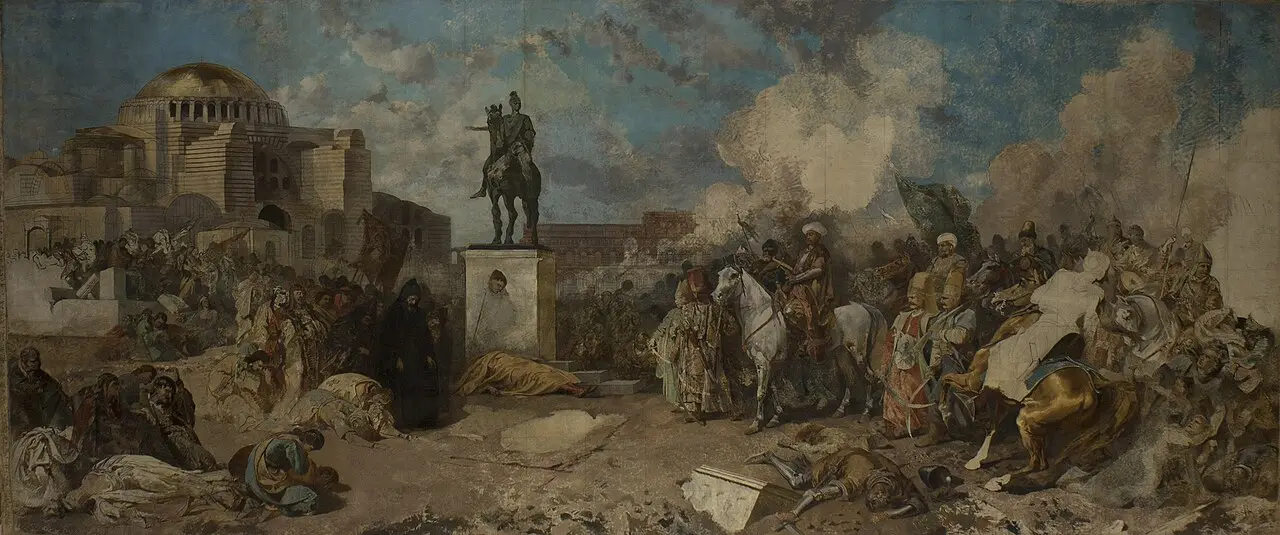
On the morning of May 29, 1453, a 21-year-old sultan rode through the gates of the most famous city on Earth.
Constantinople had been the capital of the Eastern Roman Empire — the part of Rome that survived — for more than a thousand years. Founded by Emperor Constantine in 330, it sat astride the straits between Europe and Asia, wrapped in the Theodosian Walls, a triple line of fortifications that had held off every attacker for eight centuries. By 1453, though, the empire was a shadow: little more than the city itself, surrounded on all sides by the rising Ottoman Empire.
The young Ottoman sultan, Mehmed II, was determined to finish what his predecessors could not. In April 1453 he laid siege to the city with an army that vastly outnumbered its defenders. His secret weapon was gunpowder: enormous bronze bombards that hurled stone balls weighing hundreds of pounds against the ancient walls, day after day. When a great chain blocked his ships from the city's harbor, the Golden Horn, his engineers did the near-impossible — they hauled dozens of ships overland on greased rollers, behind the suburb of Galata, and launched them into the harbor from the landward side.
Inside the walls, Emperor Constantine XI Palaiologos refused to abandon his people, even when Mehmed offered him safe passage. For nearly two months the defenders patched the breaches by night and held the line by day. But food was running out, and no relief fleet was coming.
In the dark hours before dawn on May 29, Mehmed ordered a final, all-out assault. Wave after wave of Ottoman troops — including his elite Janissaries — stormed the walls. Near the Gate of St. Romanus, where the cannon had opened a fatal gap, the defenders broke. Constantine XI died in the fighting; tradition holds that he cast off his imperial insignia and charged into the melee rather than flee. By sunrise, the city had fallen.
Mehmed entered in triumph and, according to later accounts, walked through the ruined imperial palace reciting a Persian poem about how even the mightiest palaces become homes for spiders and owls. He made Constantinople his new capital — the seat of the Ottoman Empire for centuries to come.
Why it matters: May 29, 1453, is one of history's great turning points. It ended the Byzantine Empire and, with it, the last continuous thread of ancient Rome — a state that had endured for nearly 1,500 years. Many historians use the date to mark the end of the Middle Ages and the beginning of the early modern world. And the Ottoman cannon that shattered the Theodosian Walls announced a new age of warfare, in which no wall was high enough to stop gunpowder.
Photo: Stanisław Chlebowski, public domain (via Wikimedia Commons).