Johnny Cash Sings Behind Bars at Folsom Prison
On January 13, 1968, Johnny Cash walked into California’s Folsom State Prison and recorded a live concert that rebooted his career and became one of the greatest albums ever made.
“Hello, I’m Johnny Cash.” With those five words, spoken to a roaring crowd in a prison cafeteria, country music’s most famous outlaw launched the most unlikely comeback in music history.
The date was January 13, 1968, and the setting was Folsom State Prison in California. Cash had been a star once — his 1955 song “Folsom Prison Blues” was a hit — but by 1968 his career had stalled. Years of missed concerts and addiction to prescription pills had taken their toll. He needed something to reignite it, so he convinced his record company to let him record a live album behind bars. He played two shows that day, backed by June Carter, Carl Perkins, and the Tennessee Three.
The idea wasn’t new for Cash. He’d written “Folsom Prison Blues” after watching the 1951 prison film Inside the Walls of Folsom Prison while serving in the U.S. Air Force in Germany. He’d even played Folsom once before, in 1966, at the suggestion of a local preacher. But this time the stakes were higher: a live record, armed guards on the walkways above, and an audience that couldn’t leave. Cash rehearsed feverishly in the days before the show and even taught himself a new song, “Greystone Chapel,” written by Folsom inmate Glen Sherley.
The prisoners loved him. Despite the warden’s rule against standing during the show, the crowd was loud and rowdy, and their energy crackled through the recording. When At Folsom Prison was released that May, it shot to number one on the country charts and into the national top fifteen. “Folsom Prison Blues” became Cash’s first top-40 hit in four years. At the Grammy Awards the next year, the album won for Best Album Notes, and “Folsom Prison Blues” won for Best Country Vocal Performance by a male singer.
Here’s the twist: for all his outlaw image, Johnny Cash never served hard time. Apart from a few nights drying out in local jails, he’d never been a prisoner. What he had was empathy — and he spent the rest of his career performing in prisons across America and using his fame to speak up for inmates. The Folsom album would eventually sell more than 3.4 million copies and remains one of the most celebrated live records ever made.
The Folsom concert endures because it was honest: a struggling singer, a room full of people who’d hit bottom, and songs that took both of them seriously. Cash treated the prisoners as people worth performing for — and in return, they gave him his career back.
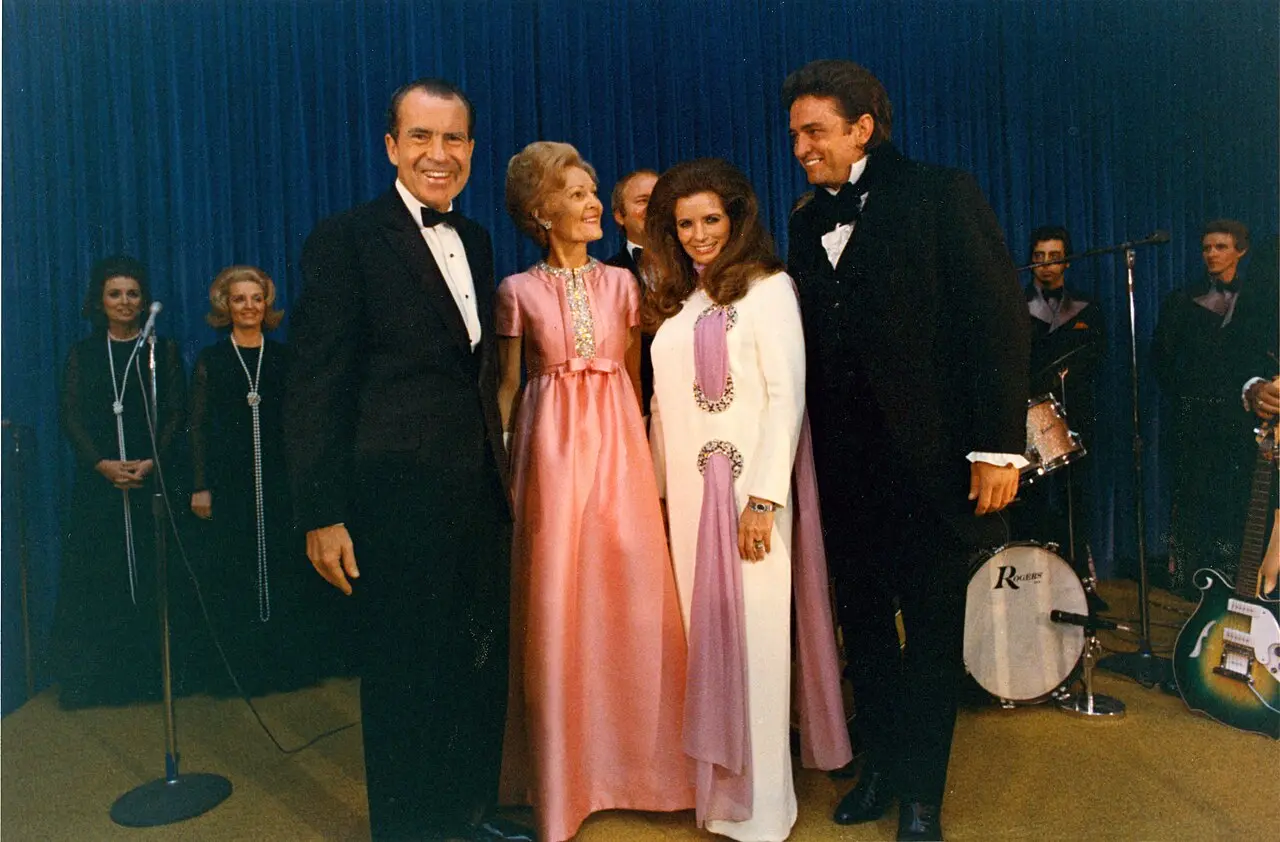
Photo: Johnny Cash and June Carter Cash on stage after a White House concert in 1970, with President Richard Nixon and Pat Nixon — public domain image (Nixon Presidential Library via DPLA) via Wikimedia Commons.